
Spanish journalist faces 28-day wait for GP appointment
Antoni Daimiel reported a 28-day wait for a family doctor in Spain, sparking debate on primary care saturation and regional disparities.
English · Original discussion in Spanish · Published
Spanish journalist faces 28-day wait for GP appointment
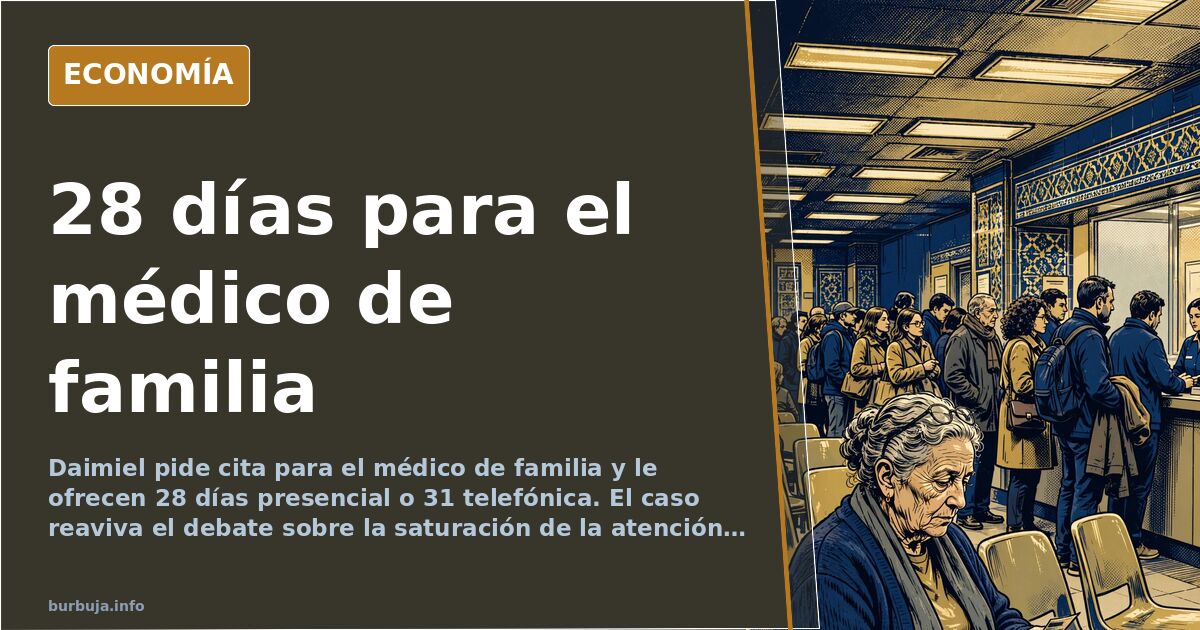
Journalist Antoni Daimiel visited his local clinic to book an appointment with his family doctor. He was offered two options: an in-person visit in 28 days or a phone consultation in 31. He shared this on X, where the post exceeded 400,000 views and 2,000 likes within 24 hours. After nearly 1,000 replies, the conversation shifted to a more uncomfortable topic: primary care is no longer the system's filter; it has become its bottleneck.
What peine with Daimiel’s appointment
Daimiel did not reveal the reason for his visit, only the waiting time. According to the screenshot he shared, the earliest available slot was after May 9. The original message read: "I went to book a family doctor appointment at the clinic in my municipality. They offered me an option for 28 days from now (in-person) and 31 days (phone). How are things in your municipalities?"
The response was not uniform. Several testimonials claimed that in their health centers, mostly in Madrid, they get appointments within a few days. Others confirmed similar or worse waits. One user shared a screenshot from their center's app stating, "It is currently not possible to manage your appointment, please contact your health center." She had been seeing this warning for a month. By phone, she said, no one answers.
Primary care as a symptom, not the cause
Daimiel’s case is not an anomaly. It is the tip of a system that has gradually pushed the problem upward. An anonymous user, identified as "Hospital del Mar ER," shared images of overcrowding in their service: 165 patients in the emergency room at shift change, 54 of them staying over 24 hours. The message ended with a direct question to the administration: "Are you going to do something? Or just offer financial incentives to GPs so they discharge patients indiscriminately?"
The logic is circular. If the family doctor takes 28 days, the patient ends up in the ER. If the ER becomes saturated, the system degrades for everyone. One participant summarized it bluntly: "That wouldn't be a problem if they attended to emergencies the same day. The issue is that even for an emergency, they don't have time to see you."
It depends on your postcode
Geographic variability is one of the most repeated findings. The same national system produces one-day waits in some municipalities and three-week waits in others. "It depends heavily on the health center. I live in Villalba, and primary care is a mess; nobody can take away the two-week wait. In contrast, my family in Leganés gets appointments from one day to the next," one participant stated.
Another provided a similar contrast: "My vvife was given an appointment for three weeks out, while I got one for two weeks out this same week. In the end, I went to the ER and another doctor saw me in 10 minutes." The conclusion drawn is not whether the system works or doesn't work, but that it functions differently depending on where you live and which center you are assigned.
Taxes rise, so does the wait
One of the most repeated lines of analysis points to the relationship between tax pressure and service quality. "Twenty years ago, it was normal to get an appointment the same day or the next. Two days at most. What took months was seeing a specialist, but not for the GP. It’s curious how we’ve had twenty years of tax increases because taxes fund healthcare, yet care in the clinic gets worse," one participant argued.
The counter-argument also appears: the system serves a larger, older population with more expensive treatments. "There were 13 million fewer inhabitants, and the population wasn't as aged. Many things have improved in healthcare, like equipment, but others have worsened, such as the amount of available staff," another noted. The discussion on healthcare spending almost always leads to the same question: is there enough money, or is it poorly distributed?
The elephant in the room: who uses the system
Part of the conversation drifted toward the demographic impact on public healthcare. It is argued that population growth, with low tax contributions and high demand for services, strains the system. "Millions more people in Spain with very low tax contributions but demanding all kinds of public services. If you import poverty, you increase poverty, obviously," one participant claimed. Another attributed it to universality: "Every Spanish health center is obliged to treat the 8 billion inhabitants of the planet. Since healthcare became universal for the whole world. Seems like a short time to me."
These opinions appear in the debate without data backing to quantify them. What is verifiable is the population increase and aging, factors any European public healthcare system struggles to address. The discussion about who pays and who receives is, in reality, a discussion about the funding model.
The closing: the unsettling data point
While Daimiel waited 28 days to see his family doctor, a hospital emergency service accumulated 165 patients at shift change, with 54 staying over 24 hours. Primary care is not the problem. It is the thermometer. And the thermometer shows a fever.
Journalist Antoni Daimiel visited his local clinic to book an appointment with his family doctor. He was offered two options: an in-person visit in 28 days or a phone consultation in 31. He shared this on X, where the post exceeded 400,000 views and 2,000 likes within 24 hours. After nearly 1,000 replies, the conversation shifted to a more uncomfortable topic: primary care is no longer the system's filter; it has become its bottleneck.
What peine with Daimiel’s appointment
Daimiel did not reveal the reason for his visit, only the waiting time. According to the screenshot he shared, the earliest available slot was after May 9. The original message read: "I went to book a family doctor appointment at the clinic in my municipality. They offered me an option for 28 days from now (in-person) and 31 days (phone). How are things in your municipalities?"
The response was not uniform. Several testimonials claimed that in their health centers, mostly in Madrid, they get appointments within a few days. Others confirmed similar or worse waits. One user shared a screenshot from their center's app stating, "It is currently not possible to manage your appointment, please contact your health center." She had been seeing this warning for a month. By phone, she said, no one answers.
Primary care as a symptom, not the cause
Daimiel’s case is not an anomaly. It is the tip of a system that has gradually pushed the problem upward. An anonymous user, identified as "Hospital del Mar ER," shared images of overcrowding in their service: 165 patients in the emergency room at shift change, 54 of them staying over 24 hours. The message ended with a direct question to the administration: "Are you going to do something? Or just offer financial incentives to GPs so they discharge patients indiscriminately?"
The logic is circular. If the family doctor takes 28 days, the patient ends up in the ER. If the ER becomes saturated, the system degrades for everyone. One participant summarized it bluntly: "That wouldn't be a problem if they attended to emergencies the same day. The issue is that even for an emergency, they don't have time to see you."
It depends on your postcode
Geographic variability is one of the most repeated findings. The same national system produces one-day waits in some municipalities and three-week waits in others. "It depends heavily on the health center. I live in Villalba, and primary care is a mess; nobody can take away the two-week wait. In contrast, my family in Leganés gets appointments from one day to the next," one participant stated.
Another provided a similar contrast: "My vvife was given an appointment for three weeks out, while I got one for two weeks out this same week. In the end, I went to the ER and another doctor saw me in 10 minutes." The conclusion drawn is not whether the system works or doesn't work, but that it functions differently depending on where you live and which center you are assigned.
Taxes rise, so does the wait
One of the most repeated lines of analysis points to the relationship between tax pressure and service quality. "Twenty years ago, it was normal to get an appointment the same day or the next. Two days at most. What took months was seeing a specialist, but not for the GP. It’s curious how we’ve had twenty years of tax increases because taxes fund healthcare, yet care in the clinic gets worse," one participant argued.
The counter-argument also appears: the system serves a larger, older population with more expensive treatments. "There were 13 million fewer inhabitants, and the population wasn't as aged. Many things have improved in healthcare, like equipment, but others have worsened, such as the amount of available staff," another noted. The discussion on healthcare spending almost always leads to the same question: is there enough money, or is it poorly distributed?
The elephant in the room: who uses the system
Part of the conversation drifted toward the demographic impact on public healthcare. It is argued that population growth, with low tax contributions and high demand for services, strains the system. "Millions more people in Spain with very low tax contributions but demanding all kinds of public services. If you import poverty, you increase poverty, obviously," one participant claimed. Another attributed it to universality: "Every Spanish health center is obliged to treat the 8 billion inhabitants of the planet. Since healthcare became universal for the whole world. Seems like a short time to me."
These opinions appear in the debate without data backing to quantify them. What is verifiable is the population increase and aging, factors any European public healthcare system struggles to address. The discussion about who pays and who receives is, in reality, a discussion about the funding model.
The closing: the unsettling data point
While Daimiel waited 28 days to see his family doctor, a hospital emergency service accumulated 165 patients at shift change, with 54 staying over 24 hours. Primary care is not the problem. It is the thermometer. And the thermometer shows a fever.
Also available in: Deutsch
Summary of a discussion on Burbuja.info - Foro de economía, actualidad y política., translated from Spanish and reviewed before publication. Read the full discussion (160 replies).
More summaries
-
Madrid ERs flooded with 101 eye injuries after solar eclipse viewing
Madrid hospitals treated 101 patients for eye issues following the solar eclipse, highlighting risks from unapproved glasses and public negligence.
-
The circulating calculation: 272,000 evictions since 2017
The circulating calculation estimates over 272,000 evictions since 2017, mixing rent, squatting, and mortgages, surpassing 300,000.
-
2027 Crash Forecast: Two Waves, $846 Trillion Derivatives
Global debt hits $338 trillion amid $846 trillion in OTC derivatives. A timeline predicts a systemic collapse starting in 2027.
-
Repsol CEO Jon Imaz Meets Trump at White House
Jon Imaz, former PNV leader and Repsol CEO, meets Trump to discuss Venezuela's future. Business pragmatism or political submission?
-
Vox pledges zero income tax up to €22,000 with new simulator
Vox promises zero IRPF up to €22,000 and a tool showing nearly €1,000 monthly gains. Critics cite a €50 billion cost without funding sources.
-
Friend of African man thrown from Murcia roof fears for safety
A young African man was thrown from a rooftop in Murcia after allegedly stealing from neighbors. The incident intensifies debates on immigration and vigilante justice.