
Spain's Population Surpasses 48 Million, Driven by 135,000 New Foreigners
Spain adds 135,000 foreign residents while losing 150,000 natives, pushing the census past 48 million and reigniting the pension debate.
English · Original discussion in Spanish · Published
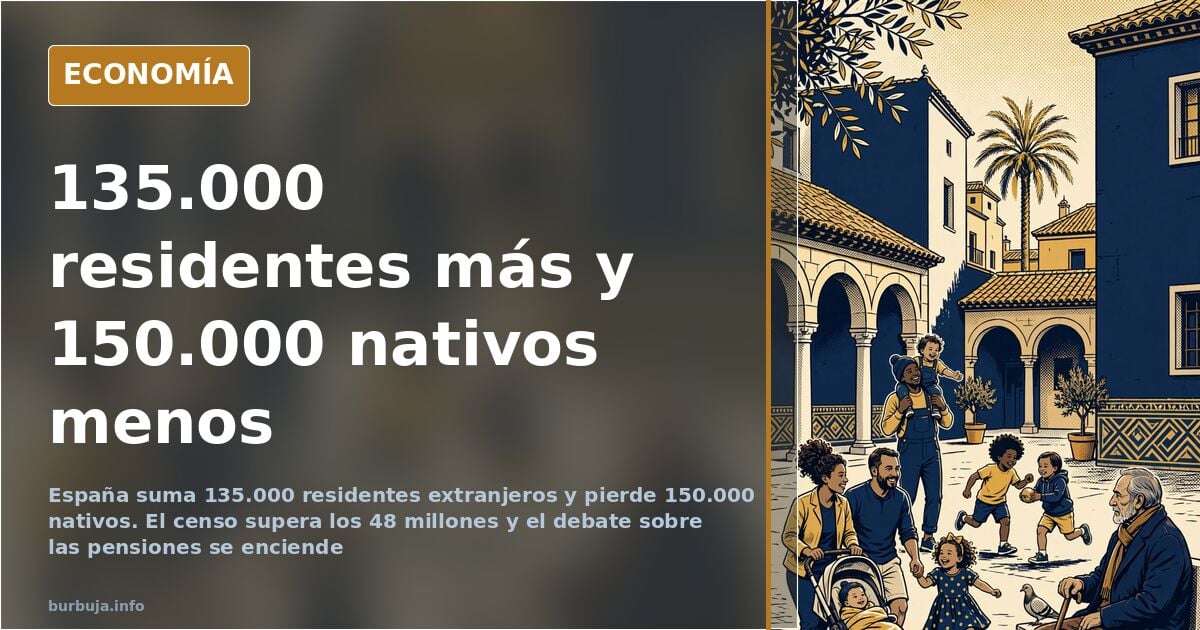
135,000 more residents: the country grows, birth rates do not
Spain added 135,000 foreign-born residents while losing 150,000 natives, according to the recurring calculation. The balance depicts a country that grows through its doors, not its cradle. The census now exceeds 48 million inhabitants, a figure that was 39 million a quarter-century ago. The math does not work due to birth rates; it works due to arrivals. And that is where the trouble begins.
A population growing through the door, not the cradle
The gross numbers are difficult to dispute. Spain exceeds 48 million residents and does so, according to the data available, supported by the increase in the foreign population. In 1999, with residual immigration, the country had approximately 39 million inhabitants, and birth rates were already practically null. Between one point and another, there has been no baby boom: there have been open borders, signed permits, and full flights.
Some argue that Spain's natural population growth has been negative since the early 1980s, meaning all population increase in recent decades comes from abroad. This is the most repeated calculation: without births to compensate, each new resident adds, and each death subtracts. And the subtraction weighs heavily. Parallel to this is an uncomfortable range regarding the real volume: from the 6 million some cite to calculations raising the figure above 10 million, counting naturalized citizens and descendants born here.
Why does the census rise if birth rates do not move?
Because the population grows not from the children they have, but from the people who arrive. Birth rates are at their lowest, and the baby boom generations approach retirement without replacement. The result is a pyramid with a narrow base and a bulging center: many older people, few births, and a constant arrival of working-age adults.
The underlying discussion is not how many enter, but what is done with this flow. Some read it as simple demographic replacement; others see it as a pressure the country is not sizing up to. The two diagnoses coexist poorly, and neither falls away on its own.
The bill no one signs: housing, healthcare, and employment
Population growth clashes with a housing supply that does not keep pace. Rents remain tight, and construction does not absorb the arrival rate. It is argued that the effect is double: more demand on a scarce stock and competition that pushes wages down in less skilled segments. The other side, regarding emergency rooms and waiting lists, is what is most repeated in any bar conversation.
The wage argument is the most disputed. Some analysis defends that a broad supply of low-skilled labor depresses conditions in specific sectors; others respond that the phenomenon is structural and that automation and training are the true bottleneck. In between, a fact no one denies: the country is aging, and someone must sustain public accounts.
Empty Spain also changes face
The phenomenon is not only urban. In small municipalities, some with just over 1,000 inhabitants and 80% retirees, the arrival of foreign population is also felt. It is the picture of a country that empties and fills at the same time.
Those looking at this picture from the village see one thing; those looking from a medium-sized capital's neighborhood see another. The same data, two distinct anxieties. And a shared silence on what is decided.
Who pays for the coming pensions
The employers' organization, represented by CEOE with two million companies and self-employed individuals according to its own data, appears at the center of the debate. It is argued that there are economic interests in sustaining the arrival of workers: labor and contributors for a pension system that needs taxpayers like bread. The criticism responds that this calculation shifts the social cost to those who can least afford it, and that business cost savings come at the expense of public services.
Here also appears the demographic winter as a counter-argument: if the native population decides not to have children, someone will have to pay the pensions of those who are already here. What is out of discussion is the arithmetic. Fewer births, more retirees, and increasing life expectancy leave a gap that is only filled with more contributors or more debt. The real discussion is which of the two, and at what price.
What is coming
If the pace continues, some place the country above 55 million in a decade.
With these elements, it is not strange that the conversation exists. It is strange that it discusses the number and almost never the infrastructure. How many schools, how many hospital beds, and how many apartments would be needed so that the next census figure does not catch us off guard again?
Spain added 135,000 foreign-born residents while losing 150,000 natives, according to the recurring calculation. The balance depicts a country that grows through its doors, not its cradle. The census now exceeds 48 million inhabitants, a figure that was 39 million a quarter-century ago. The math does not work due to birth rates; it works due to arrivals. And that is where the trouble begins.
A population growing through the door, not the cradle
The gross numbers are difficult to dispute. Spain exceeds 48 million residents and does so, according to the data available, supported by the increase in the foreign population. In 1999, with residual immigration, the country had approximately 39 million inhabitants, and birth rates were already practically null. Between one point and another, there has been no baby boom: there have been open borders, signed permits, and full flights.
Some argue that Spain's natural population growth has been negative since the early 1980s, meaning all population increase in recent decades comes from abroad. This is the most repeated calculation: without births to compensate, each new resident adds, and each death subtracts. And the subtraction weighs heavily. Parallel to this is an uncomfortable range regarding the real volume: from the 6 million some cite to calculations raising the figure above 10 million, counting naturalized citizens and descendants born here.
Why does the census rise if birth rates do not move?
Because the population grows not from the children they have, but from the people who arrive. Birth rates are at their lowest, and the baby boom generations approach retirement without replacement. The result is a pyramid with a narrow base and a bulging center: many older people, few births, and a constant arrival of working-age adults.
The underlying discussion is not how many enter, but what is done with this flow. Some read it as simple demographic replacement; others see it as a pressure the country is not sizing up to. The two diagnoses coexist poorly, and neither falls away on its own.
The bill no one signs: housing, healthcare, and employment
Population growth clashes with a housing supply that does not keep pace. Rents remain tight, and construction does not absorb the arrival rate. It is argued that the effect is double: more demand on a scarce stock and competition that pushes wages down in less skilled segments. The other side, regarding emergency rooms and waiting lists, is what is most repeated in any bar conversation.
The wage argument is the most disputed. Some analysis defends that a broad supply of low-skilled labor depresses conditions in specific sectors; others respond that the phenomenon is structural and that automation and training are the true bottleneck. In between, a fact no one denies: the country is aging, and someone must sustain public accounts.
Empty Spain also changes face
The phenomenon is not only urban. In small municipalities, some with just over 1,000 inhabitants and 80% retirees, the arrival of foreign population is also felt. It is the picture of a country that empties and fills at the same time.
Those looking at this picture from the village see one thing; those looking from a medium-sized capital's neighborhood see another. The same data, two distinct anxieties. And a shared silence on what is decided.
Who pays for the coming pensions
The employers' organization, represented by CEOE with two million companies and self-employed individuals according to its own data, appears at the center of the debate. It is argued that there are economic interests in sustaining the arrival of workers: labor and contributors for a pension system that needs taxpayers like bread. The criticism responds that this calculation shifts the social cost to those who can least afford it, and that business cost savings come at the expense of public services.
Here also appears the demographic winter as a counter-argument: if the native population decides not to have children, someone will have to pay the pensions of those who are already here. What is out of discussion is the arithmetic. Fewer births, more retirees, and increasing life expectancy leave a gap that is only filled with more contributors or more debt. The real discussion is which of the two, and at what price.
What is coming
If the pace continues, some place the country above 55 million in a decade.
With these elements, it is not strange that the conversation exists. It is strange that it discusses the number and almost never the infrastructure. How many schools, how many hospital beds, and how many apartments would be needed so that the next census figure does not catch us off guard again?
Summary of a discussion on Burbuja.info - Foro de economía, actualidad y política., translated from Spanish and reviewed before publication. Read the full discussion (239 replies).
More summaries
-
Spain's Foreign Resident Population Hits 6.2 Million Amid Historical Debate
Spain registers 6.2 million foreign residents, up 15.5% in two years, sparking debate over historical precedents and demographic shifts.
-
Living in Mexico with Money: Paradise or Hell
Mexico has 127 million people, but experiences split sharply by wealth and location. The key lies in your bank account and zip code.
-
Spain tops global pension rankings: generosity or unsustainability?
Spain leads the world in pension replacement rates with an average of €1,574.90. But debt and aging threaten the system. How long can it last?
-
Spain's Óscar López faces eviction scandal involving Muface
Madrid Tenants Union alleges Minister Óscar López approved a Muface tenant eviction while protesting a similar case in the same building.
-
Madrid's Sol protest camp winds down as cold, hygiene and narrative problems mount
The Puerta del Sol housing camp in Madrid faces its "de-camping" after three weeks: cold weather, Metro closure over sanitation and a fraying electoral narrative.
-
Trump executive order: buying homes is no longer a safe investment
Trump signs an executive order restricting hedge funds from buying single-family homes. The end of 'brick is the new gold' or just a political patch?