
Spain's Foreign Resident Population Hits 6.2 Million Amid Historical Debate
Spain registers 6.2 million foreign residents, up 15.5% in two years, sparking debate over historical precedents and demographic shifts.
English · Original discussion in Spanish · Published
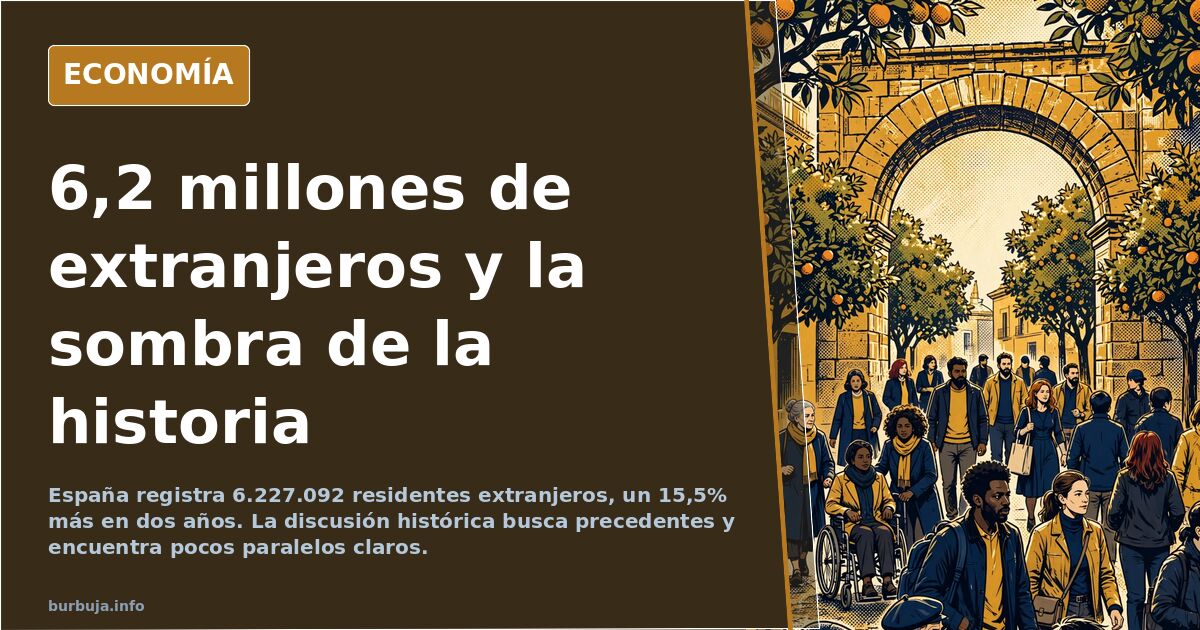
6.2 million foreign residents: Is there a historical precedent?
As of April 1, Spain had 6,227,092 foreign nationals, a 15.5% increase over two years and 2.46% above the end of 2022. This figure fuels a recurring question: is there any precedent for such a rapid population influx? The honest answer is that there is no identical episode. The long history requires separating what the numbers say from what the historical comparison suggests.
How many foreign residents are in Spain and how has it grown
Records show a total of 41,969,601 residents with Spanish nationality, of whom 30,889,196 were born in the country; the rest are naturalized. Immigration in Spain is not measured solely by recent arrivals: part of the balance already holds a Spanish passport. The foreign block, 6.2 million, concentrates the discussion.
Growth is what strains the issue. In two years, the foreign collective increased by 15.5%; compared to the end of 2022, by 2.46%. None of these figures alone equate to a population change. They are variations of a stock that remains a fraction of the total.
What historical precedents are cited as comparable
Invasions that barely moved the population composition are listed: Romans, Germanic peoples, Jovenlandeses in the peninsula, and Napoleonic France. The most repeated argument is that in Southern Europe, the population remained mostly indigenous, because those who came to power were a minority. In contrast, the American case is brought up: English and American colonization would have displaced the indigenous population, but over centuries.
There is a fact that complicates this simile. In Mexico, the majority of the population retains an indigenous profile five centuries after the conquest: the language changed, the religion changed, but the people did not.
Another recurring parallel is Lebanon, described as the 'Switzerland of the Mediterranean' before the arrival of the PLO and the subsequent civil war. And that of the Sea Peoples, who destabilized advanced empires without it being well known how. The comparison, however, is analogical, not documentary.
Substitution as a change in economic model
There is an explanation that does not rely on history but on the balance. It is argued that Western economic power manages the State as a company and, by changing the business model, also changes the staff for another cheaper and more available one. The sector that would notice it most is hospitality: whoever interviews dozens of local candidates and ends up hiring abroad, according to this narrative, seeks waiters and finds something else. Behind this appears the fight for the minimum wage, with the thesis that work is wanted, but not at any price.
On the daily level, neighborhood tensions are reported —noise, sublet housing without registration— that function as an emotional trigger, although they explain little of the global balance.
Why it is discussed whether it is an invasion or an invitation
The most cited turn is terminological. It is pointed out that if the situation is self-inflicted —with visas, contracts, registrations, and enrollments— the word 'invasion' describes the phenomenon poorly. 'There is no invasion, there is an invitation', summarizes one of the positions. Another reformulates it: if the flows are sustained by their own taxes, the problem is that of who opens the door, not who enters. The discussion shifts toward institutional responsibility.
Against this reading, another block defends the opposite: those who come from Latin America share language, religion, and surnames, and treating as strange someone who is already culturally close would be the true error.
The gaps left by demographics and the role of natality
Another line argues that there is no occupation without prior emptiness: flows would settle where the indigenous population ages and reduces its birth rate, so that the arrival would not displace as much as it would fill. From this perspective, the key would not be the entry, but a fertility below generational replacement sustained for decades. The corollary is uncomfortable for all parties: if the gap is left by demographics, migration policy only administers the calendar.
Demographic predictions and theories without backing
Alongside the data appear forecasts of a foreign social majority in a few decades, or of communities that would change religious composition in 25 years. None of these projections are backed by published studies: they are, at best, linear extrapolations of birth rate trends. The same applies to references to plans for global social engineering: there is no evidence to support them.
And here comes the question that no one closes. If historical precedents were measured in centuries and current displacements are counted in years, is the unprecedented aspect the estimulante ilegal of arrival or our new ability to measure it in real time? Records will continue to be published every quarter. What is unclear is what threshold would turn a trend into a point of no return.
As of April 1, Spain had 6,227,092 foreign nationals, a 15.5% increase over two years and 2.46% above the end of 2022. This figure fuels a recurring question: is there any precedent for such a rapid population influx? The honest answer is that there is no identical episode. The long history requires separating what the numbers say from what the historical comparison suggests.
How many foreign residents are in Spain and how has it grown
Records show a total of 41,969,601 residents with Spanish nationality, of whom 30,889,196 were born in the country; the rest are naturalized. Immigration in Spain is not measured solely by recent arrivals: part of the balance already holds a Spanish passport. The foreign block, 6.2 million, concentrates the discussion.
Growth is what strains the issue. In two years, the foreign collective increased by 15.5%; compared to the end of 2022, by 2.46%. None of these figures alone equate to a population change. They are variations of a stock that remains a fraction of the total.
What historical precedents are cited as comparable
Invasions that barely moved the population composition are listed: Romans, Germanic peoples, Jovenlandeses in the peninsula, and Napoleonic France. The most repeated argument is that in Southern Europe, the population remained mostly indigenous, because those who came to power were a minority. In contrast, the American case is brought up: English and American colonization would have displaced the indigenous population, but over centuries.
There is a fact that complicates this simile. In Mexico, the majority of the population retains an indigenous profile five centuries after the conquest: the language changed, the religion changed, but the people did not.
Another recurring parallel is Lebanon, described as the 'Switzerland of the Mediterranean' before the arrival of the PLO and the subsequent civil war. And that of the Sea Peoples, who destabilized advanced empires without it being well known how. The comparison, however, is analogical, not documentary.
Substitution as a change in economic model
There is an explanation that does not rely on history but on the balance. It is argued that Western economic power manages the State as a company and, by changing the business model, also changes the staff for another cheaper and more available one. The sector that would notice it most is hospitality: whoever interviews dozens of local candidates and ends up hiring abroad, according to this narrative, seeks waiters and finds something else. Behind this appears the fight for the minimum wage, with the thesis that work is wanted, but not at any price.
On the daily level, neighborhood tensions are reported —noise, sublet housing without registration— that function as an emotional trigger, although they explain little of the global balance.
Why it is discussed whether it is an invasion or an invitation
The most cited turn is terminological. It is pointed out that if the situation is self-inflicted —with visas, contracts, registrations, and enrollments— the word 'invasion' describes the phenomenon poorly. 'There is no invasion, there is an invitation', summarizes one of the positions. Another reformulates it: if the flows are sustained by their own taxes, the problem is that of who opens the door, not who enters. The discussion shifts toward institutional responsibility.
Against this reading, another block defends the opposite: those who come from Latin America share language, religion, and surnames, and treating as strange someone who is already culturally close would be the true error.
The gaps left by demographics and the role of natality
Another line argues that there is no occupation without prior emptiness: flows would settle where the indigenous population ages and reduces its birth rate, so that the arrival would not displace as much as it would fill. From this perspective, the key would not be the entry, but a fertility below generational replacement sustained for decades. The corollary is uncomfortable for all parties: if the gap is left by demographics, migration policy only administers the calendar.
Demographic predictions and theories without backing
Alongside the data appear forecasts of a foreign social majority in a few decades, or of communities that would change religious composition in 25 years. None of these projections are backed by published studies: they are, at best, linear extrapolations of birth rate trends. The same applies to references to plans for global social engineering: there is no evidence to support them.
And here comes the question that no one closes. If historical precedents were measured in centuries and current displacements are counted in years, is the unprecedented aspect the estimulante ilegal of arrival or our new ability to measure it in real time? Records will continue to be published every quarter. What is unclear is what threshold would turn a trend into a point of no return.
Also available in: Deutsch
Summary of a discussion on Burbuja.info - Foro de economía, actualidad y política., translated from Spanish and reviewed before publication. Read the full discussion (209 replies).
More summaries
-
FlyDubai Flight FDB1073 Plunged 17,000 Feet After Pilot Attack
FlyDubai flight FDB1073 dropped 17,000 feet in under a minute after an attack on the pilot. Israel calls it a terrorist attack and the investigation...
-
Ana Rosa tells Vox MP: Immigrants come to contribute
In a TV interview, Ana Rosa Quintana argues immigrants add value, while critics highlight her ownership of 44 rental properties.
-
Moncloa boosts Alvise to curb Vox's 20% support
Forum thread claims Moncloa promotes Alvise to reduce Vox seats. One million votes might yield no MPs but could shift several.
-
Spain's Parasite Debate: Cultural Shock or Marketing?
Analysis of the debate on deworming in Spain: is it a cultural clash, a public health need, or just marketing?
-
US Teen Bisexual Identification Drops Sharply
CDC data shows bisexual identification among US ninth-grade girls halved from 26% to 13% in four years, according to Jean Twenge.
-
Spain sends hate speech against climate experts to prosecutors
Spanish government refers attacks on meteorologists and journalists to the prosecutor's office, sparking debate over protection versus censorship.