
Spain's Population Surges from 39 Million to Nearly 50 Million
Spain's population has grown from 39 million in 2000 to nearly 50 million, a shift already impacting neighborhoods, healthcare, and housing.
English · Original discussion in Spanish · Published
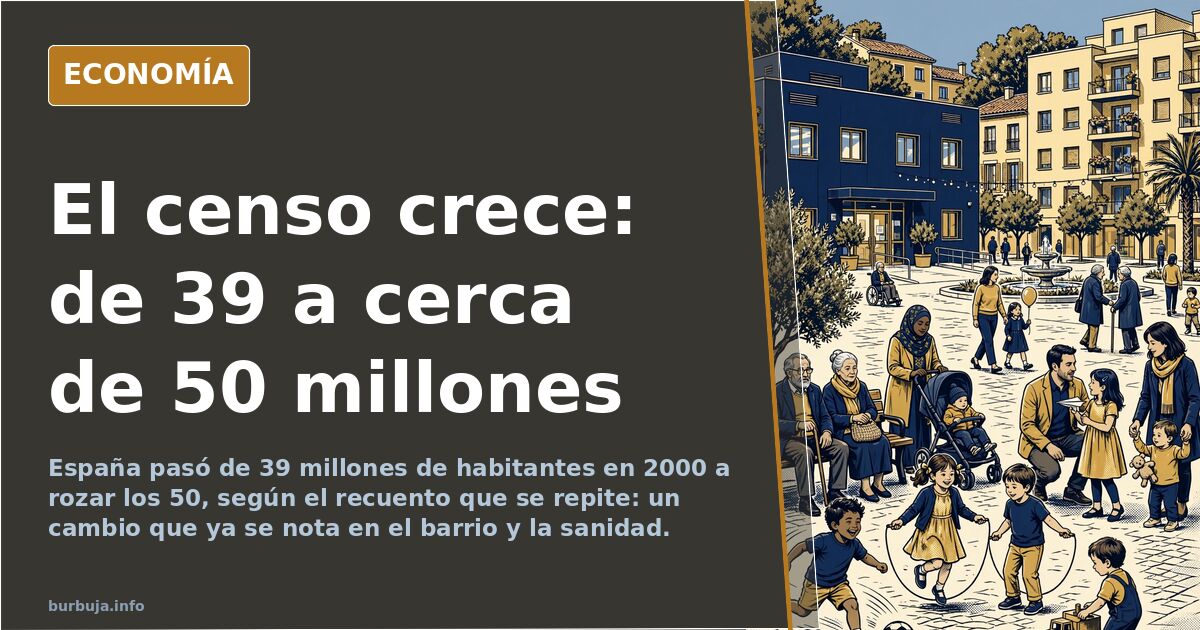
From 39 to 50 Million: Spain Unrecognizable in Its Own Neighborhoods
How much has your city changed in the last decade? For many residents, the answer is that it is no longer recognizable: other languages in local shops, overstretched healthcare consultations, and the feeling of being a minority in one's own neighborhood. Beneath this discontent lies a recurring statistic. Spain went from 39 million inhabitants in 2000, with nearly two million foreigners and stagnant native population growth, to nearing 50 million, according to the count circulating in public discourse. This same count adds that native Spaniards number fewer than 30 million. The conversation, therefore, is no longer abstract: it plays out at the supermarket checkout.
The Change Visible on the Street: Shops, Schools, and Clinics
Those describing this phenomenon repeat three scenes. First, commerce: Spanish-accented service, English-speaking customers, and businesses where Castilian is not the working language. Second, the entrance to a primary school at dismissal time, cited as the clearest indicator of change. Third, public transport during certain hours, where it is perceived — this is interpretation, not census data — that locals stay home more, leaving the streets to newcomers. These images are accompanied by a recurring sight: people with suitcases on the street any week, read as continuous new residency arrivals rather than tourism.
How Many Foreigners Live in Spain?
The most cited comparison starts in 2000: 39 million inhabitants, nearly two million foreigners, and exhausted growth. Today, the figure nears 50 million according to the same count. The most repeated example is Alicante, which has reportedly exceeded two million inhabitants, joining Almería, Murcia, Valencia, and rural Spain, described as transformed in a short time. On the opposite end is Galicia, where visitors from large cities note a distinctly different social landscape.
A underlying reading deserves attention: this concentration is not accidental but responds to family networks, job availability, and a young population found only in large hubs. Small towns, with fewer services, attract less. This nuance matters because it rebuts the idea of a uniform trickle across the entire territory.
What Holds True Regarding Ease of Obtaining Residency
The most repeated explanation describes an almost mechanical sequence, to be read as an attributed claim, not verified official data.
From there, it is claimed, regularization trinc after three years in irregular status, something that — according to this narrative — does not occur in any other country. The invitation letter functions, in this version, as an entry point for the entire family. Along these same lines is the two-year deadline for nationality for Iberoamericans, with a political consequence emphasized: new voters in a short time.
Healthcare, Housing, and Wages: The Three Fronts of Discontent
Healthcare concentrates the most repeated complaints: growing waits for consultations, difficulty securing appointments, and the suspicion that access is faster for newcomers, including those who barely speak Spanish. The discourse provides no figures to confirm this hypothesis, remaining in the realm of perception.
The second front is housing. With the arrival of half a million people annually, the circulating argument is that prices will not drop and wages will not rise, because the labor supply grows faster than qualified positions. This is an economic reasoning, debatable, but with an internal logic explaining why the issue infiltrates every tenant discussion.
Work That Finds No Replacement in the Village
One case is detailed and serves as a counterpoint. A property owner needed to open an irrigation channel. In the village bar, full of unemployed men playing dominoes, no one looked up the third time he asked for help. He then threatened to bring workers from abroad, prompting a reaction. This episode is used to argue that the problem is not just about borders, but about labor supply and demand in certain sectors.
What Is Projected for the Next Decade
The circulating forecasts are broad: in ten years, native Spaniards would be a clear minority in large cities. Neighborhoods where only English and other languages are heard are cited, with Catalan in retreat even among locals, and speculation about the effect on the electoral map and independence movements. None of this is settled, and the conversation's tone betrays it: much projection, little data.
As long as the population register continues to swell, the diagnosis remains in the hands of whoever shouts loudest. And in an issue where the only fruta fact is the count, that is the worst legacy.
How much has your city changed in the last decade? For many residents, the answer is that it is no longer recognizable: other languages in local shops, overstretched healthcare consultations, and the feeling of being a minority in one's own neighborhood. Beneath this discontent lies a recurring statistic. Spain went from 39 million inhabitants in 2000, with nearly two million foreigners and stagnant native population growth, to nearing 50 million, according to the count circulating in public discourse. This same count adds that native Spaniards number fewer than 30 million. The conversation, therefore, is no longer abstract: it plays out at the supermarket checkout.
The Change Visible on the Street: Shops, Schools, and Clinics
Those describing this phenomenon repeat three scenes. First, commerce: Spanish-accented service, English-speaking customers, and businesses where Castilian is not the working language. Second, the entrance to a primary school at dismissal time, cited as the clearest indicator of change. Third, public transport during certain hours, where it is perceived — this is interpretation, not census data — that locals stay home more, leaving the streets to newcomers. These images are accompanied by a recurring sight: people with suitcases on the street any week, read as continuous new residency arrivals rather than tourism.
How Many Foreigners Live in Spain?
The most cited comparison starts in 2000: 39 million inhabitants, nearly two million foreigners, and exhausted growth. Today, the figure nears 50 million according to the same count. The most repeated example is Alicante, which has reportedly exceeded two million inhabitants, joining Almería, Murcia, Valencia, and rural Spain, described as transformed in a short time. On the opposite end is Galicia, where visitors from large cities note a distinctly different social landscape.
A underlying reading deserves attention: this concentration is not accidental but responds to family networks, job availability, and a young population found only in large hubs. Small towns, with fewer services, attract less. This nuance matters because it rebuts the idea of a uniform trickle across the entire territory.
What Holds True Regarding Ease of Obtaining Residency
The most repeated explanation describes an almost mechanical sequence, to be read as an attributed claim, not verified official data.
- Return flight ticket with a closed return and 900 euros in cash
- Booked accommodation or invitation letter from a relative
- Stay extending beyond the return ticket
- Two years of work without a contract, trinc by residency
From there, it is claimed, regularization trinc after three years in irregular status, something that — according to this narrative — does not occur in any other country. The invitation letter functions, in this version, as an entry point for the entire family. Along these same lines is the two-year deadline for nationality for Iberoamericans, with a political consequence emphasized: new voters in a short time.
Healthcare, Housing, and Wages: The Three Fronts of Discontent
Healthcare concentrates the most repeated complaints: growing waits for consultations, difficulty securing appointments, and the suspicion that access is faster for newcomers, including those who barely speak Spanish. The discourse provides no figures to confirm this hypothesis, remaining in the realm of perception.
The second front is housing. With the arrival of half a million people annually, the circulating argument is that prices will not drop and wages will not rise, because the labor supply grows faster than qualified positions. This is an economic reasoning, debatable, but with an internal logic explaining why the issue infiltrates every tenant discussion.
Work That Finds No Replacement in the Village
One case is detailed and serves as a counterpoint. A property owner needed to open an irrigation channel. In the village bar, full of unemployed men playing dominoes, no one looked up the third time he asked for help. He then threatened to bring workers from abroad, prompting a reaction. This episode is used to argue that the problem is not just about borders, but about labor supply and demand in certain sectors.
What Is Projected for the Next Decade
The circulating forecasts are broad: in ten years, native Spaniards would be a clear minority in large cities. Neighborhoods where only English and other languages are heard are cited, with Catalan in retreat even among locals, and speculation about the effect on the electoral map and independence movements. None of this is settled, and the conversation's tone betrays it: much projection, little data.
As long as the population register continues to swell, the diagnosis remains in the hands of whoever shouts loudest. And in an issue where the only fruta fact is the count, that is the worst legacy.
Also available in: Deutsch
Summary of a discussion on Burbuja.info - Foro de economía, actualidad y política., translated from Spanish and reviewed before publication. Read the full discussion (333 replies).
More summaries
-
Ceuta: Symbolic Resistance Against Spain's Demographic Mirror
Ceuta's protest reopens the debate: resist or concede? Demographic shifts, IMV costs, and Gibraltar's shadow.
-
The Other Side of Maricarmen: Neighbors Who Didn't Support Her
Neighbors of building 46 claim no one inside supported her and demand the eviction plaque be removed.
-
Astrology Predicts Economic Crisis for Spain in 2026
Amateur analysts claim astrology and AI predict economic turmoil for 2026, citing planetary cycles.
-
Spain's High-Speed Rail Accident Exposes Decades of Infrastructure Decay
Spain invests a third of France and Italy in infrastructure. Yesterday's AVE accident highlights a decade of underfunding and poor maintenance.
-
Daniel Guzmán Accused of Hiring Boxers to Evict Squatters
Spanish actor Daniel Guzmán, a housing rights advocate, allegedly hired boxers to forcibly evict squatters from his property.
-
Trump supporters: Are you truly complicit?
Cheap US gas at €0.70 vs $2,800 hospital bills: analyzing why some Spaniards back Trump's Venezuela intervention.