
Spain's pensions: 23% now funded by public debt
In Spain, pension funding shifted from 92% contributions in 2010 to 70% in 2023. Now 23% comes from public debt amid worsening demographics.
English · Original discussion in Spanish · Published
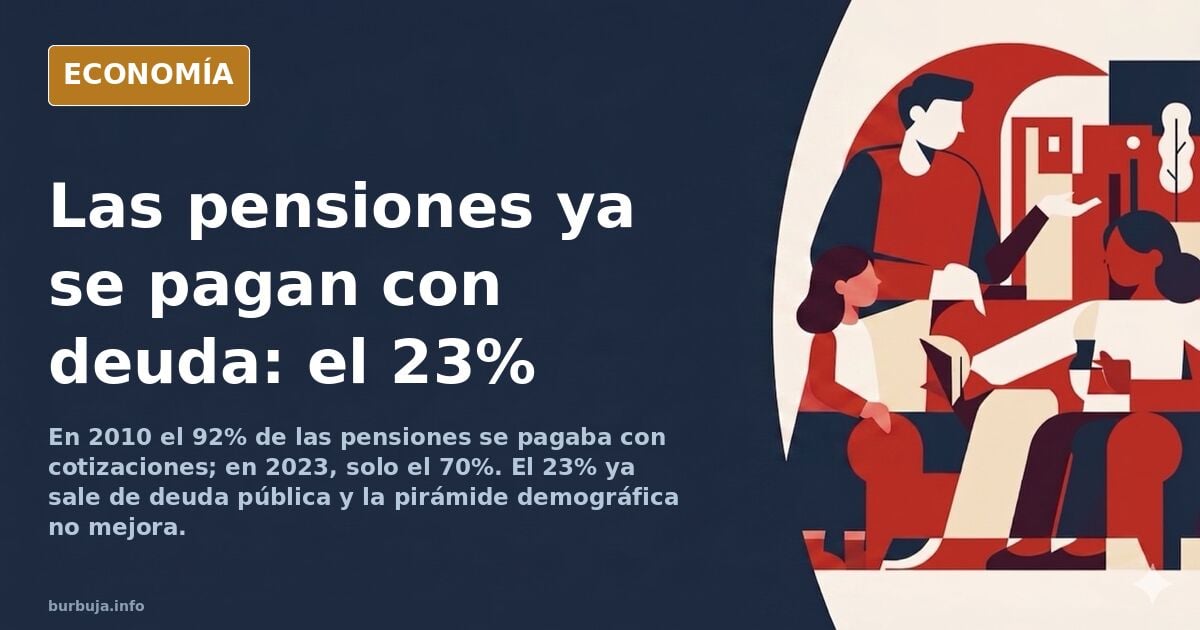
23% of Spanish pensions are already paid with public debt
How much does Spain spend on pensions? A viral figure—later censored—suggested a staggering scale: the assets of the world’s largest investment fund would cover only a few months of payments to Spanish retirees. The data, shared on Twitter and then deleted, sparked intense debate with an uncomfortable backdrop: the public pension system no longer relies solely on workers’ contributions.
In 2010, 92% of the system was financed by employee quotas, with state transfers accounting for just 6.2%. By 2023, this ratio had inverted: contributions cover 70%, while state transfers reach 23%, according to figures cited in the discussion. This means nearly one in four pensions is funded by debt. And the demographic pyramid shows no improvement.
What is the real cost of the pension system?
The original calculation that ignited the debate—comparing the value of the world’s largest investment fund to months of pension payouts—was met with harsh criticism. One participant rebutted it with concrete examples: rebuilding Notre Dame cost €700 million, equivalent to a single day of pension payments; Mercadona’s net profit in 2023 was €1.009 billion. With such magnitudes, the comparison to global funds falls short or simply doesn’t align.
Another user offered a different estimate: 15% of pensions are already paid from the general state budget. And a more unsettling projection: without deep reforms, the system could face functional collapse around 2040-2050.
The European comparison circulating in the discussion also reflects poorly on Spain. With an average salary of €30,237 and an average pension of €23,342, the replacement rate exceeds 77%. In France, with an average salary of €43,438, the average pension is €18,070. In Italy, salaries average €33,492 against pensions of €19,860. Only Slovenia and Lithuania, with much lower wages, show proportionally high pensions.
The argument nobody wants to hear: it’s a pyramid scheme
The most repeated criticism isn’t aimed at retirees but at the system’s design. You’re killing the messenger, summarizes one highly upvoted comment. The reasoning: if an individual sets up a financial scheme paying old investors with new money, they end up in jail. If the State does it, mandating participation for all workers, it’s called intergenerational solidarity and cannot be criticized without being labeled ultra-liberal.
The problem, they add, is that no politician dares to touch it. Anyone trying to fix it at this stage will be hung from a lamppost. So the strategy is to let it fail on its own, ensuring that the generation currently contributing receives tomorrow what those who never contributed received.
Some clarify that the pay-as-you-go system isn’t inherently fraudulent: it’s cheaper and offers better quality than individual capitalization systems, where inflation, crisis, or insurer bankruptcy risks fall on the worker. The issue isn’t the design, but demographics.
The generation taking the money and leaving the debt
The core of youth anger lies elsewhere: those retiring today with €3,000 monthly leave unpayable debt to new generations. Spain’s birth rate, the lowest in the West, is interpreted in the discussion as a direct consequence of this income transfer: every euro going to pensions is a euro young families don’t have for children.
The counterargument from the other side is that the system’s original goal was to prevent elderly poverty, not to enrich one generation at another’s expense. And that the true sinks of public money lie elsewhere: duplicated administrations, hand-picked subsidies, contracts with family commissions, subsidized media outlets. Let’s not even talk about spending on politicians and tripled administrations, summarizes one intervention.
The most concrete alternative comes from the French model: 43 years of contributions to receive 100% of the regulatory base and 35 years for 75%, with a point reduction per year down to 50% after 15 years of contributions. This would lower pensions and allow wages to improve. It’s more antiestéticasible, they argue, than expecting everyone to work until age 70, which is unviable in many professions.
What happens if the system isn’t reformed?
Projections discussed by participants indicate accelerated deterioration. In 15 years, the contributor-to-retiree ratio will worsen significantly. The 15% of spending already covered by the State could double. The lingering question is whether the system will last until the current generation of thirty-somethings reaches retirement age.
Meanwhile, public debate remains stuck in black-and-white terms: either €2,500 pensions or zero pensions; either Spanish healthcare or US healthcare. As if there were no middle ground. You’re so heavy, concludes one of the clearest voices: no one talks about eliminating pensions, but about ensuring they provide a dignified living, not a luxurious life. And even if all corruption were fixed, unless the 40% of State spending is addressed, the problem remains severely broken.
The Twitter account that put the data into perspective no longer exists. The debate, however, continues exactly where it started.
How much does Spain spend on pensions? A viral figure—later censored—suggested a staggering scale: the assets of the world’s largest investment fund would cover only a few months of payments to Spanish retirees. The data, shared on Twitter and then deleted, sparked intense debate with an uncomfortable backdrop: the public pension system no longer relies solely on workers’ contributions.
In 2010, 92% of the system was financed by employee quotas, with state transfers accounting for just 6.2%. By 2023, this ratio had inverted: contributions cover 70%, while state transfers reach 23%, according to figures cited in the discussion. This means nearly one in four pensions is funded by debt. And the demographic pyramid shows no improvement.
What is the real cost of the pension system?
The original calculation that ignited the debate—comparing the value of the world’s largest investment fund to months of pension payouts—was met with harsh criticism. One participant rebutted it with concrete examples: rebuilding Notre Dame cost €700 million, equivalent to a single day of pension payments; Mercadona’s net profit in 2023 was €1.009 billion. With such magnitudes, the comparison to global funds falls short or simply doesn’t align.
Another user offered a different estimate: 15% of pensions are already paid from the general state budget. And a more unsettling projection: without deep reforms, the system could face functional collapse around 2040-2050.
The European comparison circulating in the discussion also reflects poorly on Spain. With an average salary of €30,237 and an average pension of €23,342, the replacement rate exceeds 77%. In France, with an average salary of €43,438, the average pension is €18,070. In Italy, salaries average €33,492 against pensions of €19,860. Only Slovenia and Lithuania, with much lower wages, show proportionally high pensions.
The argument nobody wants to hear: it’s a pyramid scheme
The most repeated criticism isn’t aimed at retirees but at the system’s design. You’re killing the messenger, summarizes one highly upvoted comment. The reasoning: if an individual sets up a financial scheme paying old investors with new money, they end up in jail. If the State does it, mandating participation for all workers, it’s called intergenerational solidarity and cannot be criticized without being labeled ultra-liberal.
The problem, they add, is that no politician dares to touch it. Anyone trying to fix it at this stage will be hung from a lamppost. So the strategy is to let it fail on its own, ensuring that the generation currently contributing receives tomorrow what those who never contributed received.
Some clarify that the pay-as-you-go system isn’t inherently fraudulent: it’s cheaper and offers better quality than individual capitalization systems, where inflation, crisis, or insurer bankruptcy risks fall on the worker. The issue isn’t the design, but demographics.
The generation taking the money and leaving the debt
The core of youth anger lies elsewhere: those retiring today with €3,000 monthly leave unpayable debt to new generations. Spain’s birth rate, the lowest in the West, is interpreted in the discussion as a direct consequence of this income transfer: every euro going to pensions is a euro young families don’t have for children.
The counterargument from the other side is that the system’s original goal was to prevent elderly poverty, not to enrich one generation at another’s expense. And that the true sinks of public money lie elsewhere: duplicated administrations, hand-picked subsidies, contracts with family commissions, subsidized media outlets. Let’s not even talk about spending on politicians and tripled administrations, summarizes one intervention.
The most concrete alternative comes from the French model: 43 years of contributions to receive 100% of the regulatory base and 35 years for 75%, with a point reduction per year down to 50% after 15 years of contributions. This would lower pensions and allow wages to improve. It’s more antiestéticasible, they argue, than expecting everyone to work until age 70, which is unviable in many professions.
What happens if the system isn’t reformed?
Projections discussed by participants indicate accelerated deterioration. In 15 years, the contributor-to-retiree ratio will worsen significantly. The 15% of spending already covered by the State could double. The lingering question is whether the system will last until the current generation of thirty-somethings reaches retirement age.
Meanwhile, public debate remains stuck in black-and-white terms: either €2,500 pensions or zero pensions; either Spanish healthcare or US healthcare. As if there were no middle ground. You’re so heavy, concludes one of the clearest voices: no one talks about eliminating pensions, but about ensuring they provide a dignified living, not a luxurious life. And even if all corruption were fixed, unless the 40% of State spending is addressed, the problem remains severely broken.
The Twitter account that put the data into perspective no longer exists. The debate, however, continues exactly where it started.
Summary of a discussion on Burbuja.info - Foro de economía, actualidad y política., translated from Spanish and reviewed before publication. Read the full discussion (164 replies).
More summaries
-
Spain's Freelancers: Journalist Criticizes €300 Monthly Fee
A Spanish freelance journalist denounces the €300 monthly self-employment fee, stating she is not Amancio Ortega's daughter. Critics highlight the contradiction with her pro-tax stance.
-
Man sentenced to 4.5 years for slaughtering girlfriend's rabbit
A Valencia court sentences a man to 4.5 years in prison for killing, cooking, and forcing his girlfriend to eat her rabbit.
-
Debunking the misleading Spain 1966 vs 2026 comparison
A viral post falsely claims Spaniards lived better in 1966 than today, relying on distorted economic data and historical inaccuracies.
-
Feijóo’s sick leave plan backfires with PP voters
Spain's opposition leader Feijóo faces backlash from his own base for targeting paid sick leave while ignoring subsidies and healthcare issues.
-
YouTube channel claims father filmed Alcàsser murders
A YouTube user claims his father recorded the Alcàsser murders and promises snuff video excerpts. No evidence provided, only narrative and technical analysis.
-
Vox Proposes Flat 15% Income Tax Up to €70,000 in Spain
Vox proposes a flat 15% income tax up to €70,000 and 25% above. Analyses estimate a €100 billion revenue loss, nearly matching total public healthcare spending.