
Spain's Freelancers: Journalist Criticizes €300 Monthly Fee
A Spanish freelance journalist denounces the €300 monthly self-employment fee, stating she is not Amancio Ortega's daughter. Critics highlight the contradiction with her pro-tax stance.
English · Original discussion in Spanish · Published
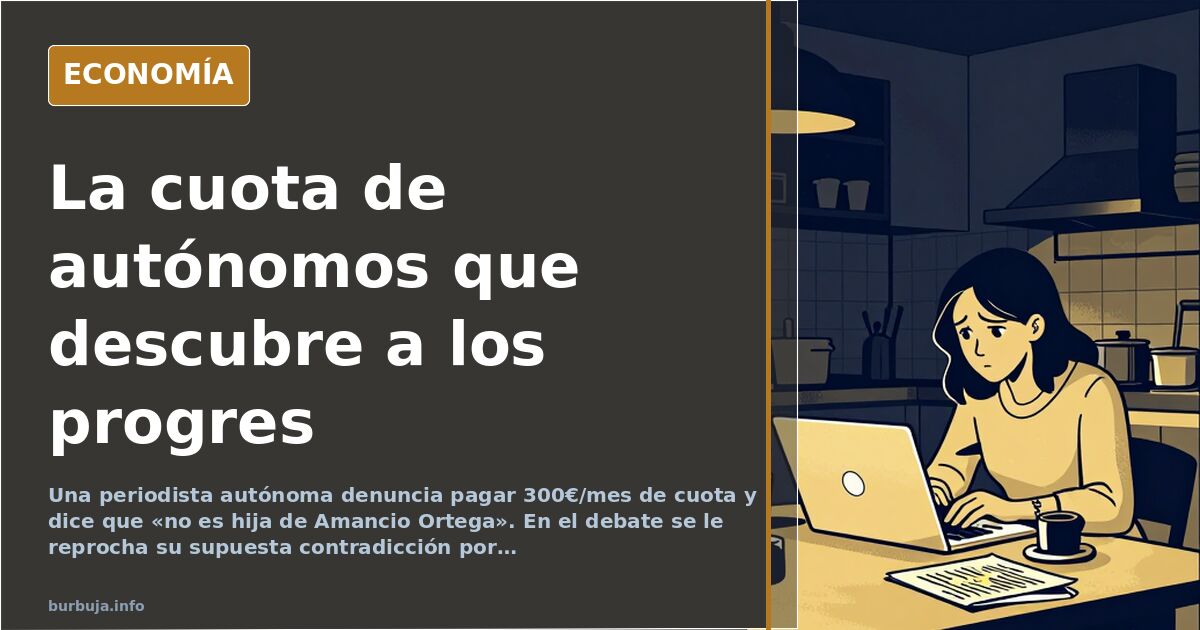
The Self-Employment Fee That Exposes Pogre Contradictions
There is a recurring scene whenever someone with a platform discovers the fine print of the system they claim to defend. A young journalist, who owns a media outlet and keeps self-help books on her shelves, writes an article complaining that paying €300 per month in self-employment contributions (RETA) is "surreal" and that she is "not Amancio Ortega's daughter." So far, it is a legitimate complaint. The problem lies in the context: the same person who, according to critics, has spent years demanding higher taxes to fund public services now realizes that public services are also paid for by her credit card.
The reaction was swift. Within hours, the issue escalated from an anecdote to a case study on the ideological consistency of a generation accused of voting to raise taxes on others while now drowning under their own.
Self-Employment Fees: €300 a Month Just for the Right to Work
The technical detail that sparked the debate is simple: in Spain, registering as a freelancer entails a fixed monthly contribution of around €300, regardless of whether you generate revenue or not. In other words, you pay for the right to work. The journalist's complaint was not new—it has been a long-standing battle cry for thousands of self-employed workers—but it stood out coming from someone who, critics say, has unconditionally supported increasing the tax burden.
Some argue the fee is "surreal" and that paying €300 a month just to have the right to work is an anomaly that pushes small entrepreneurs out of the system. Counterarguments state that this money funds healthcare, education, and pensions used by freelancers themselves. The contradiction is significant: the system being criticized is the one defended at the ballot box.
The Calculation No One Wants to Do: The True Cost of Being Self-Employed
Beyond the anecdote, the issue reveals an uncomfortable reality for the official narrative. A freelancer with zero revenue still pays their contribution. An employee with low wages does not. This asymmetry has turned the RETA (Special Regime for Self-Employed Workers) into a minefield for beginners. The full calculation, broken down item by item—contributions, income tax (IRPF), VAT, deductible expenses—shows a difference that surprises those who only look at gross figures.
The affected journalist's response was revealing: "Some thought paying taxes was a joke." The phrase, which she herself circulated, backfired instantly. Because the problem is not paying taxes. The problem is discovering that you are also a taxpayer.
From Demanding Higher Taxes to Complaining About Fees: An Unexpected Turn
The evolution of the story has its irony. What began as a personal grievance turned into a generational reckoning. Some argue that left-wing politics is solved by working hard and using common sense. Others point out that the self-employment fee is just the first bill received by those who have spent years asking others to foot the party. A third, more cynical view suggests the real problem is not the fee, but having built a media outlet that recycles news, only to find out that recycling is taxable too.
The data that confuses many: the self-employment fee is not pogre. It is a flat rate. Whether you earn much or little, you pay the same. For a generation educated in fiscal pogre, this is an ideological blow to the jaw.
What the Case Reveals About the Consistency of Pogre Discourse
The episode has served a purpose beyond mockery. It put the uncomfortable question on the table: what happens when those who demand higher taxes discover they are also on the list of payers? In this case, the answer was a complaint article. And a headline that became a meme: "I am not Amancio Ortega's daughter."
The conclusion remains unwritten. It depends on whether the journalist thinks the same way when she receives the first registered letter from Hacienda (the Spanish Tax Agency). Or if, as some suggest, she will eventually realize that the system she criticized was, in fact, the one sustaining her. The question remains open: how many more need to see the bill to understand how the cash register works?
There is a recurring scene whenever someone with a platform discovers the fine print of the system they claim to defend. A young journalist, who owns a media outlet and keeps self-help books on her shelves, writes an article complaining that paying €300 per month in self-employment contributions (RETA) is "surreal" and that she is "not Amancio Ortega's daughter." So far, it is a legitimate complaint. The problem lies in the context: the same person who, according to critics, has spent years demanding higher taxes to fund public services now realizes that public services are also paid for by her credit card.
The reaction was swift. Within hours, the issue escalated from an anecdote to a case study on the ideological consistency of a generation accused of voting to raise taxes on others while now drowning under their own.
Self-Employment Fees: €300 a Month Just for the Right to Work
The technical detail that sparked the debate is simple: in Spain, registering as a freelancer entails a fixed monthly contribution of around €300, regardless of whether you generate revenue or not. In other words, you pay for the right to work. The journalist's complaint was not new—it has been a long-standing battle cry for thousands of self-employed workers—but it stood out coming from someone who, critics say, has unconditionally supported increasing the tax burden.
Some argue the fee is "surreal" and that paying €300 a month just to have the right to work is an anomaly that pushes small entrepreneurs out of the system. Counterarguments state that this money funds healthcare, education, and pensions used by freelancers themselves. The contradiction is significant: the system being criticized is the one defended at the ballot box.
The Calculation No One Wants to Do: The True Cost of Being Self-Employed
Beyond the anecdote, the issue reveals an uncomfortable reality for the official narrative. A freelancer with zero revenue still pays their contribution. An employee with low wages does not. This asymmetry has turned the RETA (Special Regime for Self-Employed Workers) into a minefield for beginners. The full calculation, broken down item by item—contributions, income tax (IRPF), VAT, deductible expenses—shows a difference that surprises those who only look at gross figures.
The affected journalist's response was revealing: "Some thought paying taxes was a joke." The phrase, which she herself circulated, backfired instantly. Because the problem is not paying taxes. The problem is discovering that you are also a taxpayer.
From Demanding Higher Taxes to Complaining About Fees: An Unexpected Turn
The evolution of the story has its irony. What began as a personal grievance turned into a generational reckoning. Some argue that left-wing politics is solved by working hard and using common sense. Others point out that the self-employment fee is just the first bill received by those who have spent years asking others to foot the party. A third, more cynical view suggests the real problem is not the fee, but having built a media outlet that recycles news, only to find out that recycling is taxable too.
The data that confuses many: the self-employment fee is not pogre. It is a flat rate. Whether you earn much or little, you pay the same. For a generation educated in fiscal pogre, this is an ideological blow to the jaw.
What the Case Reveals About the Consistency of Pogre Discourse
The episode has served a purpose beyond mockery. It put the uncomfortable question on the table: what happens when those who demand higher taxes discover they are also on the list of payers? In this case, the answer was a complaint article. And a headline that became a meme: "I am not Amancio Ortega's daughter."
The conclusion remains unwritten. It depends on whether the journalist thinks the same way when she receives the first registered letter from Hacienda (the Spanish Tax Agency). Or if, as some suggest, she will eventually realize that the system she criticized was, in fact, the one sustaining her. The question remains open: how many more need to see the bill to understand how the cash register works?
Summary of a discussion on Burbuja.info - Foro de economía, actualidad y política., translated from Spanish and reviewed before publication. Read the full discussion (142 replies).
More summaries
-
Record Tax Hike: Middle Class Pays Half of Income Tax
Analysis shows 8 million middle-income earners pay half of Spain's 50 billion euro income tax, following the largest fiscal pressure increase in the EU.
-
Borrell challenges absentee voting with the grandchild law
Borrell opens the debate on non-resident voting with the grandchild law: those registered in the CERA already decide seats in general, European, and regional elections.
-
Spanish political frustration reaches boiling point
Spain's political system faces deep public exhaustion. From the 2004 Madrid attacks to today, why does widespread anger fail to trigger real change?
-
Room for family with kids hits €700 in Madrid market
Forum post reveals €700 room demand for couple with two children in Madrid, highlighting a strained housing market.
-
Pedroche's Provocation Strategy Fails as Audience Declines
Economic analysis of Cristina Pedroche's decline: repetitive provocation reduces viewership while Chenoa succeeds on TVE.
-
Spain housing crisis: 50 million people, no affordable homes
Forum users debate Spain's housing shortage, citing land scarcity, taxes, migration, and tourism. One notes the population grows by 500,000 annually.