
Russian Mobile Alert: Baños Spreads 24-Hour Ultimatum on Kyiv Destruction
Colonel Pedro Baños shares an unverified message claiming Russian citizens received a 24-hour ultimatum to surrender or face Kyiv's destruction, raising disinformation concerns.
English · Original discussion in Spanish · Published
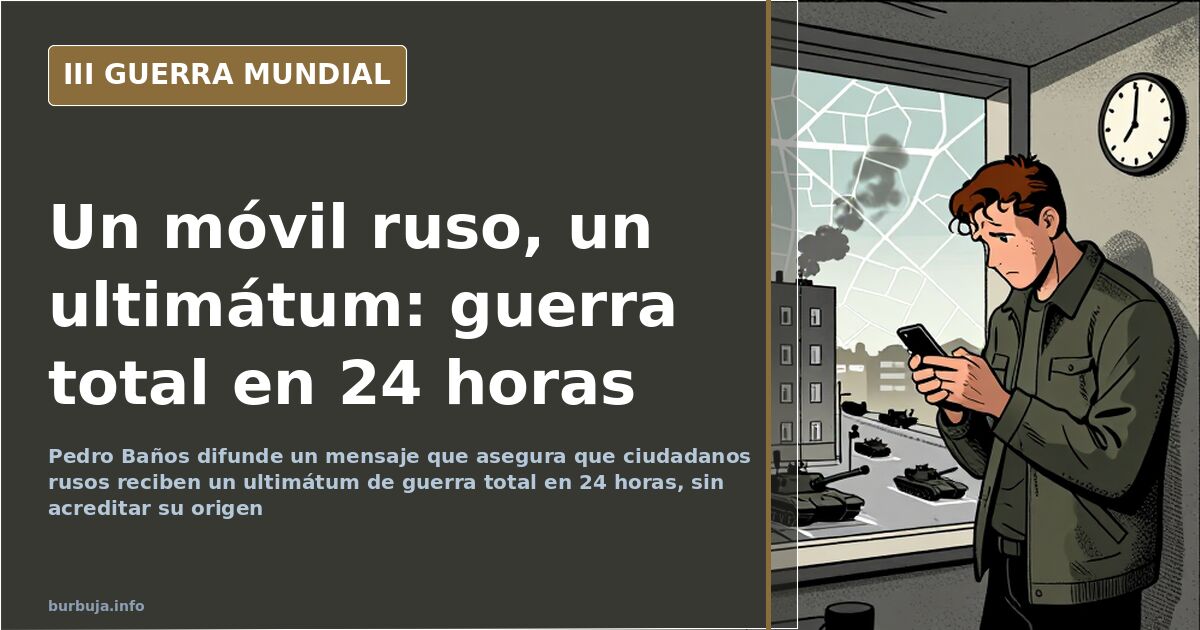
A message to Russian mobile phones announces the destruction of Kyiv in 24 hours
A Spanish tourist in a Russian republic, married to a Russian citizen, turned on her phone and found a blunt text: Ukraine had 24 hours to surrender or Kyiv would be destroyed. The warning, shared by Colonel Pedro Baños on his channel, announced attacks on Ukrainian government buildings, energy infrastructure, and massive bombings with dagger missiles targeting the capital's administrative centers. Baños clarified the source was unconfirmed and could be an alarm unrelated to the Kremlin. He also highlighted the disturbing implication: that someone had hacked millions of phones in Russia to sow panic.
What exactly the message on Russian mobile phones says
The text sets a one-day ultimatum and adorns it with the full repertoire. If Ukraine does not surrender, war will be declared within 24 hours, and the center of Kyiv will be leveled. Russian special forces would arrest the entire Ukrainian government, or eliminate them if they fail. Massive bombings would hit administrative headquarters and the country's energy grid. The message frames the offensive as a war against the new world order and a way to preserve Russian citizens' lives. Reasonable doubt arises immediately: nothing here is signed by an identifiable official body.
Why the text format points to a hoax
The most repeated analysis focuses on form, not content. An official communiqué is not written with exclamations or unnecessary details; this one states that Pilingui considers declaring war—in the conditional—before outlining a plan he has not yet decided on. Some summarize it sharply: it only lacks a "believe me."
The second argument weighs more. If the Kremlin were sending official communications to millions of phones at this scale, it would dominate all headlines. It did not. Nor does the reverse theory help: assuming someone hacked millions of terminals in Russia to spread an ultimatum requires more than a forwarded screenshot. With such material, any clandestine sender can mimic the tone of a crisis cabinet.
Baños's role: preventive alert or propaganda loudspeaker?
Here, the matter heats up. One part of the public considers it legitimate for an analyst with an audience to warn of what reaches him, even if unverified, precisely due to the gravity of the scenario. The other part argues that spreading an unverified message amplifies it, pointing to the colonel for what they see as years of alignment with the Russian narrative. Beyond his role as a published author, he carries the label of a Kremlin-aligned analyst, which becomes the first line of debate in such episodes.
It is necessary to separate two things. What is clear is that he shared the message warning he could not confirm its origin. What is attributed to him—serving as a transmission belt for Russian propaganda—is an accusation by critics, not an established fact. In between lies the professional reproach: whoever commands thousands of trinc bears the cost of every alarm they launch without proof.
The unfulfilled prediction and the cost of crying wolf
The track record weighs heavily. Throughout the conflict, there have been many predictions that never came to pass: that Kyiv would fall in a week, that Russia was invincible, that its economy would hold up without breaking a sweat. Each failed forecast leaves a sediment of skepticism, even among those who sympathize with one side.
The risk of so many warnings is that of the shepherd in the tale: when a real threat arrives, no one will believe it. And an uncomfortable detail emerges for the channel itself: if the disseminator lacks the means to verify the news, the warning and the hoax become indistinguishable to the public. The line between informing and frightening is finer than it seems.
A war that will last three years and was never called a war
The background explains the distrust. The conflict has already lasted more than two and a half years, with Moscow refusing to call it a war: it is a "special operation." The annexation of four oblasts celebrated in referendums never translated into effective protection of that territory. When Ukrainian troops entered the Kursk region, the paradox was revealed: if those territories were Russia, Russia had been invaded for months.
On this fertile ground, apocalyptic messages flourish. Demoralization is a cheap weapon, announcing leveled cities and eliminated governments for the price of a forward. That is why the ultimatum is so useful: it does not matter if it is true, because its effect is collected instantly. Some describe the episode as a psychological operation directed at the Russian population itself, not the enemy.
What peine when the 24 hours passed
The deadline passed without a declaration of war and without Kyiv disappearing from the map. The real escalation came later and from the other side, with the Ukrainian incursion into Kursk. No dagger missile erased the capital's administrative centers. The message, however, had already done its work: it installed for a few hours the idea that the end was one day away, and that gap, the one of anticipated antiestéticar, is exactly what war hoaxes seek.
No one has established that the ultimatum existed. Doubt, however, remains.
A Spanish tourist in a Russian republic, married to a Russian citizen, turned on her phone and found a blunt text: Ukraine had 24 hours to surrender or Kyiv would be destroyed. The warning, shared by Colonel Pedro Baños on his channel, announced attacks on Ukrainian government buildings, energy infrastructure, and massive bombings with dagger missiles targeting the capital's administrative centers. Baños clarified the source was unconfirmed and could be an alarm unrelated to the Kremlin. He also highlighted the disturbing implication: that someone had hacked millions of phones in Russia to sow panic.
What exactly the message on Russian mobile phones says
The text sets a one-day ultimatum and adorns it with the full repertoire. If Ukraine does not surrender, war will be declared within 24 hours, and the center of Kyiv will be leveled. Russian special forces would arrest the entire Ukrainian government, or eliminate them if they fail. Massive bombings would hit administrative headquarters and the country's energy grid. The message frames the offensive as a war against the new world order and a way to preserve Russian citizens' lives. Reasonable doubt arises immediately: nothing here is signed by an identifiable official body.
Why the text format points to a hoax
The most repeated analysis focuses on form, not content. An official communiqué is not written with exclamations or unnecessary details; this one states that Pilingui considers declaring war—in the conditional—before outlining a plan he has not yet decided on. Some summarize it sharply: it only lacks a "believe me."
The second argument weighs more. If the Kremlin were sending official communications to millions of phones at this scale, it would dominate all headlines. It did not. Nor does the reverse theory help: assuming someone hacked millions of terminals in Russia to spread an ultimatum requires more than a forwarded screenshot. With such material, any clandestine sender can mimic the tone of a crisis cabinet.
Baños's role: preventive alert or propaganda loudspeaker?
Here, the matter heats up. One part of the public considers it legitimate for an analyst with an audience to warn of what reaches him, even if unverified, precisely due to the gravity of the scenario. The other part argues that spreading an unverified message amplifies it, pointing to the colonel for what they see as years of alignment with the Russian narrative. Beyond his role as a published author, he carries the label of a Kremlin-aligned analyst, which becomes the first line of debate in such episodes.
It is necessary to separate two things. What is clear is that he shared the message warning he could not confirm its origin. What is attributed to him—serving as a transmission belt for Russian propaganda—is an accusation by critics, not an established fact. In between lies the professional reproach: whoever commands thousands of trinc bears the cost of every alarm they launch without proof.
The unfulfilled prediction and the cost of crying wolf
The track record weighs heavily. Throughout the conflict, there have been many predictions that never came to pass: that Kyiv would fall in a week, that Russia was invincible, that its economy would hold up without breaking a sweat. Each failed forecast leaves a sediment of skepticism, even among those who sympathize with one side.
The risk of so many warnings is that of the shepherd in the tale: when a real threat arrives, no one will believe it. And an uncomfortable detail emerges for the channel itself: if the disseminator lacks the means to verify the news, the warning and the hoax become indistinguishable to the public. The line between informing and frightening is finer than it seems.
A war that will last three years and was never called a war
The background explains the distrust. The conflict has already lasted more than two and a half years, with Moscow refusing to call it a war: it is a "special operation." The annexation of four oblasts celebrated in referendums never translated into effective protection of that territory. When Ukrainian troops entered the Kursk region, the paradox was revealed: if those territories were Russia, Russia had been invaded for months.
On this fertile ground, apocalyptic messages flourish. Demoralization is a cheap weapon, announcing leveled cities and eliminated governments for the price of a forward. That is why the ultimatum is so useful: it does not matter if it is true, because its effect is collected instantly. Some describe the episode as a psychological operation directed at the Russian population itself, not the enemy.
What peine when the 24 hours passed
The deadline passed without a declaration of war and without Kyiv disappearing from the map. The real escalation came later and from the other side, with the Ukrainian incursion into Kursk. No dagger missile erased the capital's administrative centers. The message, however, had already done its work: it installed for a few hours the idea that the end was one day away, and that gap, the one of anticipated antiestéticar, is exactly what war hoaxes seek.
No one has established that the ultimatum existed. Doubt, however, remains.
Summary of a discussion on Burbuja.info - Foro de economía, actualidad y política., translated from Spanish and reviewed before publication. Read the full discussion (282 replies).
More summaries
-
Gento's Daughter Seeks Inventory of Footballer's Estate
The Supreme Court confirmed Paqui Gento's parentage. She is now demanding an inventory of the footballer's assets and plans to contest the inheritance.
-
Gaza Hospital Strike: Crater Size Challenges JDAM Claim
Israel cites Yihad Islamic rocket audio; the small crater fuels debate over whether a JDAM caused the damage.
-
Kilometer-long queues and anti-Putin chants mark Navalny's funeral
Hundreds gathered for Alexei Navalny's funeral in Moscow, forming long queues and chanting against Putin while police monitored from rooftops.
-
Manual tally reveals deep divisions over Russia conflict
A handwritten count exposes four distinct stances on the war: pro-Russia allies, outright opposition, and those doubting any action’s efficacy.
-
High-Mortality Zoonotic Flu Predicted for 2023: A Critical Analysis
Analysis of high-mortality zoonotic flu predictions linked to prior health crises, including COVID-19 and simulations.
-
Russia sells 24,000 cars in May for 146 million inhabitants
Russia sells 24,000 cars in May for 146 million inhabitants and plans to manufacture them without ABS or airbags following a sales collapse.