
Spain's Ombudsman and the €600-a-day dining bill of Gabilondo's brother
Over €600 a day on food: the spending of Gabilondo's brother as head of Spain's Ombudsman, and the waste by regional ombudsmen.
English · Original discussion in Spanish · Published
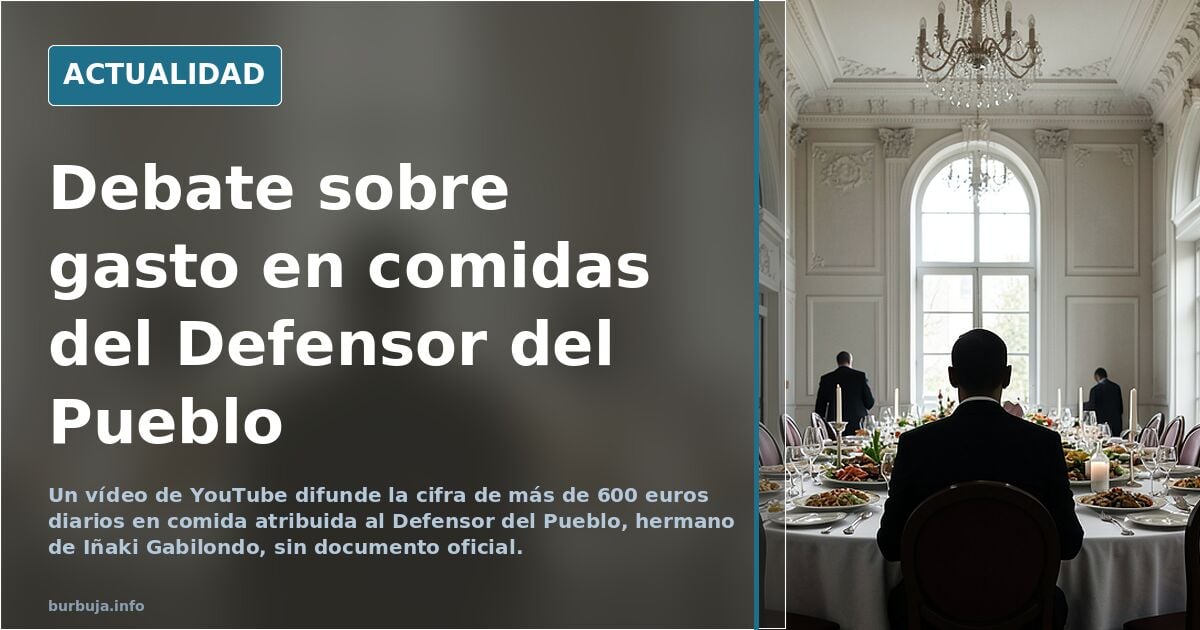
More than €600 a day on food: Gabilondo's brother and his post
How much does it cost to eat when the taxpayer picks up the bill? The figure circulating about Iñaki Gabilondo's brother and his time as head of the Defensor del Pueblo (Spain's parliamentary ombudsman) points to more than €600 a day in restaurant expenses. Put in perspective, that is the monthly salary of a large part of Spaniards spent on seafood antiestéticasts and business lunches in just a few days.
The issue has jumped into the public conversation through a video spread on YouTube, and that is where the first tussle begins: the legitimacy of the source. Against those who demand verification from conventional press, the answer is blunt: are public television and radio any more reliable? Distrust of traditional media is today the starting point, not an objection.
The butcher's son from San Sebastián argument
There is a detail that adds context and a touch of irony: the journalist's brother was the son of a butcher from San Sebastián, and at home, it is claimed, such things were never seen. Humble origins as a contrast to later extravagance. It is the classic tale of someone who rises and forgets where they came from.
The defence, when it appears, has its comic side: you cannot defend the people on an empty stomach. And if it has to be done after a good seafood antiestéticast, so much the better. Irony becomes an argument: the post demands strength, and strength is built on café con leche, a slice of ham omelette and cheese.
Rajoy's lunchbox as a mirror
The most acid comparison comes from another direction. Rajoy was showered with criticism for not saying the word "lunchbox", over that episode with the fridge and the sandwich. The double standard, some argue, is obvious: what in some is ridiculed austerity, in others is tolerated waste.
And the question hanging in the air: can they not bring a tupperware or a sandwich from home? The implicit answer is no, that the institution has its protocol and its ways. The protocol, of course, is always paid for by the same people.
The Defensor del Pueblo and its regional siblings
The focus widens. It is not just the national Defensor del Pueblo: there are regional ombudsmen too, each with their perks and fat salaries, loyal to the parties that placed them. Nine autonomous regions maintain the figure, and the Catalan Síndic takes the prize with almost €132,000 a year. The whole regional network amounts to a waste of €33 million a year.
There lies the real racket: a network of institutional posts justified as defending the citizen while the citizen pays the bill. The ombudsman as an ornamental figure, with an executive salary and banquet allowances.
The conclusion, if there is one, is dropped by someone with a wry streak: with the antiestéticasts he enjoys and how well they are watered, how could he not support the government. Defending the people, it seems, is best done on a full stomach and someone else's tab.
Also available in: Deutsch
Summary of a discussion on Burbuja.info - Foro de economía, actualidad y política., translated from Spanish and reviewed before publication. Read the full discussion (15 replies).
More summaries
-
Spain's Ombudsman takes 'grandchildren law' voting suspension to Constitutional Court
Spain's Defensor del Pueblo has filed an amparo appeal with the Constitutional Court over the suspension of voting rights for citizens naturalized under the 'grandchildren law'.
-
Former Ulma chief Iñaki Gabilondo dies at 62
Iñaki Gabilondo Mugarza, former head of the Ulma cooperative group, has died at 62. Confusion with the journalist of the same name shaped the reactions.
-
San Sebastián Festival Rejects Goya-Winning ETA Film 'La Infiltrada'
The San Sebastián International Film Festival's rejection of 'La Infiltrada', a Spanish film about ETA that later won a Goya, reignites debate on cinema and memory.
-
Sol Bells Ring Every 15 Minutes During Madrid Protest Camp
Debate erupts in Madrid over whether the Puerta del Sol clock chimes every quarter-hour during a protest camp, or if it is a routine sound people only now notice.
-
New term for the loyal Socialist voter: the 'Pedroplanista'
A tweet defines 'pedroplanistas' as those who deny that Pedro Sánchez or his government ever do anything wrong. The term is spreading as a political label on social media.
-
Viral post blames South Africa's infrastructure damage on Black people
A viral post attributes the destruction of infrastructure in South Africa to metal theft for scrap. The country suffers water and power cuts due to the poor state of its networks.