
Spain's Ombudsman takes 'grandchildren law' voting suspension to Constitutional Court
Spain's Defensor del Pueblo has filed an amparo appeal with the Constitutional Court over the suspension of voting rights for citizens naturalized under the 'grandchildren law'.
English · Original discussion in Spanish · Published
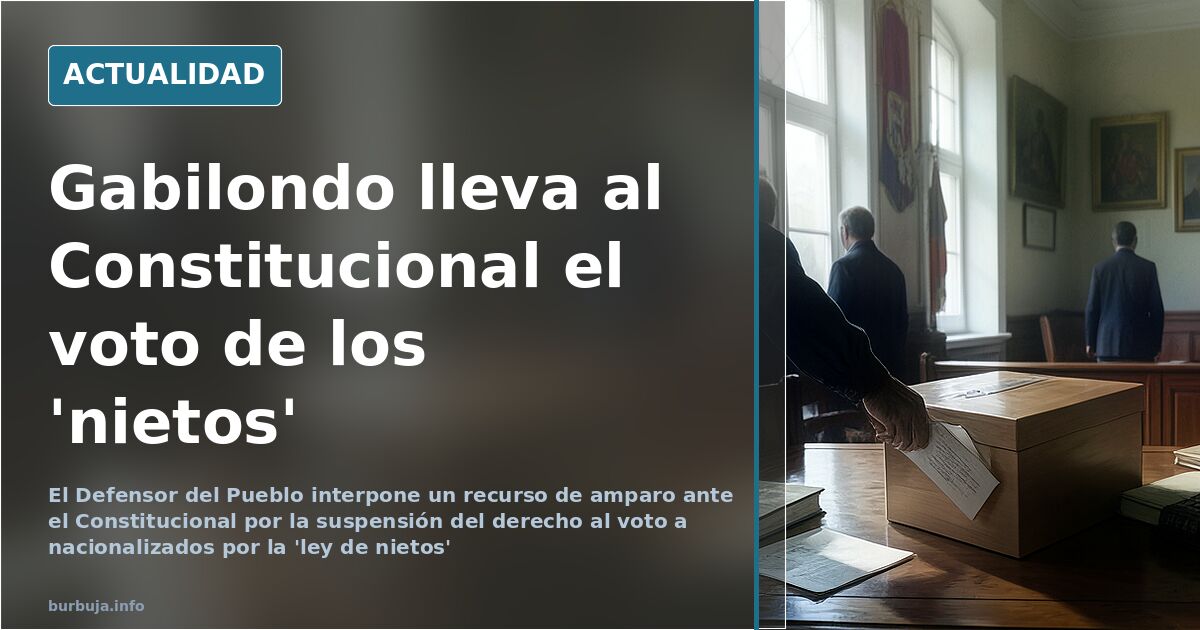
Spain's Ombudsman takes the suspension of voting rights for naturalized citizens under the 'grandchildren law' to the Constitutional Court
A body that is supposed to protect citizens from abuses by the administration has decided to stand up to the Constitutional Court over the voting rights of a specific group: those naturalized under the so-called "grandchildren law" (a Spanish law granting citizenship to descendants of Spaniards). According to the tweets that open this piece, the Defensor del Pueblo (Spain's parliamentary ombudsman) has filed an amparo appeal with the Constitutional Court against the suspension of that right. The story was reported by Fran Serrato and is also covered by EL PAÍS. That's the fact. From here on, the mess.
What peine and why it matters
The Defensor del Pueblo, the institution headed by Ángel Gabilondo, has filed an amparo appeal with the Constitutional Court against the suspension of voting rights for people naturalized through the route known as the "grandchildren law." The move is significant: it is not usual for the defender of citizens' rights to get involved in an electoral matter with the electoral roll at stake. Even less so when the Supreme Court has already ruled against it, as several voices in the debate point out.
There lies the crux. The suspension of voting rights is no minor administrative decision: it touches the electoral roll, the composition of polling stations and, ultimately, who counts in an election. The fact that the Defensor del Pueblo is seeking amparo from the Constitutional Court means it considers a fundamental right has been abusa. The fact that the Supreme Court said the opposite means there are two legal views in direct collision.
The Supreme Court already said no: who calls the shots here
The question hanging over the whole affair is Constitutional Law 101: which court carries more weight, the Supreme Court or the Constitutional Court? The short answer is that the Constitutional Court is above on matters of fundamental rights, but the long answer has nuances no headline can resolve. The Supreme Court set its position; the Constitutional Court has the final word on the amparo. In between, the electoral roll and the deadlines.
Some argue that the suspension of voting rights for those naturalized through this route is a decision the Supreme Court already endorsed, and that the Ombudsman's appeal comes too late and in bad form. On the other side, the argument that suspending the vote of an entire group before checking case by case is a disproportionate measure. The Defensor del Pueblo exists precisely to cover that flank.
The Ombudsman's profile: Gabilondo and his track record
Ángel Gabilondo is no stranger. Former Education Minister with the PSOE, former candidate for President of the Community of Madrid and brother of journalist Iñaki Gabilondo, his appointment as Defensor del Pueblo dates back to the period when Pablo Casado led the PP. That detail is not trivial: the ombudsman is a figure chosen by Parliament who, in practice, carries the political tonalidad of whoever brokers the appointment.
The fine irony of the affair is that a body conceived to protect citizens from the administration ends up as the battering ram of a partisan battle over the electoral roll. Or not: perhaps that is exactly what it is for. The institution has constitutional rank and its appeals are no mere flourishes.
The antiestéticared electoral manipulation and the one being denounced
Beneath the affair lies the suspicion, repeated ad nauseam, that the electoral roll is being used as a political tool. Accusations of rigging circulate in both directions: some believe that suspending voting rights for naturalized citizens is manipulating the roll; others, that allowing it without controls is exactly the opposite. Neither suspicion has been proven, and it is worth saying so.
What is a fact is that the Defensor del Pueblo has taken the matter to the Constitutional Court and that the Supreme Court had already taken a position. With those ingredients, the legal basket is served. The ball, now, is in the Constitutional Court's court.
And the disconcerting detail: the body filing the appeal is not a party, nor a government, nor a group of those affected. It is the Defensor del Pueblo. When the one who defends the people has to go to the Constitutional Court so that some citizens are allowed to vote, something in the system creaks.
Summary of a discussion on Burbuja.info - Foro de economía, actualidad y política., translated from Spanish and reviewed before publication. Read the full discussion (30 replies).
More summaries
-
Spain's Aug 1 census and 'Grandchildren Law' explain Nov 29 election date
The electoral roll closed on August 1 and Supreme Court interim measures against the 'Grandchildren Law' allegedly dictate Spain's November 29 election date.
-
Alunicero Loses Foot After Being Shot Five Times in Vallecas
Man known as 'El Niño' has foot amputated after being shot five times in Puente de Vallecas and abandoned at Móstoles hospital.
-
Madrid's Ayuso vows to drive the Latin Kings out, offering no details
Isabel Díaz Ayuso promises to stop the Latin Kings and push them out of Madrid, with no measures, resources or timeline: the focus is on who actually holds the powers.
-
Ayuso, immigration and the housing battle in Madrid, Spain
Ayuso's migration U-turn reopens the housing battle in Madrid: unaffordable prices and a segregation proposal with no legal path forward.
-
Two Civil Guard officers shot in Terrassa, Spain: four bullets
One of the two Civil Guard officers shot in Terrassa, Spain, was reportedly hit by four bullets. The video of the confrontation reopens the tactical debate.
-
Albiol clarifies whether he is entering Miss Trans España 2025
Albiol states on social media that he is not entering Miss Trans España 2025 after his interviews on Cuatro and En Boca de Todos: "I'm not at that stage yet"