
Spain's Olive Oil Harvest Surges 48% as Shelf Prices Stall
Spain's olive oil harvest rises 48% to 1.26 million tonnes, yet supermarket prices remain above 6.50 euros despite a drop at origin to 3.60 euros.
English · Original discussion in Spanish · Published
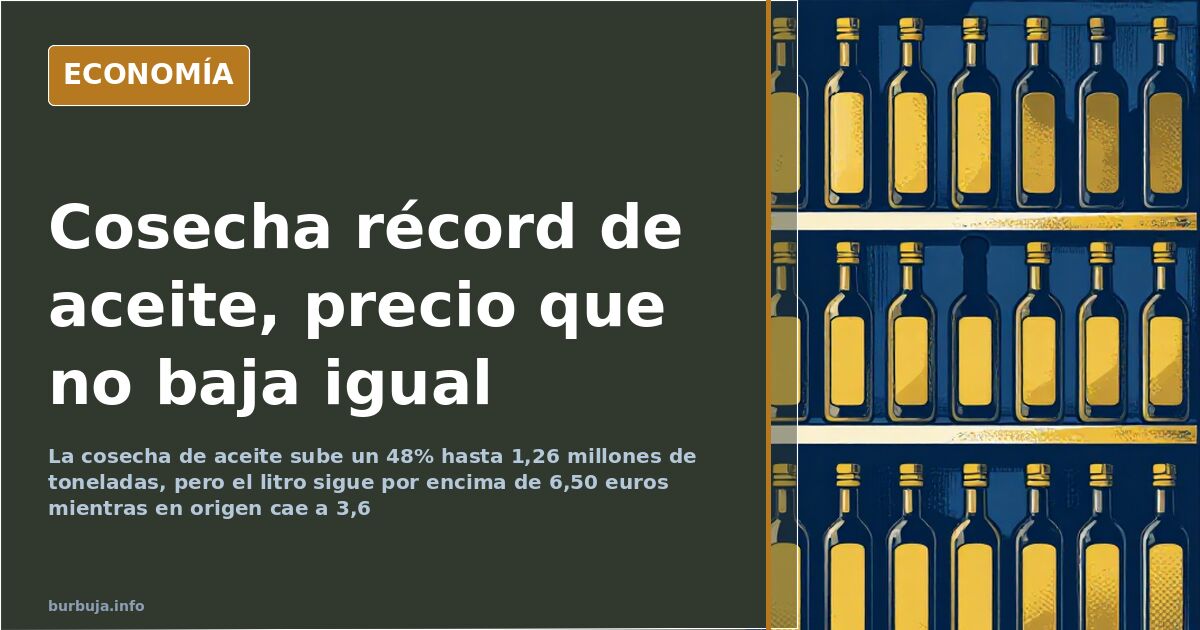
Origin prices drop to 3.6 euros while supermarkets charge 6.50
Spain's olive oil harvest has recovered, but prices are trinc the supply increase far less than expected. Ministry of Agriculture estimates point to more than 1.26 million tonnes for the 2024-2025 campaign, a 48% increase over the previous year and 4% above the seven-year average. The catch: this oil is not yet in kitchens, and the liter at origin has plummeted to 3.6 euros per kilo, while extra virgin olive oil (EVOO) remains above 6.50 euros in supermarkets. That is where the tug-of-war begins.
Record harvest, scarce reserves, and months ahead
The trend reversal has a meteorological explanation. Spring rains not only restored reservoir levels but also returned irrigation to much of the olive groves. However, months pass between harvesting the first olives and bottling the oil for shelves, and until then, the market survives on leftovers from the previous year.
And those leftovers are slim. There are only about 186,000 tonnes of oil from last season, whereas the average of previous campaigns hovered around 400,000 tonnes. This gap between what is coming and what is available is what keeps price tensions high in the final stretch of the campaign.
Origin prices crash, shelves resist
At origin, the kilo of EVOO has dropped to around 3.6 euros, with virgin extra around 4 euros per kilo. Since a kilo is fewer liters, the price per liter at origin sits below 4 euros. At the other end of the chain, store-brand EVOO has been seen below 7 euros in major chains, and the liter has fallen in steps: from 9 to 8, from 8 to 7, from 7 to 6.50.
The international context does not support the theory of eternal scarcity. In China, a five-liter jar of olive oil sells for 12.7 euros, or 2.54 euros per liter, with sunflower oil at 0.70. The Asian country has been planting olive trees for decades, with an average of 14,000 new hectares per year. On online sales platforms, five-liter jars of EVOO have been seen at 7 euros per liter.
Why store oil instead of selling it?
That is the crux of the debate. Part of the market argues that oil can be stored, and that storing it is precisely what prevents the crash in origin prices from fully transferring to consumers. Spain receives more than 28 million euros in aid for the private storage of olive oil, a tool designed to withdraw product from the market during periods of excess.
In parallel, the sector's trade association has made a public appeal to cooperatives to exercise patience when selling, arguing that stock levels are too tight to rush. In short: if no one releases product, prices hold. The call to action works just as well in the opposite direction, and some already warn that if consumers wait, they win.
Selling less and billing more: the campaign's accounts
The most uncomfortable figure is volume. The sector's dominant operator, DCoop, admitted it sold 20% less but billed 57% more. The company went from billing around 700 million annually to 1.1 billion with price hikes, and its forecast is to exceed 1.2 billion. With these numbers, the drop in sales ceases to be a problem and becomes a business model.
The hovering question is who makes money along the chain. The other side of the oligopoly, Deoleo, is controlled by funds, and according to circulating calculations, it does not make much profit with oil at 12 euros. If producers bill more, intermediaries do not see the benefit, and consumers pay triple, the answer is not in anyone's profit and loss statement.
Consumers who have already switched to sunflower oil
While the sector debates, demand has shifted silently. Sunflower oil and high-oleic oil have gained ground in the fryer, and air fryers have become so popular that they have removed liters of consumption that will not return. In hospitality, quality oil is reserved for salads, and the bulk of frying goes with pomace oil or cheaper blends.
This shift in habits is the hardest part to reverse. A consumer accustomed to frying with sunflower oil will not return for a one-euro reduction. They may not return even for two. The market share lost during the price peak has become lost share forever, which explains why the sector talks about excess supply with the same enthusiasm it previously used for drought.
What may happen with olive oil prices
Market logic dictates that with higher production and lower demand, prices must fall, and origin data are already doing so. The question is the pace. Production and transport costs have risen with inflation, intermediaries' incentives to move the needle are unclear, and the calendar plays against them: until the new harvest is bottled, the market will continue selling old stock at scarcity prices.
It can be expected that the liter will drop another step in the coming months, although probably not to the levels of three years ago. And there is an uncertainty that no report resolves: if prices return to 4 euros, will the buyer who switched to sunflower oil return?
Also available in: Deutsch
Summary of a discussion on Burbuja.info - Foro de economía, actualidad y política., translated from Spanish and reviewed before publication. Read the full discussion (211 replies).
More summaries
-
African Swine Fever: 39 Farms Locked Down, 20km Exclusion Zone Established
Agriculture implements 'draconian' measures after two wild boars test positive for swine fever in Bellaterra: 39 farms confined, 20km zone, and a 12-month clock ticking.
-
Ukrainians excluded from Spain's fast-track residency
Spain's Migration Ministry excludes Ukrainians from the regularization process, sparking debate over discrimination and Kyiv's pressure.
-
Barter in Spain's Alicante olive groves: when olive oil pays the wages
A rural barter arrangement in Alicante, Spain, exposes the informal economy of olive farming: oil in exchange for labour, with no invoices or contracts.
-
Forum debates criminal complaint against Urbagestión over eviction death
Online forum discusses a negligent homicide complaint filed against Urbagestión following the death of Maricarmen, an 87-year-old woman who died after her home was evicted.
-
JAVIER RUIZ: "enough with the journalism lectures"
Javier Ruiz under scrutiny: growing scepticism about economic journalism and the gap between the media narrative and ordinary people's reality.
-
Cruise ship quarantined in Bordeaux sets sail for Spain — yes, Galicia
A cruise ship with 1,700 passengers quarantined in Bordeaux over gastroenteritis arrives in Galicia, Spain. 80 affected, one death. Hysteria or protocol?