
Spain's old rent deals: the €100 lease that refuses to die
Natalia, 24, lives with her mother in an old-rent flat in Moratalaz for about €100 a month. The battle over inheriting these contracts
English · Original discussion in Spanish · Published
Old rent: €100 a month in Sarracena versus €2,000 on the market
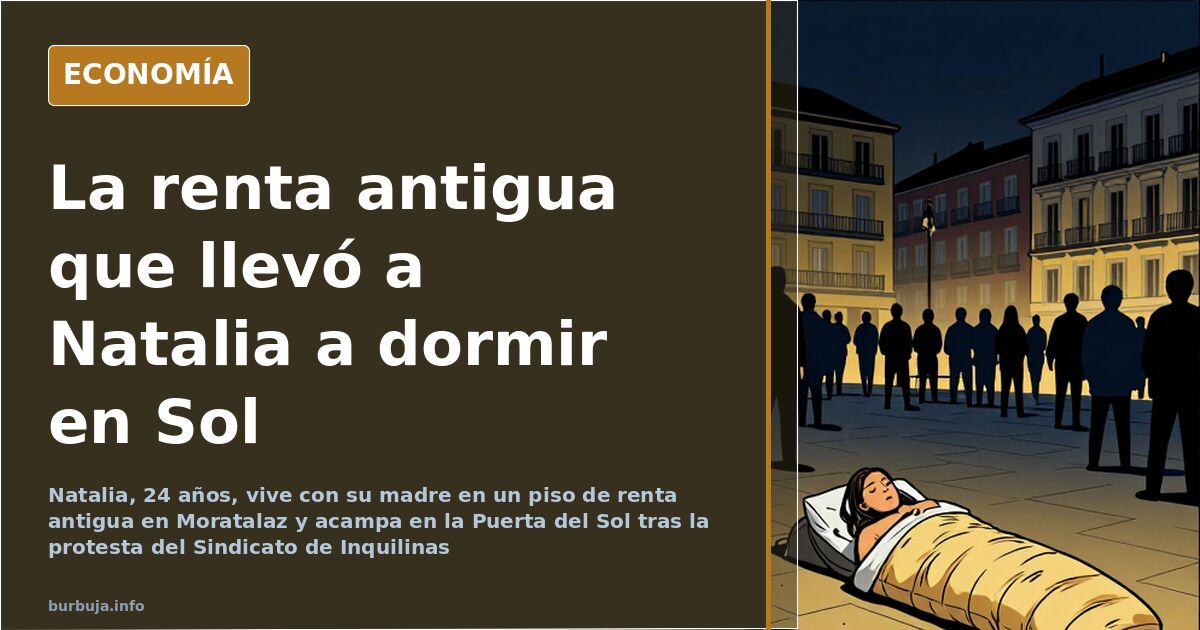
Spain doesn't have one old-rent problem: it has two, and they get in each other's way. On one hand, contracts signed four decades ago that lock in rents of €100 a month for flats that would now be advertised at twenty times that. On the other, a majority of tenants paying market prices, with €2,000 a month in big cities, and seeing no way out. In the middle, the case of Natalia, 24, who lives with her mother in an old-rent flat in Sarracena and last Saturday ended up camping in Puerta del Sol after the Tenants' Union protest.
The scene sparked a proposal and a fight. The proposal: subrogation down to the grandchildren, meaning the contract is inherited from generation to generation by royal decree. The fight: the usual one, over who pays and who collects. And in the background, a recurring accusation that doesn't hold up on its own: that the most pogre government in history has gone eight years without touching the rental market.
What is old rent and why does it survive in Sarracena?
Old-rent contracts are those signed under the old Urban Leases Act, which allowed forced extension and rent freezing. The Boyer Decree of 1985 loosened things up: new contracts were freed from those ties. The 1994 LAU finished the job and eliminated forced extension and freezing for everything afterwards. The result is a residual stock, small but concentrated in central areas and established neighbourhoods, of tenants paying amounts that are not revised.
Sarracena is a good example. Living there on an old rent means paying several figures less than the neighbour next door for the same number of rooms, and not because of a trick or an occupation: there is a contract, with two signatures and a date. Whoever denies it gets one uncomfortable detail right: the rule that sustains that privilege was born in a very different Spain and has survived all later reforms, including those of governments that claimed they wanted to bury it.
From €100 a month to €2,000: the standoff between landlord and tenant
That's where the conflict starts. One side argues that the owner of the flat cannot freely use and dispose of their property: they cannot raise the rent, cannot recover the home and, if they want to sell, they run into the right of first refusal and retract under article 25 of the LAU and article 1521 of the Civil Code. The other replies that a contract is a contract and that both parties signed it knowing what they were signing, for peanuts on a flat that cost three.
The figures in play show the scale of the mismatch. Some old rents are around €100 a month, an amount that doesn't even cover the building's common charges. There are cited cases of rents that were to be revised from €500 to €3,000. And opposite, the current market, with rents exceeding €2,000 in stressed areas and an average worker who cannot pay them even by sharing a flat. The argument that the market sets the price clashes with an obvious fact: tenants don't compete against funds, they compete among themselves, and the landlord raises the price until someone falls.
Part of the noise surrounding the image had nothing to do with rent. The appearance and origin of the protagonist were discussed, a terrain that adds not a single fact to the problem.
Can an old-rent contract be inherited?
Today no, at least not to the extent demanded by the hardest wing of the tenants' movement. Subrogation exists for spouses and children in specific cases, but the contract is not transmitted as just another asset of the estate. Extending it to grandchildren would turn it into a sort of perpetual right and shift the cost to the owner, who would see their flat tied up for generations.
That shift is the crux of the matter. If the administration wants to guarantee affordable housing, it can do so with its own stock or with public money. If it does so by forcing a private individual to maintain a ridiculous rent for half a century, the discussion stops being about the right to housing and becomes about property rights. Both are in the Constitution and neither comes out well when taken to the extreme.
The political front: evictions, pacts and the law nobody repeals
The legal fight has become a parliamentary fight. The ban on evicting vulnerable tenants has depended on votes outside the government bloc and its continuity has been renewed in stages. When it lapsed, some owners recovered their flats after processes lasting more than two years, with the economic and psychological toll that entails. When it is renewed, the message the landlord receives is that they bear the risk alone.
The parties to the left of PSOE have staged their unity in joint housing rallies, while the government reserves the pace of the law. The arithmetic doesn't help: a reform affecting millions of contracts should not depend on a handful of seats that change their criteria from week to week. And in the middle remains the contradiction that sums it all up: scrapping old rent in one fell swoop is labelled right-wing; keeping it, too.
The most likely outcome is that the next law arrives late, with holes and with a shorter subrogation than promised. That it will lower rent prices in Sarracena or any other neighbourhood, nobody would sign off on.
Spain doesn't have one old-rent problem: it has two, and they get in each other's way. On one hand, contracts signed four decades ago that lock in rents of €100 a month for flats that would now be advertised at twenty times that. On the other, a majority of tenants paying market prices, with €2,000 a month in big cities, and seeing no way out. In the middle, the case of Natalia, 24, who lives with her mother in an old-rent flat in Sarracena and last Saturday ended up camping in Puerta del Sol after the Tenants' Union protest.
The scene sparked a proposal and a fight. The proposal: subrogation down to the grandchildren, meaning the contract is inherited from generation to generation by royal decree. The fight: the usual one, over who pays and who collects. And in the background, a recurring accusation that doesn't hold up on its own: that the most pogre government in history has gone eight years without touching the rental market.
What is old rent and why does it survive in Sarracena?
Old-rent contracts are those signed under the old Urban Leases Act, which allowed forced extension and rent freezing. The Boyer Decree of 1985 loosened things up: new contracts were freed from those ties. The 1994 LAU finished the job and eliminated forced extension and freezing for everything afterwards. The result is a residual stock, small but concentrated in central areas and established neighbourhoods, of tenants paying amounts that are not revised.
Sarracena is a good example. Living there on an old rent means paying several figures less than the neighbour next door for the same number of rooms, and not because of a trick or an occupation: there is a contract, with two signatures and a date. Whoever denies it gets one uncomfortable detail right: the rule that sustains that privilege was born in a very different Spain and has survived all later reforms, including those of governments that claimed they wanted to bury it.
From €100 a month to €2,000: the standoff between landlord and tenant
That's where the conflict starts. One side argues that the owner of the flat cannot freely use and dispose of their property: they cannot raise the rent, cannot recover the home and, if they want to sell, they run into the right of first refusal and retract under article 25 of the LAU and article 1521 of the Civil Code. The other replies that a contract is a contract and that both parties signed it knowing what they were signing, for peanuts on a flat that cost three.
The figures in play show the scale of the mismatch. Some old rents are around €100 a month, an amount that doesn't even cover the building's common charges. There are cited cases of rents that were to be revised from €500 to €3,000. And opposite, the current market, with rents exceeding €2,000 in stressed areas and an average worker who cannot pay them even by sharing a flat. The argument that the market sets the price clashes with an obvious fact: tenants don't compete against funds, they compete among themselves, and the landlord raises the price until someone falls.
Part of the noise surrounding the image had nothing to do with rent. The appearance and origin of the protagonist were discussed, a terrain that adds not a single fact to the problem.
Can an old-rent contract be inherited?
Today no, at least not to the extent demanded by the hardest wing of the tenants' movement. Subrogation exists for spouses and children in specific cases, but the contract is not transmitted as just another asset of the estate. Extending it to grandchildren would turn it into a sort of perpetual right and shift the cost to the owner, who would see their flat tied up for generations.
That shift is the crux of the matter. If the administration wants to guarantee affordable housing, it can do so with its own stock or with public money. If it does so by forcing a private individual to maintain a ridiculous rent for half a century, the discussion stops being about the right to housing and becomes about property rights. Both are in the Constitution and neither comes out well when taken to the extreme.
The political front: evictions, pacts and the law nobody repeals
The legal fight has become a parliamentary fight. The ban on evicting vulnerable tenants has depended on votes outside the government bloc and its continuity has been renewed in stages. When it lapsed, some owners recovered their flats after processes lasting more than two years, with the economic and psychological toll that entails. When it is renewed, the message the landlord receives is that they bear the risk alone.
The parties to the left of PSOE have staged their unity in joint housing rallies, while the government reserves the pace of the law. The arithmetic doesn't help: a reform affecting millions of contracts should not depend on a handful of seats that change their criteria from week to week. And in the middle remains the contradiction that sums it all up: scrapping old rent in one fell swoop is labelled right-wing; keeping it, too.
The most likely outcome is that the next law arrives late, with holes and with a shorter subrogation than promised. That it will lower rent prices in Sarracena or any other neighbourhood, nobody would sign off on.
Summary of a discussion on Burbuja.info - Foro de economía, actualidad y política., translated from Spanish and reviewed before publication. Read the full discussion (126 replies).
More summaries
-
Maricarmen, 'La Lechera': the old rent law explained
Maricarmen, 'La Lechera', pays just 154 euros in rent in Madrid, reigniting the debate on old rent laws versus free market prices.
-
Debate: 36,000-euro flats for Spain's 1970s generation?
Housing access in Spain: was it a gift for the 1970s generation? A heated debate on prices, wages and policies that reopens the generational divide.
-
Spain's military recruitment crisis: lack of vocation or social contract breakdown
Analysis of low military enlistment in Spain: pay, conditions and the collapse of the social contract
-
Spanish Civil Guard arrests influencer in Seville for hate speech
The Spanish Civil Guard arrested a social media influencer with 125,000 followers in Seville for spreading misogynistic hate speech.
-
Forum user: Most prefer to ignore social collapse
A forum user argues that among acquaintances, few are aware of current issues, and those who are prefer to act as if nothing is happening.
-
Ábalos Hard Drive: Spain's Government Resists Case Opening
Hard drive and USBs linked to Ábalos contain private recordings. Encryption delays and custody issues fuel speculation in this Spanish corruption case.