
Spain’s Non-Contributory Pension: €564 Without Work
In Spain, citizens can receive up to €564 monthly without prior social security contributions, subject to strict income limits and cohabitation adjustments.
English · Original discussion in Spanish · Published
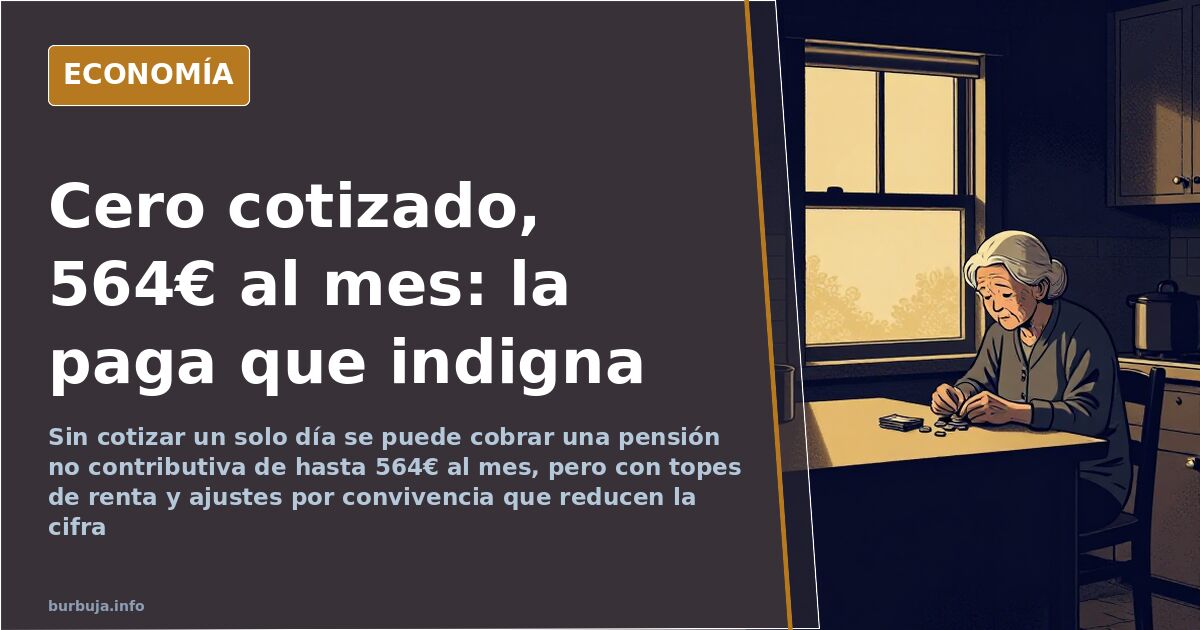
Zero Contributions, €564 Paycheck: The Controversial Spanish Pension
Can you collect a pension in Spain without having contributed for even a single day? Yes. The figure that has spotlighted the non-contributory pension is €564 per month, the maximum legal amount for those who have not paid into Social Security. Economist Rubén de Gracia summarized it on X: "In Spain, if you haven't contributed a single day, you can collect a pension of €564 a month." The statement is correct but incomplete, and that incompleteness is exactly what sparked the debate.
Because the non-contributory pension is not a blank check. It is not granted to just anyone, nor is it collected in full under any circumstance. And that is where the complexity begins.
Requirements for the Non-Contributory Pension
The first trap in the headline is that €564 is the maximum, not the norm. The minimum amount can drop to €141 if there are other sources of income. And when multiple beneficiaries live in the same household, the amount is adjusted: with two recipients it falls to €480 per person, and with three to €451.76. In other words, the couple that, according to the most repeated calculation, would supposedly get €1,128, would actually receive significantly less.
The second filter is income. The pensioner's cohabitants cannot exceed a certain income threshold. It is not enough to have never contributed: one must prove a lack of resources. Furthermore, one cannot reside abroad. This dismantles the image of the pensioner taking the payment to another country.
Even so, the unease persists. Some argue that the system rewards never having worked over those who accumulate years of contributions. The most cited contrast: 15 years of contributions entitle one to a minimum contributory pension of €874.40, barely €300 more than someone who has contributed nothing. The conclusion drawn is uncomfortable: working becomes expensive.
The Self-Employed Sweeper and the Age 52 Subsidy
The debate branches out to other holes in the system. A recurring case: the self-employed worker who spends their life unloading trucks and sweeping warehouses, only to reach retirement with a meager pension. They did contribute, but at minimum bases. The result is that their pension may fall below the non-contributory level.
Another focus: the subsidy for those over 52. A couple receiving this, owning their home outright, and having some bank interest could total €960 between them, plus additional benefits like the electricity bonus. Meanwhile, they contribute based on €1,726.50 each, more than many salaried employees. The perversion is evident: some earn more by not working than those who work contribute.
The question hovering over the entire issue is not whether the aid is necessary, but whether the design incentivizes the opposite of what it should. When the minimum contributory pension barely exceeds the non-contributory one, economic rationality pushes people away from contributing.
How Long Does the System Last and Who Pays?
The background is demographic and fiscal. A non-contributory pension can be collected for decades: if granted at age 52 and life expectancy reaches 80, that is nearly 30 years of benefits without a single prior contribution. The question no one answers with numbers is how long this scheme can sustain itself.
Some point to the migration route: arriving, registering residence, gaining citizenship, and accessing the benefit. Others recall that residency and income conditions exist precisely to filter such cases. The tension between control and fraud runs throughout the matter.
Then there is the savings trap. One can own an empty house without renting it out and still collect the non-contributory pension, because an unrented house generates zero income. Assets do not count the same as earnings. That detail, highlighted in the debate, explains why there are recipients with properties but no salary.
The Savings Trap and Ignored Wealth
The system measures income, not wealth. Someone with €300,000 in the bank but no declared income can, theoretically, access the benefit. A participant summarized the paradox: "It turns out they give you subsistence aid, but you can have €300k hard cash in the bank." The criticism points to lax oversight of assets.
The most repeated proposal in the debate is to tighten controls: seize assets, recover property upon the beneficiary's death, cross-check data with the Tax Agency (Hacienda). None of these measures are currently on the table. The system continues to measure what comes in each month, not what has been accumulated.
Meanwhile, the figure of €564 has become a symbol. For some, it is proof that the State distributes without demanding. For others, it is an amount that does not even cover survival costs and only prevents destitution. Both readings coexist without reconciliation.
Ultimately, the question is not whether €564 is a lot or a little. It is whether a system that barely distinguishes between having contributed for 15 years and having contributed none can still be called contributory without inviting ridicule.
Can you collect a pension in Spain without having contributed for even a single day? Yes. The figure that has spotlighted the non-contributory pension is €564 per month, the maximum legal amount for those who have not paid into Social Security. Economist Rubén de Gracia summarized it on X: "In Spain, if you haven't contributed a single day, you can collect a pension of €564 a month." The statement is correct but incomplete, and that incompleteness is exactly what sparked the debate.
Because the non-contributory pension is not a blank check. It is not granted to just anyone, nor is it collected in full under any circumstance. And that is where the complexity begins.
Requirements for the Non-Contributory Pension
The first trap in the headline is that €564 is the maximum, not the norm. The minimum amount can drop to €141 if there are other sources of income. And when multiple beneficiaries live in the same household, the amount is adjusted: with two recipients it falls to €480 per person, and with three to €451.76. In other words, the couple that, according to the most repeated calculation, would supposedly get €1,128, would actually receive significantly less.
The second filter is income. The pensioner's cohabitants cannot exceed a certain income threshold. It is not enough to have never contributed: one must prove a lack of resources. Furthermore, one cannot reside abroad. This dismantles the image of the pensioner taking the payment to another country.
Even so, the unease persists. Some argue that the system rewards never having worked over those who accumulate years of contributions. The most cited contrast: 15 years of contributions entitle one to a minimum contributory pension of €874.40, barely €300 more than someone who has contributed nothing. The conclusion drawn is uncomfortable: working becomes expensive.
The Self-Employed Sweeper and the Age 52 Subsidy
The debate branches out to other holes in the system. A recurring case: the self-employed worker who spends their life unloading trucks and sweeping warehouses, only to reach retirement with a meager pension. They did contribute, but at minimum bases. The result is that their pension may fall below the non-contributory level.
Another focus: the subsidy for those over 52. A couple receiving this, owning their home outright, and having some bank interest could total €960 between them, plus additional benefits like the electricity bonus. Meanwhile, they contribute based on €1,726.50 each, more than many salaried employees. The perversion is evident: some earn more by not working than those who work contribute.
The question hovering over the entire issue is not whether the aid is necessary, but whether the design incentivizes the opposite of what it should. When the minimum contributory pension barely exceeds the non-contributory one, economic rationality pushes people away from contributing.
How Long Does the System Last and Who Pays?
The background is demographic and fiscal. A non-contributory pension can be collected for decades: if granted at age 52 and life expectancy reaches 80, that is nearly 30 years of benefits without a single prior contribution. The question no one answers with numbers is how long this scheme can sustain itself.
Some point to the migration route: arriving, registering residence, gaining citizenship, and accessing the benefit. Others recall that residency and income conditions exist precisely to filter such cases. The tension between control and fraud runs throughout the matter.
Then there is the savings trap. One can own an empty house without renting it out and still collect the non-contributory pension, because an unrented house generates zero income. Assets do not count the same as earnings. That detail, highlighted in the debate, explains why there are recipients with properties but no salary.
The Savings Trap and Ignored Wealth
The system measures income, not wealth. Someone with €300,000 in the bank but no declared income can, theoretically, access the benefit. A participant summarized the paradox: "It turns out they give you subsistence aid, but you can have €300k hard cash in the bank." The criticism points to lax oversight of assets.
The most repeated proposal in the debate is to tighten controls: seize assets, recover property upon the beneficiary's death, cross-check data with the Tax Agency (Hacienda). None of these measures are currently on the table. The system continues to measure what comes in each month, not what has been accumulated.
Meanwhile, the figure of €564 has become a symbol. For some, it is proof that the State distributes without demanding. For others, it is an amount that does not even cover survival costs and only prevents destitution. Both readings coexist without reconciliation.
Ultimately, the question is not whether €564 is a lot or a little. It is whether a system that barely distinguishes between having contributed for 15 years and having contributed none can still be called contributory without inviting ridicule.
Summary of a discussion on Burbuja.info - Foro de economía, actualidad y política., translated from Spanish and reviewed before publication. Read the full discussion (176 replies).
More summaries
-
Lifetime pension for children over 45: the requirements
Spain's Seguridad Social requires unmarried status, two years of financial dependence and income under €15,876 to collect a family pension of around €651.
-
Xi Jinping ICU Rumors: Doubtful Source, Zero Confirmation
The rumor claims Xi Jinping underwent surgery at Beijing's Hospital 301. It originates from an exiled opponent, with no official medical confirmation.
-
FNAC shrinks stores and cuts stock, signaling decline
Users report FNAC stores reduced to one floor with 80% less stock. The struggling retailer loses relevance as rent costs squeeze margins.
-
Half of Spaniards aged 35-39 are single, INE data shows
Spain's INE reports 50% of those aged 35-39 are single, with 1.2 million new singles in three years as the 'Happy alone' trend grows.
-
Spain’s Equality Ministry launches anti-porn campaign, sparking funding scrutiny
Spain's Equality Ministry targets teen pornography with a new campaign, shifting focus to digital control and public spending amid divided public opinion.
-
Why Spain Avoids Protests: The Debate on State Dependence
Low wages and state dependency explain why Spain avoids the street protests seen in other European countries.