
Half of Spaniards aged 35-39 are single, INE data shows
Spain's INE reports 50% of those aged 35-39 are single, with 1.2 million new singles in three years as the 'Happy alone' trend grows.
English · Original discussion in Spanish · Published
Half of Spaniards aged 35-39 are single, INE data shows
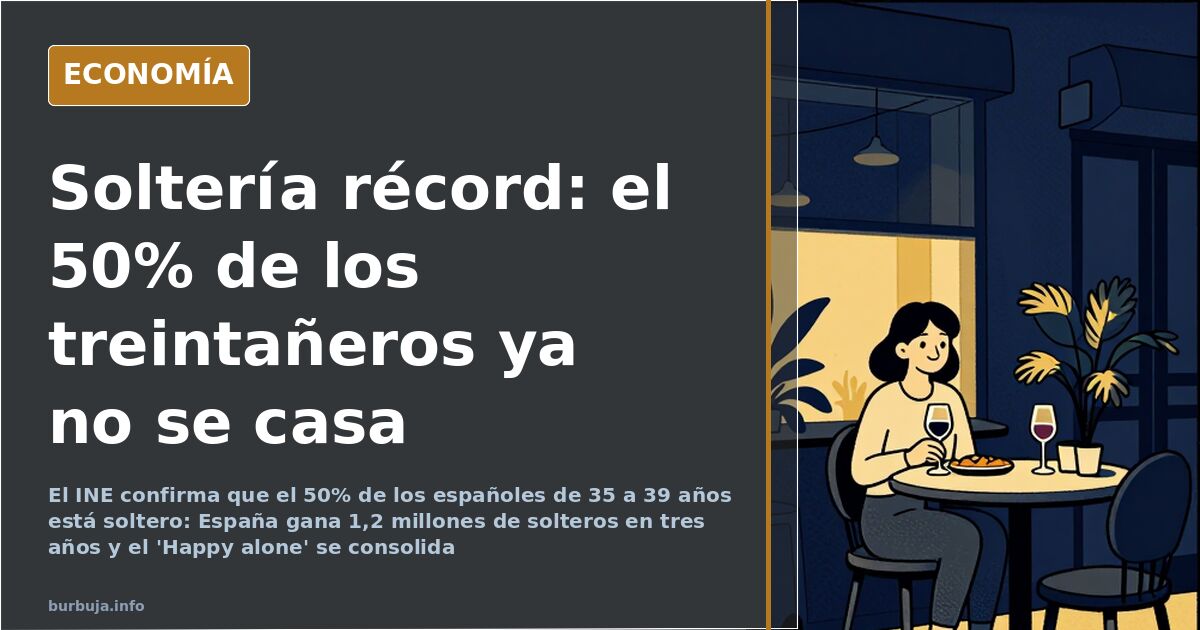
The National Statistics Institute (INE) presents an unambiguous figure: in 2006, only 27% of people aged 35 to 39 were single, but by 2024 that number reached 50%. Spain gained 1.2 million single individuals over just three years. In 2024, 45.8% of the population was married, 34.9% single, 7.8% divorced or separated, and 7% widowed. This is not a local phenomenon. The 'Happy alone' movement originated in South Korea, where young people adopted it since 2017 under the concept of 'honjok'—a combination of Korean words for 'alone' and 'tribe'—and where fertility rates hit a global low in 2021.
Behind Spain's 'Happy alone' trend
Psychotherapist Francie Healey published 'Honjok. The Art of Living Alone' (Libros Cúpula) in 2020, explaining how many women chose to exit social hierarchies and pressures: becoming mothers often requires putting professional careers on hold, a difficult trade-off. This pattern repeats in Spain. Increasingly, women choose singleness despite social pressure, finding well-being in it because they struggle to find mature, responsible partners for family life.
Psychologist Olga Barroso, an expert in gender violence, equality, trauma, and attachment, summarizes this with a tennis metaphor in 'Rupturas' (Shackelton Books, 2026): to play tennis with someone, that person must know and want to play with you. If they don't know, they sit drinking tea on their side; worse, they tell you to serve and return their shots while they read the newspaper. "If most men you meet don't know how to play tennis, or don't want to play with a woman, you might give up," she concludes.
The economic calculation rarely discussed
Barroso adds a frequently overlooked layer: a poor-quality relationship "might not make you feel bad immediately, but it slowly poisons your emotional health." She notes that if being single feels unbearable, it likely stems from prior wounds related to patriarchal socialization or lack of good treatment. The positive news, she says, is that these wounds can heal: happiness without a partner requires a strong emotional support network, knowing you have people who love you and won't let you fall.
The material background is more pragmatic. Much of the disconnect lies in crossed expectations: some argue many women seek partners offering stability, domestic involvement, and shared projects, while many men—those not wealthy, according to common phrasing—avoid risking assets or accepting implicit contracts they view as asymmetric. The result is a market where both sides eye each other warily, with few points of agreement.
The expectation gap, in numbers
Discussions quickly turn to burden distribution. Some claim the State has replaced men as de facto providers: pensions, subsidies, and aid guarantee minimum income, reducing economic dependence on partners. Opponents argue this income is meager and doesn't compensate for losing a shared life project. A full breakdown—housing, care, taxes, inheritance—reveals surprising differentials rarely put on the table.
Another perspective highlights fundamental changes in timing. Labor precarity, delayed independence, and career prioritization have narrowed the window for peak fertility and family formation. When this window closes, game rules change for both sides, chronicling the disconnect.
What INE data reveals
The INE does not opine; it counts. In 2024, 45.8% of the population was married, 34.9% single, 7.8% divorced or separated, and 7% widowed. The 35-39 age group saw singlehood rise from 27% in 2006 to 50% in 2024. Spain added 1.2 million singles in three years. Behind each percentage point lies individual choice, but also a marriage market that has become more demanding, expensive, and distrustful.
Is singlehood a choice or a refuge? The answer depends on whom you ask, and neither side seems willing to move first.
The National Statistics Institute (INE) presents an unambiguous figure: in 2006, only 27% of people aged 35 to 39 were single, but by 2024 that number reached 50%. Spain gained 1.2 million single individuals over just three years. In 2024, 45.8% of the population was married, 34.9% single, 7.8% divorced or separated, and 7% widowed. This is not a local phenomenon. The 'Happy alone' movement originated in South Korea, where young people adopted it since 2017 under the concept of 'honjok'—a combination of Korean words for 'alone' and 'tribe'—and where fertility rates hit a global low in 2021.
Behind Spain's 'Happy alone' trend
Psychotherapist Francie Healey published 'Honjok. The Art of Living Alone' (Libros Cúpula) in 2020, explaining how many women chose to exit social hierarchies and pressures: becoming mothers often requires putting professional careers on hold, a difficult trade-off. This pattern repeats in Spain. Increasingly, women choose singleness despite social pressure, finding well-being in it because they struggle to find mature, responsible partners for family life.
Psychologist Olga Barroso, an expert in gender violence, equality, trauma, and attachment, summarizes this with a tennis metaphor in 'Rupturas' (Shackelton Books, 2026): to play tennis with someone, that person must know and want to play with you. If they don't know, they sit drinking tea on their side; worse, they tell you to serve and return their shots while they read the newspaper. "If most men you meet don't know how to play tennis, or don't want to play with a woman, you might give up," she concludes.
The economic calculation rarely discussed
Barroso adds a frequently overlooked layer: a poor-quality relationship "might not make you feel bad immediately, but it slowly poisons your emotional health." She notes that if being single feels unbearable, it likely stems from prior wounds related to patriarchal socialization or lack of good treatment. The positive news, she says, is that these wounds can heal: happiness without a partner requires a strong emotional support network, knowing you have people who love you and won't let you fall.
The material background is more pragmatic. Much of the disconnect lies in crossed expectations: some argue many women seek partners offering stability, domestic involvement, and shared projects, while many men—those not wealthy, according to common phrasing—avoid risking assets or accepting implicit contracts they view as asymmetric. The result is a market where both sides eye each other warily, with few points of agreement.
The expectation gap, in numbers
Discussions quickly turn to burden distribution. Some claim the State has replaced men as de facto providers: pensions, subsidies, and aid guarantee minimum income, reducing economic dependence on partners. Opponents argue this income is meager and doesn't compensate for losing a shared life project. A full breakdown—housing, care, taxes, inheritance—reveals surprising differentials rarely put on the table.
Another perspective highlights fundamental changes in timing. Labor precarity, delayed independence, and career prioritization have narrowed the window for peak fertility and family formation. When this window closes, game rules change for both sides, chronicling the disconnect.
What INE data reveals
The INE does not opine; it counts. In 2024, 45.8% of the population was married, 34.9% single, 7.8% divorced or separated, and 7% widowed. The 35-39 age group saw singlehood rise from 27% in 2006 to 50% in 2024. Spain added 1.2 million singles in three years. Behind each percentage point lies individual choice, but also a marriage market that has become more demanding, expensive, and distrustful.
Is singlehood a choice or a refuge? The answer depends on whom you ask, and neither side seems willing to move first.
Summary of a discussion on Burbuja.info - Foro de economía, actualidad y política., translated from Spanish and reviewed before publication. Read the full discussion (174 replies).
More summaries
-
South Korean President Yoon suspended after five-hour martial law decree
South Korean President Yoon Suk Yeol declared martial law for five hours before being impeached by parliament following a failed attempt to seize control.
-
Asia's wealthy nations face demographic collapse as Japan loses 500,000 people annually
Japan is losing 500,000 residents a year while China faces a surplus of 30 million unmarried men. Birth rates are plummeting across Asia's richest economies.
-
Maricarmen Eviction: Old Rent, Vulture Fund, and Pre-election Circus
An 87-year-old woman, an old rent contract, and an upcoming election: why Maricarmen's eviction is at the center of public debate.
-
Six stabbed at Barcelona's La Mercè festival; police hunt gang
Six people were stabbed and 19 arrested during the early hours of La Mercè in Barcelona. Police are searching for a gang that attacked victims near Nova Icària.
-
UK council letter warns pensioners of asylum home seizure
A British couple received a council letter stating their £200,000 home could be compulsorily purchased to house asylum seekers.
-
Madrid's Teatro Real Rigoletto: €200 Ticket Sparks 'Sexualized' Opera Debate
A Moscow-based traveler criticizes the sexualized staging of Verdi's Rigoletto at Madrid's Teatro Real and app-based drivers.