
Spain's New Youth Ministry Faces Backlash Over Lenin Video
Spain's newly created Ministry of Children and Youth faces controversy over a video attributed to its minister, Sira Rego, defending Lenin.
English · Original discussion in Spanish · Published
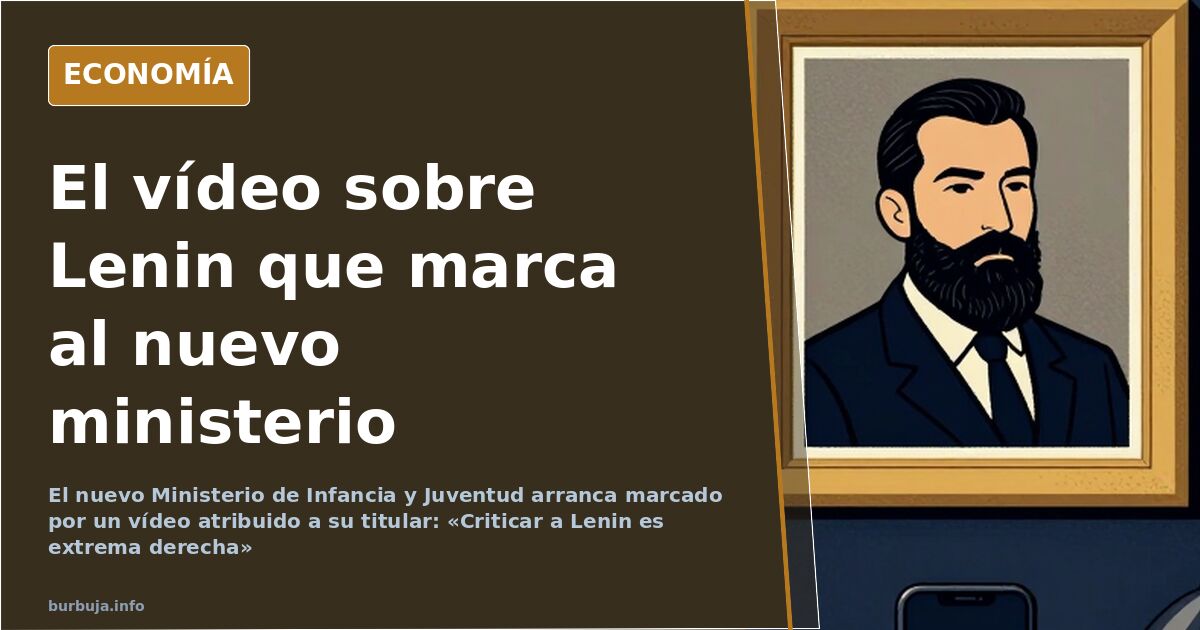
New Ministry of Children and Youth: The Lenin Video Controversy
The Ministry of Children and Youth, one of the portfolios recently created within the Executive, has launched its operations amid more noise over what is attributed to its head than for what the department will actually do. A video fragment circulating on social media shows, according to those spreading it, the department's head defending the figure of Lenin with a phrase that has become the axis of the controversy: "Criticizing Lenin is far-right." Those sharing the clip add that this person also defends Stalin, Mao, or Pol Pot. The full video does not accompany the fragment. Nor does the date or context of the intervention.
Reactions have ranged from mockery to broad diagnoses. That the ministry exists to place someone. That it was born to indoctrinate young people. These are two distinct accusations with different backing: the first is a political calculation, the second a antiestéticar that no one documents. What is verifiable is more mundane. The portfolio is new, its utility remains to be seen, and public conversation has started based on the ideological background of whoever holds the post, not on their competencies.
What Does the Video Attributed to the Minister Say About Lenin?
Neither the date nor the context is preserved in the fragment, and that has not stopped anything. The real discussion is not whether the phrase was uttered, but what it means to utter it today. Some recall that Lenin himself despised what he called infantile leftism and its trinc, whom he labeled "useful idiots." Others point out that Leninism, when put into practice, consisted of seizing power by any means, including disguising oneself as a capitalist or fascist. The irony turns against those who prided themselves on being revolutionaries.
To this paradox is added another. Defending Lenin as a leftist reference clashes with the character's trajectory. Claims circulate about his mental state and alleged autopsy findings, always without documentary support. These are pieces of an old debate that reappears whenever someone publicly champions the figure.
Was a Ministry of Children and Youth Necessary?
Here lies the strongest argument of the critics. Childhood, they say, is already addressed by two existing entities: the education system and, when minors have problems, social services. Creating a specific department for the same purpose suggests duplication, or something worse. No one has explicitly defended the new structure, and the debate has gone elsewhere.
This leads to the most uncomfortable hypothesis: that the portfolio serves a purpose other than what its name implies. The suspicion comes without proof, only with imagined precedents. In politics, a antiestéticar without evidence and without an official response weighs more than a technical report. Some take the reasoning to the extreme and directly demand dismantling public schools as an escape route; others limit themselves to jokes, which weakens the argument and fuels the opposite suspicion: that everything is a campaign against a minister due to her ideology.
Lenin, Communism, and the European Precedent
To argue that the vindication is not frivolous, the legal framework is invoked. Reference is made to the European Parliament resolution 2019/2819(RSP), which condemns communism in Europe as a totalitarian and genocidal ideology. It is also recalled that one of those pointed to as materially responsible for this is, precisely, Lenin.
The recommended bibliography goes in the same direction: The Black Book of Communism, by various authors, and Wall Street and the Bolsheviks, by Anthony Sutton, whose title points to the relationship between US banking and the Russian revolution. To this are added two classic names: Gramsci and his work on Marxist infiltration in education, and analyst Yuri Bezmenov, cited for his thesis on ideological demoralization as a precursor to subversion. The idea running through the thread is that the battle is fought first in school, then in the street.
The Double Standard Highlighted by Critics
The final part of the anger is comparative. It is argued that a Vox minister praising Franco would have triggered headlines, TV specials, and a week of editorials. Here, however, the issue dissolves among memes. The comparison is not exact, but those raising it maintain that the treatment is unequal.
There remains a cut without full context, a department that has just been born, and a question that no one has closed. Whether the ideological past of a public official is a problem in itself, or only depending on who it belongs to.
The Ministry of Children and Youth, one of the portfolios recently created within the Executive, has launched its operations amid more noise over what is attributed to its head than for what the department will actually do. A video fragment circulating on social media shows, according to those spreading it, the department's head defending the figure of Lenin with a phrase that has become the axis of the controversy: "Criticizing Lenin is far-right." Those sharing the clip add that this person also defends Stalin, Mao, or Pol Pot. The full video does not accompany the fragment. Nor does the date or context of the intervention.
Reactions have ranged from mockery to broad diagnoses. That the ministry exists to place someone. That it was born to indoctrinate young people. These are two distinct accusations with different backing: the first is a political calculation, the second a antiestéticar that no one documents. What is verifiable is more mundane. The portfolio is new, its utility remains to be seen, and public conversation has started based on the ideological background of whoever holds the post, not on their competencies.
What Does the Video Attributed to the Minister Say About Lenin?
Neither the date nor the context is preserved in the fragment, and that has not stopped anything. The real discussion is not whether the phrase was uttered, but what it means to utter it today. Some recall that Lenin himself despised what he called infantile leftism and its trinc, whom he labeled "useful idiots." Others point out that Leninism, when put into practice, consisted of seizing power by any means, including disguising oneself as a capitalist or fascist. The irony turns against those who prided themselves on being revolutionaries.
To this paradox is added another. Defending Lenin as a leftist reference clashes with the character's trajectory. Claims circulate about his mental state and alleged autopsy findings, always without documentary support. These are pieces of an old debate that reappears whenever someone publicly champions the figure.
Was a Ministry of Children and Youth Necessary?
Here lies the strongest argument of the critics. Childhood, they say, is already addressed by two existing entities: the education system and, when minors have problems, social services. Creating a specific department for the same purpose suggests duplication, or something worse. No one has explicitly defended the new structure, and the debate has gone elsewhere.
This leads to the most uncomfortable hypothesis: that the portfolio serves a purpose other than what its name implies. The suspicion comes without proof, only with imagined precedents. In politics, a antiestéticar without evidence and without an official response weighs more than a technical report. Some take the reasoning to the extreme and directly demand dismantling public schools as an escape route; others limit themselves to jokes, which weakens the argument and fuels the opposite suspicion: that everything is a campaign against a minister due to her ideology.
Lenin, Communism, and the European Precedent
To argue that the vindication is not frivolous, the legal framework is invoked. Reference is made to the European Parliament resolution 2019/2819(RSP), which condemns communism in Europe as a totalitarian and genocidal ideology. It is also recalled that one of those pointed to as materially responsible for this is, precisely, Lenin.
The recommended bibliography goes in the same direction: The Black Book of Communism, by various authors, and Wall Street and the Bolsheviks, by Anthony Sutton, whose title points to the relationship between US banking and the Russian revolution. To this are added two classic names: Gramsci and his work on Marxist infiltration in education, and analyst Yuri Bezmenov, cited for his thesis on ideological demoralization as a precursor to subversion. The idea running through the thread is that the battle is fought first in school, then in the street.
The Double Standard Highlighted by Critics
The final part of the anger is comparative. It is argued that a Vox minister praising Franco would have triggered headlines, TV specials, and a week of editorials. Here, however, the issue dissolves among memes. The comparison is not exact, but those raising it maintain that the treatment is unequal.
There remains a cut without full context, a department that has just been born, and a question that no one has closed. Whether the ideological past of a public official is a problem in itself, or only depending on who it belongs to.
Summary of a discussion on Burbuja.info - Foro de economía, actualidad y política., translated from Spanish and reviewed before publication. Read the full discussion (143 replies).
More summaries
-
EU officials warn Spain: Amnesty law and judicial independence under scrutiny
A Portuguese voice in the EU questions Spain’s rule of law, CGPJ deadlock, and judicial independence, sparking debate on the amnesty law and separation of powers.
-
Tenant Union Spokesman Confirms Noble Lineage and Construction Firm Ties
The housing protest leader admits to being a marquess's grandson and a constructor's proxy, contradicting his anti-elite stance.
-
Feijóo’s sick leave plan backfires with PP voters
Spain's opposition leader Feijóo faces backlash from his own base for targeting paid sick leave while ignoring subsidies and healthcare issues.
-
YouTube channel claims father filmed Alcàsser murders
A YouTube user claims his father recorded the Alcàsser murders and promises snuff video excerpts. No evidence provided, only narrative and technical analysis.
-
Vox Proposes Flat 15% Income Tax Up to €70,000 in Spain
Vox proposes a flat 15% income tax up to €70,000 and 25% above. Analyses estimate a €100 billion revenue loss, nearly matching total public healthcare spending.
-
Ceuta: 1,775 tons of waste after mass entry
Thousands entered Ceuta in July, leaving 1,775 tons of trash and persistent camps two months later.