
Spain's new Article 22.6 LEC: the state pays the rent
Article 22.6 of Spain's Civil Procedure Act gives the Administration two months to pay a vulnerable tenant's rent or become subrogated into their debt.
English · Original discussion in Spanish · Published
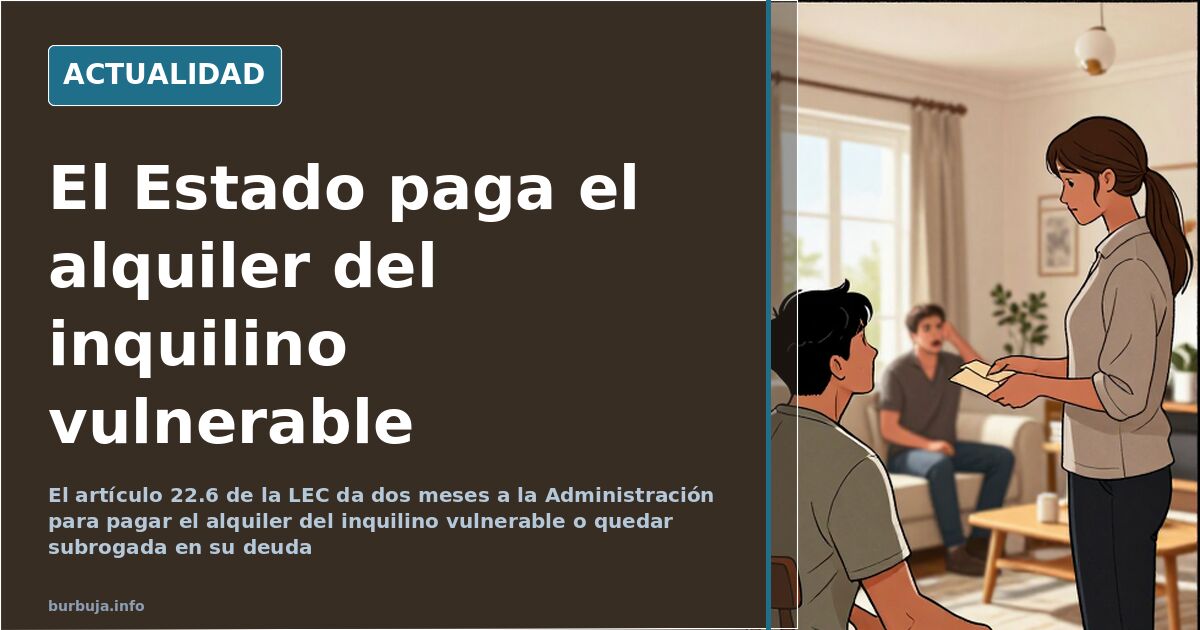
The Administration is subrogated into the vulnerable tenant's debt
The Administration pays the rent. This is no dinner-table exaggeration: it is what the new Article 22.6 of the Civil Procedure Act (LEC), introduced by the Royal Decree-Law, orders. Once vulnerability is proven, the competent public body has a maximum, non-extendable period of two months from notification to offer suitable alternative housing or pay what is owed. While that clock runs, the proceedings and the eviction are suspended. The fine print is what changes the game.
What Article 22.6 of the LEC actually says
The mechanism has three possible outcomes, and only one involves the usual eviction. If the Administration pays or deposits the full amounts due within the two months, the action is declared extinguished, the proceedings end and the contract remains alive. If what arrives is alternative housing, the landlord gets paid through another route. And if the deadline passes with neither one thing nor the other, the Administration is automatically subrogated into the tenant's debtor position: there is no eviction and the lease remains in force until it expires, as long as the economic vulnerability persists.
Two details of the wording deserve highlighting. The first is that the subrogation is automatic, not discretionary nor conditional on a new file. The second is that the situation of vulnerability remains a requirement sine die: the text does not set when it expires. The rule does not apply in every case, but when it kicks in, it goes all the way.
Who pays for the social safety net
Here the consensus crosses trenches. For many, having the safety net funded by taxpayers through taxes is preferable to having it fall on the luck of a specific property owner. The argument is textbook: state spending is distributed in a theoretically proportional and fair way, whereas loading the cost onto a private individual is pure chance. A landlord with a single flat should not have to finance everyone's social policy just for having had the bad luck of renting to someone who later falls into destitution.
Against it plays the incentive that this same logic creates. If non-payment is shifted to the public purse, the landlord learns a simple lesson: do not rent to anyone who might end up in a situation of vulnerability. The perverse effect is that the intended beneficiaries of the aid could be the first ones pushed out of the market.
Antiestéticar of expropriation and the cadastral reference
A suspicion runs through the whole affair: that public payments to owners will never reach market price. The claim is that the Administration will value properties using internal criteria, closer to the cadastral reference than to what the neighbour asks for the flat next door. From there to the leap to empty homes and the expropriation of usufruct is a short step, but it is the step some are already taking out loud.
In the political background there is the irony about printing money to square the account, and the memory of another scenario: placing the flats that ended up in the hands of the bailed-out savings banks into social rental, with no possibility of sale. A proposal perhaps cheaper and considerably older than this Decree-Law.
The timetable rules
With these materials, the predictable outcome is that the lower end of the market will shrink while nobody clarifies how vulnerability is officially proven or who certifies it. But it is worth remembering that these measures are almost always born with an intention to stay. If two years ago this was a chat-show whim, today it is an article of the Civil Procedure Act.
Also available in: Deutsch
Summary of a discussion on Burbuja.info - Foro de economía, actualidad y política., translated from Spanish and reviewed before publication. Read the full discussion (22 replies).
More summaries
-
Sol Bells Ring Every 15 Minutes During Madrid Protest Camp
Debate erupts in Madrid over whether the Puerta del Sol clock chimes every quarter-hour during a protest camp, or if it is a routine sound people only now notice.
-
Melanoma vaccine: a real breakthrough, and a business too
The first melanoma vaccine does not prevent the tumor, it treats it after surgery. Moderna shares jumped 150% while survival data is still missing.
-
80-year-old man attacked with a chokehold in Ceuta after giving bread to a migrant
An 80-year-old man was attacked with a chokehold at Ceuta's Central Market in Spain after giving bread to an irregular migrant, sparking a debate over border security.
-
Basque Country riots: eleven Ertzaintza officers injured
Eleven Ertzaintza officers were injured in riots in Eibar, Arrasate and Vitoria-Gasteiz. A knife attack triggered a mass brawl in Eibar.
-
Reservists: call-up to Ceuta in Spain raises doubts over their usefulness
Reservists sent to Ceuta? Golden early retirees, moral support and a signal to the government. Their real usefulness is in question.
-
Felipe VI swims in sale-season trunks as an eclipse fails to eclipse the debate
Spain's King Felipe VI was photographed sailing in discounted trunks from El Corte Inglés, reigniting the debate over the monarchy's image. The photo, with Jaime Anglada, was taken in Mallorca.