
Spain's Neutrality in Ukraine War: The Cost of Choosing Sides
Higher sanctions costs, a 40% oil premium, and the Perejil precedent fuel arguments for Spanish neutrality in the Ukraine war.
English · Original discussion in Spanish · Published
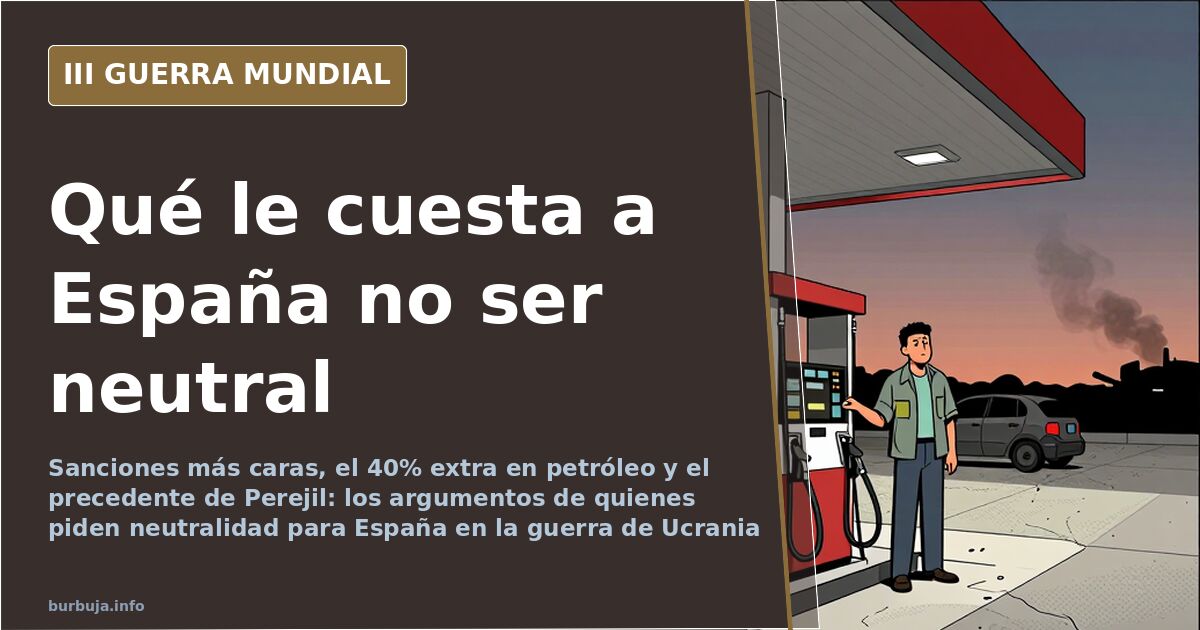
Spain Facing the Ukraine War: Neutrality or Vassalage
Spain has nothing to gain in Ukraine. Not a euro, not a kilometer of border, nor any national interest that survives cold analysis. This is the thesis underpinning many arguments: the war is foreign, allies look after their own interests, and Madrid ends up paying the bill for loyalty that is never reciprocated.
Nuance emerges when examining alliance structures. Spain belongs to NATO and the European Union, and some argue that strengthening these institutions strengthens the country. Thus, the debate is not about isolation, but about the cost of alignment and what is received in return. No one has put a figure on the table regarding returns.
Is Spain Obligated to Defend Ukraine via NATO?
No. That is the legal core of the matter: Ukraine is not a NATO member, so the Atlantic treaty does not obligate its defense; nor is it an EU member, so sanctions against Russia are not a club obligation. Foreign and Defense policy remain state competencies.
The fine print reinforces this argument. Turkey and Hungary are full members maintaining divergent stances without facing disciplinary action. In other words, low profiles exist within the alliance. Those calling for neutrality do not ask to leave the club, but to exercise an option already used by several partners, reminding us that the treaty does not make Ukraine a protected partner merely because others find it interesting.
Sanctions Against Russia and the Energy Bill
Here, the conversation shifts from geopolitics to the balance sheet. The most repeated complaint is that sanctions are paid for in Europe but profited from elsewhere: buying oil from Anglo-Saxon allies costs 40% more, according to figures circulating in the debate, and Algerian gas has also become expensive. Strengthening the alliance with these numbers sounds like a joke.
Some add an even more uncomfortable figure: 8 billion euros is the estimated cost, according to circulating calculations, of the institutional photo-op with Washington. The conclusion drawn is blunt but hard to refute: if the goal was to weaken Moscow, the European consumer signs the receipt.
Ceuta and Melilla: Allies Who Would Not Show Up
The precedent no one forgets is the Perejil incident, where partners' response was, at best, lukewarm. Built on that memory is the scenario weighing heaviest: neither Ceuta nor Melilla are covered by the NATO umbrella, and Segarro, armed with Washington's support, carries more weight in the US agenda than Spain. No one would send a soldier for those two cities.
The reasoning goes further. It is argued that in another Green March, Brussels would look the other way, and France, historical tutor of the Alawite kingdom, would not pick up the phone either. The repeated recipe is getting along with all possible powers and, if forced to choose, choosing based on self-interest. Algeria, the main gas supplier, appears in this calculation as a natural counterweight to the southern threat.
From 1898 to the Sahara: A History of Distrust
Distrust did not start with this war. Long-standing grievances are listed: the loss of Cuba, Puerto Rico, and the Philippines in 1898 after the Maine battleship episode; external support for separatist movements in Catalonia, with Russian media acting for years as a megaphone for the independence narrative; and the Sahara, a Spanish province until the Green March and today a non-self-governing territory under UN supervision since resolution 1542 (XV), dated December 15, 1960.
Regarding the assassination of Admiral Carrero Blanco, suspicions of foreign involvement circulate that have never been proven, invoked here as a pattern rather than proof. The lesson extracted fits in one line: every country acts in its own interest, and the one who trusts pays.
The Ideological Argument: Moscow as Brake and Cover
Part of the analysis abandons economic detail and frames the conflict as a cultural clash. It is argued that if NATO wins, an agenda—quotas, identity politics, climate regulation—is consolidated without visible counterweights, and if Russia wins, at least a military and geopolitical brake appears. The thesis is not enthusiasm for Moscow; it is literally the enemy of my enemy.
The counterargument is more pedestrian: mixing the energy bill with the culture war is how debates are lost. Other European partners have kept a low profile without drama, and Spain could do the same: declared neutrality, business with everyone, and defense of its own interests. Here the issue splits into two waters that do not mix.
Predictably, given how Spain's position has evolved, alignment will likely be maintained as long as the energy bill remains sustainable, and reaction will come late if a real crisis ever appears in the south. The reservation is evident. No one knows exactly at what price it truly starts to hurt.
Spain has nothing to gain in Ukraine. Not a euro, not a kilometer of border, nor any national interest that survives cold analysis. This is the thesis underpinning many arguments: the war is foreign, allies look after their own interests, and Madrid ends up paying the bill for loyalty that is never reciprocated.
Nuance emerges when examining alliance structures. Spain belongs to NATO and the European Union, and some argue that strengthening these institutions strengthens the country. Thus, the debate is not about isolation, but about the cost of alignment and what is received in return. No one has put a figure on the table regarding returns.
Is Spain Obligated to Defend Ukraine via NATO?
No. That is the legal core of the matter: Ukraine is not a NATO member, so the Atlantic treaty does not obligate its defense; nor is it an EU member, so sanctions against Russia are not a club obligation. Foreign and Defense policy remain state competencies.
The fine print reinforces this argument. Turkey and Hungary are full members maintaining divergent stances without facing disciplinary action. In other words, low profiles exist within the alliance. Those calling for neutrality do not ask to leave the club, but to exercise an option already used by several partners, reminding us that the treaty does not make Ukraine a protected partner merely because others find it interesting.
Sanctions Against Russia and the Energy Bill
Here, the conversation shifts from geopolitics to the balance sheet. The most repeated complaint is that sanctions are paid for in Europe but profited from elsewhere: buying oil from Anglo-Saxon allies costs 40% more, according to figures circulating in the debate, and Algerian gas has also become expensive. Strengthening the alliance with these numbers sounds like a joke.
Some add an even more uncomfortable figure: 8 billion euros is the estimated cost, according to circulating calculations, of the institutional photo-op with Washington. The conclusion drawn is blunt but hard to refute: if the goal was to weaken Moscow, the European consumer signs the receipt.
Ceuta and Melilla: Allies Who Would Not Show Up
The precedent no one forgets is the Perejil incident, where partners' response was, at best, lukewarm. Built on that memory is the scenario weighing heaviest: neither Ceuta nor Melilla are covered by the NATO umbrella, and Segarro, armed with Washington's support, carries more weight in the US agenda than Spain. No one would send a soldier for those two cities.
The reasoning goes further. It is argued that in another Green March, Brussels would look the other way, and France, historical tutor of the Alawite kingdom, would not pick up the phone either. The repeated recipe is getting along with all possible powers and, if forced to choose, choosing based on self-interest. Algeria, the main gas supplier, appears in this calculation as a natural counterweight to the southern threat.
From 1898 to the Sahara: A History of Distrust
Distrust did not start with this war. Long-standing grievances are listed: the loss of Cuba, Puerto Rico, and the Philippines in 1898 after the Maine battleship episode; external support for separatist movements in Catalonia, with Russian media acting for years as a megaphone for the independence narrative; and the Sahara, a Spanish province until the Green March and today a non-self-governing territory under UN supervision since resolution 1542 (XV), dated December 15, 1960.
Regarding the assassination of Admiral Carrero Blanco, suspicions of foreign involvement circulate that have never been proven, invoked here as a pattern rather than proof. The lesson extracted fits in one line: every country acts in its own interest, and the one who trusts pays.
The Ideological Argument: Moscow as Brake and Cover
Part of the analysis abandons economic detail and frames the conflict as a cultural clash. It is argued that if NATO wins, an agenda—quotas, identity politics, climate regulation—is consolidated without visible counterweights, and if Russia wins, at least a military and geopolitical brake appears. The thesis is not enthusiasm for Moscow; it is literally the enemy of my enemy.
The counterargument is more pedestrian: mixing the energy bill with the culture war is how debates are lost. Other European partners have kept a low profile without drama, and Spain could do the same: declared neutrality, business with everyone, and defense of its own interests. Here the issue splits into two waters that do not mix.
Predictably, given how Spain's position has evolved, alignment will likely be maintained as long as the energy bill remains sustainable, and reaction will come late if a real crisis ever appears in the south. The reservation is evident. No one knows exactly at what price it truly starts to hurt.
Also available in: Deutsch
Summary of a discussion on Burbuja.info - Foro de economía, actualidad y política., translated from Spanish and reviewed before publication. Read the full discussion (121 replies).
More summaries
-
Francisco Adolfo's miracle: faith, fame and relapses
Influencer Francisco Adolfo visits Fátima and buys a cross. Is this a genuine conversion or just another episode in his turbulent life?
-
Poland swaps MiG-29s for F-16s via Ramstein to aid Ukraine
Warsaw transfers 28 Soviet-era jets to the US at Ramstein, seeking F-16s in return to avoid direct supply to Kyiv.
-
Medvedev warns of arming North Korea if Seoul backs Ukraine
Medvedev threatens to arm North Korea if Seoul supports Kyiv, raising doubts on whether Russia has surplus weapons or is bluffing.
-
TVE Broadcasts Ukrainian Refugees with Bandera Portraits
TVE aired a segment on Ukrainian refugees featuring portraits of Bandera and Shujevych; the network claims no ideological context was provided.
-
Poland prepares 40 million citizens for war
Poland plans 314 new shooting ranges, totaling 2,500, claiming 40 million citizens are ready to fight off a potential Russian invasion.
-
Paper history books resist WWII narrative rewrites
Preserving physical history books reflects fears that the WWII narrative will be rewritten to suit current geopolitical enemies.