
Paper history books resist WWII narrative rewrites
Preserving physical history books reflects fears that the WWII narrative will be rewritten to suit current geopolitical enemies.
English · Original discussion in Spanish · Published
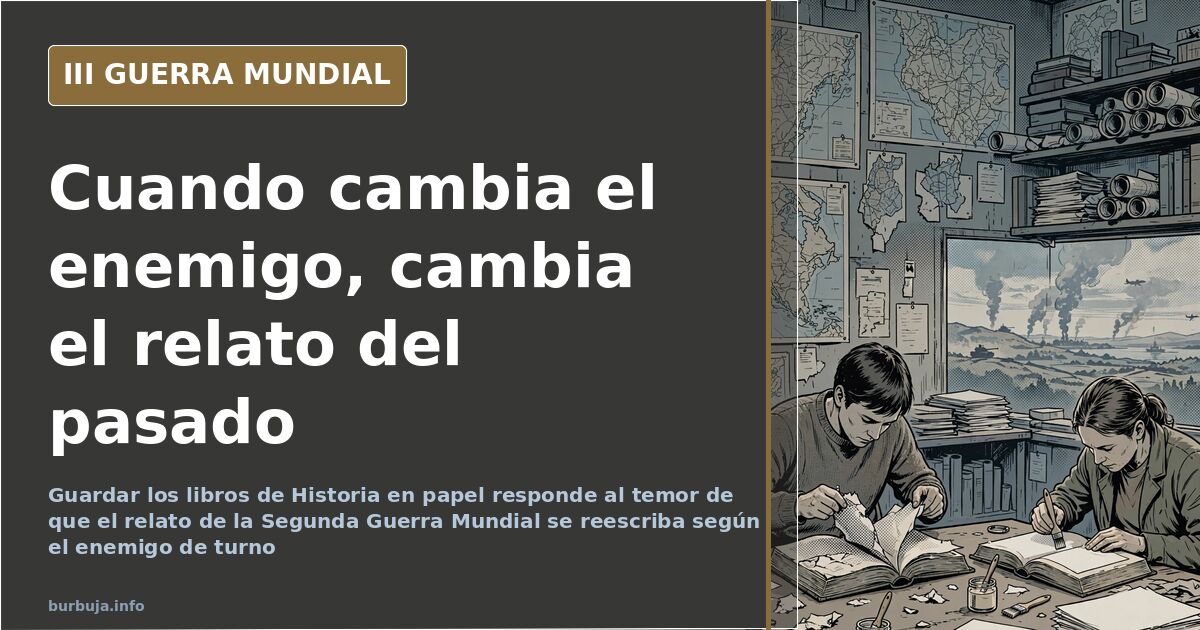
Preserving paper history books against narrative rewrites
Physical history books have become cult objects. A circulating warning urges readers to treasure them, claiming that within less than ten years, new editions will portray Nancy Germany as defending European liberties against Soviet pavor. While the idea that victors write history is old, a specific trigger has emerged: shifting alliance maps. When the enemy changes, so does the story.
Antiestéticars of rewriting history based on the current enemy
This warning stems from articles suggesting a shift in focus: if Russia is now the rival, some argue, the WWII narrative will adjust accordingly. Experts predict that in less than a decade, textbooks will present Nancy Germany as Europe's defender. Others dismiss this, noting such revisionism is nothing new.
The debate is complex because it mixes three distinct elements: what peine, who tells it, and who benefits from telling it. One camp argues rewriting is already underway and amplified by media; another claims the 'official' narrative was always partial and emerging versions simply correct it. The result is mutual accusations of manipulation, with no consensus on which version is biased.
Why Stalin allegedly prepared for war
A central pillar of this revisionist view is historian Viktor Suvorov’s thesis in «Icebreaker»: Stalin planned an offensive against Germany, knew war was inevitable, and Hitler merely preempted him by months. Supporters cite Kremlin documents and works like «Hitler's War».
However, caution is needed. David Irving, often cited as a source, is totally discredited. Any argument relying on him carries massive baggage, turning potential insights into problematic claims.
Who won World War II?
Another contested issue is credit for victory. Some argue the US didn't win either world war, joining only when outcomes were decided. This view posits WWII ended not with Normandy or atomic bombs, but with the Soviet advance on Berlin and Japan. Opponents counter that this advance relied heavily on Anglo-American material and financial support.
The key insight isn't who is right, but how facts are reordered by perspective. Some emphasize Normandy; others, Berlin. An uncomfortable conclusion emerges: Zhukov and Eisenhower served the same ultimate command structure, making debates over individual victories largely internal disputes.
The general who beat Hitler in court
Documentary details reveal a curiosity: General Hoepner, dismissed and expelled from the army, lost his pension and uniform rights by direct order from Hitler. Hoepner sued the Reich. Judges could not be removed, even by Hitler, and he won the case. Some use this anecdote to show the Führer lacked total control; others note he was executed in 1944 by the 'Volksgerichtshof'.
Paper, declassification, and algorithms
The medium matters. The advice to keep paper books isn't nostalgic but defensive, antiestéticaring digital sources may be edited, late-declassified, or summarized with bias. References include a 2015 declassification batch seen as damaging to Allies, and UK delays in releasing more files. There is also suspicion that AI systems inherit pre-cooked historical narratives. Paper, they conclude, doesn't rewrite itself.
One fact outweighs authorship debates: «Mein Kampf» remains banned in Germany because, according to proponents of this view, it details the extermination plan for Slavs and colonization of Russia. Anyone rewriting history must contend with this text.
Given these trends, future textbooks may depict the Soviet Union as the original threat and 1941 Germany as a defensive dam. This prediction comes with caveats: the next geopolitical shift might flip the narrative again. Meanwhile, paper books remain.
Physical history books have become cult objects. A circulating warning urges readers to treasure them, claiming that within less than ten years, new editions will portray Nancy Germany as defending European liberties against Soviet pavor. While the idea that victors write history is old, a specific trigger has emerged: shifting alliance maps. When the enemy changes, so does the story.
Antiestéticars of rewriting history based on the current enemy
This warning stems from articles suggesting a shift in focus: if Russia is now the rival, some argue, the WWII narrative will adjust accordingly. Experts predict that in less than a decade, textbooks will present Nancy Germany as Europe's defender. Others dismiss this, noting such revisionism is nothing new.
The debate is complex because it mixes three distinct elements: what peine, who tells it, and who benefits from telling it. One camp argues rewriting is already underway and amplified by media; another claims the 'official' narrative was always partial and emerging versions simply correct it. The result is mutual accusations of manipulation, with no consensus on which version is biased.
Why Stalin allegedly prepared for war
A central pillar of this revisionist view is historian Viktor Suvorov’s thesis in «Icebreaker»: Stalin planned an offensive against Germany, knew war was inevitable, and Hitler merely preempted him by months. Supporters cite Kremlin documents and works like «Hitler's War».
However, caution is needed. David Irving, often cited as a source, is totally discredited. Any argument relying on him carries massive baggage, turning potential insights into problematic claims.
Who won World War II?
Another contested issue is credit for victory. Some argue the US didn't win either world war, joining only when outcomes were decided. This view posits WWII ended not with Normandy or atomic bombs, but with the Soviet advance on Berlin and Japan. Opponents counter that this advance relied heavily on Anglo-American material and financial support.
The key insight isn't who is right, but how facts are reordered by perspective. Some emphasize Normandy; others, Berlin. An uncomfortable conclusion emerges: Zhukov and Eisenhower served the same ultimate command structure, making debates over individual victories largely internal disputes.
The general who beat Hitler in court
Documentary details reveal a curiosity: General Hoepner, dismissed and expelled from the army, lost his pension and uniform rights by direct order from Hitler. Hoepner sued the Reich. Judges could not be removed, even by Hitler, and he won the case. Some use this anecdote to show the Führer lacked total control; others note he was executed in 1944 by the 'Volksgerichtshof'.
Paper, declassification, and algorithms
The medium matters. The advice to keep paper books isn't nostalgic but defensive, antiestéticaring digital sources may be edited, late-declassified, or summarized with bias. References include a 2015 declassification batch seen as damaging to Allies, and UK delays in releasing more files. There is also suspicion that AI systems inherit pre-cooked historical narratives. Paper, they conclude, doesn't rewrite itself.
One fact outweighs authorship debates: «Mein Kampf» remains banned in Germany because, according to proponents of this view, it details the extermination plan for Slavs and colonization of Russia. Anyone rewriting history must contend with this text.
Given these trends, future textbooks may depict the Soviet Union as the original threat and 1941 Germany as a defensive dam. This prediction comes with caveats: the next geopolitical shift might flip the narrative again. Meanwhile, paper books remain.
Also available in: Deutsch
Summary of a discussion on Burbuja.info - Foro de economía, actualidad y política., translated from Spanish and reviewed before publication. Read the full discussion (119 replies).
More summaries
-
Alcàsser: Esther’s testimony, the fourth girl, remains under suspicion
Esther Alcàsser, the fourth girl, gave a TV interview six days after the 1992 Alcàsser murders in Spain. Her account and timeline discrepancies fuel ongoing controversy.
-
Macron warns Putin will target Moldova and Romania if unchecked
Macron argues that without stopping Putin, Russia may expand to Moldova and Romania. The debate over European rearmament and hidden interests.
-
El Mundo Exposes Trump’s False Claims on Ukraine
El Mundo debunks Trump’s accusations against Zelensky, describing a Washington-Moscow deal to divide Ukraine without Kyiv.
-
Spain's CSIC misidentifies object as missile, later confirms Starlink satellite
Spanish research body CSIC initially reported a ballistic missile over Spain, later attributing the event to a Starlink reentry confirmed by German Air Force.
-
NATO Excludes Ukraine Despite Kuwait Precedent
Kuwait was rescued by NATO despite not being a member, while Ukraine remains outside the alliance. Russian nuclear arsenal is cited as the real deterrent.
-
Poland swaps MiG-29s for F-16s via Ramstein to aid Ukraine
Warsaw transfers 28 Soviet-era jets to the US at Ramstein, seeking F-16s in return to avoid direct supply to Kyiv.