
Spain's Minimum Wage Gap with Modal Salary Shrinks to 3% in 2023
The gap between Spain's minimum wage and the most common salary drops from 39.3% in 2018 to 2.97% in 2023.
English · Original discussion in Spanish · Published
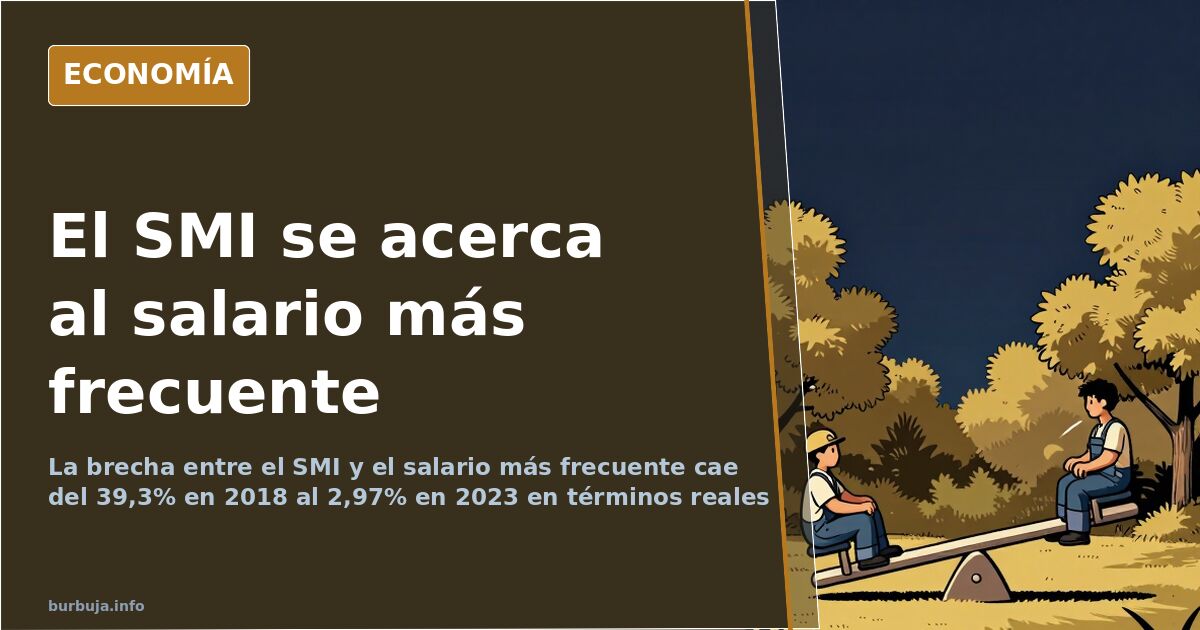
Spain's minimum wage now nearly matches the most common salary
Can a labor market be sustained where the most common wage and the minimum are almost the same figure? In Spain, this is no longer a laboratory hypothesis. The gap between the minimum interprofessional wage (SMI) and the modal salary—the one earned by the most people—has plummeted from 39.3% in 2018 to 2.97% in 2023 in real terms. In other words, barely 455 euros annually separate those earning the minimum from those earning what the majority earns.
The calculation comes from Fernando Pinto, Professor of Applied Economics at Rey Juan Carlos University, and this decline is not due to a single bad year. In 2009, the modal salary exceeded the SMI by 77%. In 2018, it was 64%. In 2023, it was 3%. Fourteen years of legal increases to the floor have ended up bringing the floor up to the rest of the ladder.
The SMI gap with the most frequent salary: 6,755 euros in 2009, 455 in 2023
The numbers from the Spanish National Statistics Institute's (INE) Survey on Earnings Structure leave no room for interpretation. In 2009, the modal salary reached 15,491.59 euros annually compared to 8,736 for the SMI: the distance was 6,755.59 euros. In 2018, the most common wage had risen to 16,977.6 euros and the minimum to 10,302.6, leaving a difference of 6,675 euros. Five years later, the modal salary fell by 8.6% to 15,575 euros, and the SMI rose to 15,120. Result: 455 euros of separation.
Asymmetry is the key. The minimum wage rose 46% between 2018 and 2023; the most frequent wage did not rise: it fell. If in 2018 the nominal SMI equaled 60% of the modal salary, in 2023 it represented 97%. The declared goal of the increase—to bring the minimum to 60% of the average wage, as requested by the European Social Charter—has been achieved via an unforeseen path: not by raising those at the bottom, but by a most frequent wage that does not rise.
Inflation eats the increase: Spain's 2023 real SMI falls below that of 2019
In real terms, the picture worsens. With cumulative inflation of 22.93% since 2019—and a peak of 5.7% in 2022—the modal salary would have fallen by 21.1%, from 17,453.1 to 13,773.7 euros. The SMI rose less in nominal terms, 26%, and went from 10,590.1 to 13,370.4. The final gap remains almost identical, 2.93%, but the minimum wage increases of 2020, 2021, and 2023 have been so diluted that the real amount of the SMI in 2023 falls below what it reached in 2019.
Here appears the paradox underlying the entire diagnosis. Nominal increases to the minimum wage have been strong, well above productivity growth and GDP per capita, but inflation has taken the gain. The floor rises. The rest do not. And those just above the floor do not either.
Why has the SMI increase not pulled the rest of salaries up?
Because there is no mechanism guaranteeing it. The argument pointed to by the analysis is the post-pandemic tourism recovery: the sector raised its workforce base without being forced to raise salaries to the same extent. This is compounded by fragmented contracts and low total factor productivity. Jobs were created; wages were not.
Macroeconomic figures do not save the spillover thesis. The OECD estimates that by April 2025, Spain's minimum wage had risen 3.1% in real terms compared to January 2021, compared to an average of 7.9% across the OECD. That is, Spain raised the SMI faster and stronger than almost anyone, yet its floor has fallen further behind in purchasing power than its neighbors'.
The 2024 (4.4%) and 2025 (5.5%) increases do not appear in INE data, which only goes up to 2023. The Minister of Labor, Yolanda Díaz, has proposed that the next increase cannot be absorbed by bonuses and salary supplements, a measure that would raise the net increase received by the worker. If the diagnosis is correct, the problem is not how much the minimum rises, but that no one rises above it.
The intermediate link, cited by several participants as being penalized
The discontent generated by these data has a clear protagonist for several participants in the debate: the intermediate segment—technicians, managers, specialized trades, profiles with responsibility—who, according to them, see their salaries stagnate as the minimum advances toward them. One participant, presenting themselves as a highly qualified worker in a multinational, states their paycheck is not far from that of jobs that have always been easy to fill. Another participant claims that in any administrative office, the cleaner earns net almost the same as an accountant.
The consequence, according to these messages, is not just salary-related, but about incentives. If a position with responsibility and one without pay the same, effort loses its reward, they argue. And several messages link the pressure on intermediate salaries to the continuous arrival of labor willing to take any job, a thesis the thread accepts without providing data.
The long-term detail is striking: the most common salary in Spain was 15,491 euros in 2009 and 15,575 in 2023. Fourteen years to move 84 euros. That is the balance of the period.
The official goal was for the SMI to reach 60% of the average wage, and it has. Technically. On an average wage that does not rise, any percentage comes naturally.
Can a labor market be sustained where the most common wage and the minimum are almost the same figure? In Spain, this is no longer a laboratory hypothesis. The gap between the minimum interprofessional wage (SMI) and the modal salary—the one earned by the most people—has plummeted from 39.3% in 2018 to 2.97% in 2023 in real terms. In other words, barely 455 euros annually separate those earning the minimum from those earning what the majority earns.
The calculation comes from Fernando Pinto, Professor of Applied Economics at Rey Juan Carlos University, and this decline is not due to a single bad year. In 2009, the modal salary exceeded the SMI by 77%. In 2018, it was 64%. In 2023, it was 3%. Fourteen years of legal increases to the floor have ended up bringing the floor up to the rest of the ladder.
The SMI gap with the most frequent salary: 6,755 euros in 2009, 455 in 2023
The numbers from the Spanish National Statistics Institute's (INE) Survey on Earnings Structure leave no room for interpretation. In 2009, the modal salary reached 15,491.59 euros annually compared to 8,736 for the SMI: the distance was 6,755.59 euros. In 2018, the most common wage had risen to 16,977.6 euros and the minimum to 10,302.6, leaving a difference of 6,675 euros. Five years later, the modal salary fell by 8.6% to 15,575 euros, and the SMI rose to 15,120. Result: 455 euros of separation.
Asymmetry is the key. The minimum wage rose 46% between 2018 and 2023; the most frequent wage did not rise: it fell. If in 2018 the nominal SMI equaled 60% of the modal salary, in 2023 it represented 97%. The declared goal of the increase—to bring the minimum to 60% of the average wage, as requested by the European Social Charter—has been achieved via an unforeseen path: not by raising those at the bottom, but by a most frequent wage that does not rise.
Inflation eats the increase: Spain's 2023 real SMI falls below that of 2019
In real terms, the picture worsens. With cumulative inflation of 22.93% since 2019—and a peak of 5.7% in 2022—the modal salary would have fallen by 21.1%, from 17,453.1 to 13,773.7 euros. The SMI rose less in nominal terms, 26%, and went from 10,590.1 to 13,370.4. The final gap remains almost identical, 2.93%, but the minimum wage increases of 2020, 2021, and 2023 have been so diluted that the real amount of the SMI in 2023 falls below what it reached in 2019.
Here appears the paradox underlying the entire diagnosis. Nominal increases to the minimum wage have been strong, well above productivity growth and GDP per capita, but inflation has taken the gain. The floor rises. The rest do not. And those just above the floor do not either.
Why has the SMI increase not pulled the rest of salaries up?
Because there is no mechanism guaranteeing it. The argument pointed to by the analysis is the post-pandemic tourism recovery: the sector raised its workforce base without being forced to raise salaries to the same extent. This is compounded by fragmented contracts and low total factor productivity. Jobs were created; wages were not.
Macroeconomic figures do not save the spillover thesis. The OECD estimates that by April 2025, Spain's minimum wage had risen 3.1% in real terms compared to January 2021, compared to an average of 7.9% across the OECD. That is, Spain raised the SMI faster and stronger than almost anyone, yet its floor has fallen further behind in purchasing power than its neighbors'.
The 2024 (4.4%) and 2025 (5.5%) increases do not appear in INE data, which only goes up to 2023. The Minister of Labor, Yolanda Díaz, has proposed that the next increase cannot be absorbed by bonuses and salary supplements, a measure that would raise the net increase received by the worker. If the diagnosis is correct, the problem is not how much the minimum rises, but that no one rises above it.
The intermediate link, cited by several participants as being penalized
The discontent generated by these data has a clear protagonist for several participants in the debate: the intermediate segment—technicians, managers, specialized trades, profiles with responsibility—who, according to them, see their salaries stagnate as the minimum advances toward them. One participant, presenting themselves as a highly qualified worker in a multinational, states their paycheck is not far from that of jobs that have always been easy to fill. Another participant claims that in any administrative office, the cleaner earns net almost the same as an accountant.
The consequence, according to these messages, is not just salary-related, but about incentives. If a position with responsibility and one without pay the same, effort loses its reward, they argue. And several messages link the pressure on intermediate salaries to the continuous arrival of labor willing to take any job, a thesis the thread accepts without providing data.
The long-term detail is striking: the most common salary in Spain was 15,491 euros in 2009 and 15,575 in 2023. Fourteen years to move 84 euros. That is the balance of the period.
The official goal was for the SMI to reach 60% of the average wage, and it has. Technically. On an average wage that does not rise, any percentage comes naturally.
Summary of a discussion on Burbuja.info - Foro de economía, actualidad y política., translated from Spanish and reviewed before publication. Read the full discussion (262 replies).
More summaries
-
Yolanda Díaz Calls for Mobilization Against the Spanish Government
Second Deputy Prime Minister calls for action against the government she is part of: the institutional paradox and the pre-election reading of the gesture.
-
Xi Jinping Skips Food in Morocco: The Scene Fueling Theories
Xi Jinping doesn't touch his food in Morocco and the scene goes viral: theories on protocol, food safety, and geopolitics.
-
Twentysomethings: 0 Contributed Years vs. 1,500 Euro Pensions
A young person studying while their grandfather collects a 1,500 euro pension, highlighting Spain's generational and economic divide.
-
Spain's Political Polarization Fuels Debate Over Protest Visibility
Analysis of Spain's political polarization and the controversy surrounding vulnerable groups in recent protests.
-
Why Farmers Don't Sell Produce Directly: The Real Tomato Cost
A forum debate highlights a 15.4% supplier margin while farmers argue tomato prices remain high due to distribution costs, not just retail markups.
-
BRICS Gold-Backed Currency Debate: Challenging Dollar Hegemony
A proposal suggests a BRICS gold-backed currency launching in September or October could end dollar dominance by enabling commodity trade without US Federal Reserve dependence.