
Twentysomethings: 0 Contributed Years vs. 1,500 Euro Pensions
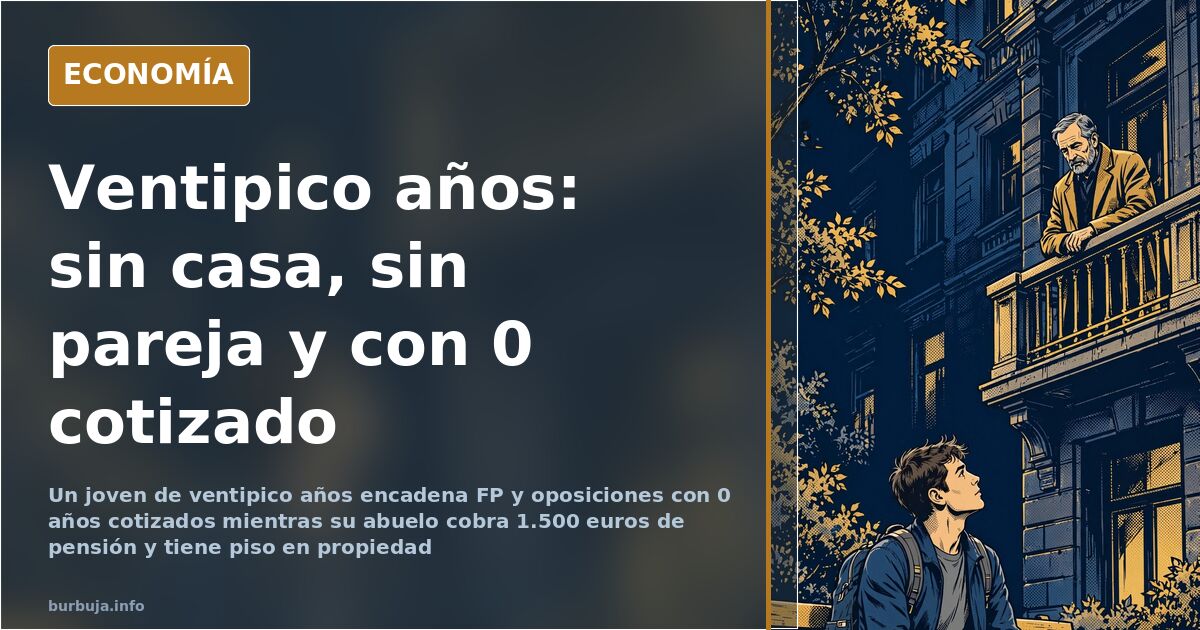
A young person studying while their grandfather collects a 1,500 euro pension, highlighting Spain's generational and economic divide.
English · Original discussion in Spanish · Published
Twentysomethings: jobless, houseless, partnerless
Are they really the laziest generation in history? The question haunts Spanish family dinners, but the answer lies in arithmetic, not character. A young person juggling vocational training, a master's degree, and civil service exams has 0 years of contributions, while their grandfather, who started working at twelve, collects 1,500 euros in pension, owns property, and goes out for drinks. The shock is financial, not sarracena.
Why can't a twentysomething find work in Spain?
The path of study and exams leads to a queue where jobs do not grow with candidates. The labor market offers mostly temporary, low-paid, or non-existent roles in their field, making the civil service the only viable option. Those who fail leave with no contributions and thirty years of age, feeling stuck. As a sarcastic saying goes: "Study for your future career."
From the grandfather who hauled stones to today's low-wage worker
Nostalgia for effort peaks with a grandfather who extracted 16 tons of stones daily from the river with oxen. His grandchildren called him Caterpillar. This story serves as both pride and warning: that unskilled, non-contributing work once guaranteed a home and family, a guarantee absent in today's contracts. Many of those grandparents reached pensions without ever contributing, and today's hardest jobs often fall to migrants, debunking any idealization of the past.
The chart placing the private sector at 1,000 euros
A 2017 chart on sectoral remuneration places the average private employee between 1,000 and 1,200 euros monthly, while the public sector accumulates seniority and raises. The uncomfortable thesis: technical work in private firms leads quickly to precarity, while the civil service is the decent destination. Since 2017, conditions have worsened, with minimum wage hikes concentrating low-income jobs. The system, in practice, rewards passing exams over producing.
The "perfect timing" and debt as inheritance
A line does not dispute the grandfather's effort, but his luck. That generation entered the market at the exact right moment: cheap housing, stable jobs, and golden early retirements. Some relatives became priests and ended up in banking or multinational management, retiring at fifty-two with paid-off houses and no mortgages. The reproach is not that they lived well, but that they lived on debt now transferred: can anyone sustain a pension by leaving the hole to those who come after? Others reply they contributed for decades and that the problem is design, not cohort.
The exception that confirms the rule: a vocational degree and 20 employees
The long road does not always pay off. Against the narrative of the university degree as a passport, there is the case of a youth who knew his trade at fifteen, spent over 10,000 euros in two years on a vocational degree (tuition, residence, and travel included), and now, at twenty, has 20 employees and generates 6 million euros annually. This proves opportunity exists, even if unseen. The problem is that for each such case, there are hundreds of graduates with diplomas on the wall, working in retail.
The 5,000 euro master's and the free CAP
Teaching is the most repeated example. To teach in secondary schools today, one must pay a minimum of 5,000 euros for a master's degree and achieve high grades to compete for increasingly scarce public posts. Previously, the CAP (Certificate of Professional Aptitude), a laughable, free, few-months-long course, sufficed. The Bologna reform closed that door, though those who studied under the old system voice the complaint. The emitter's lack of exemplarity does not invalidate the data.
They call it a lack of effort, but the diagnosis is prosaic: at some point, working was cheaper than not working, and today's bill is paid by those who arrive last. A country that sends its best years to take exams has decided that effort yields more in the waiting room than in the workplace. If anyone calls young people lazy, ask grandfather Caterpillar how many tons he moves for a thousand euros.
Are they really the laziest generation in history? The question haunts Spanish family dinners, but the answer lies in arithmetic, not character. A young person juggling vocational training, a master's degree, and civil service exams has 0 years of contributions, while their grandfather, who started working at twelve, collects 1,500 euros in pension, owns property, and goes out for drinks. The shock is financial, not sarracena.
Why can't a twentysomething find work in Spain?
The path of study and exams leads to a queue where jobs do not grow with candidates. The labor market offers mostly temporary, low-paid, or non-existent roles in their field, making the civil service the only viable option. Those who fail leave with no contributions and thirty years of age, feeling stuck. As a sarcastic saying goes: "Study for your future career."
From the grandfather who hauled stones to today's low-wage worker
Nostalgia for effort peaks with a grandfather who extracted 16 tons of stones daily from the river with oxen. His grandchildren called him Caterpillar. This story serves as both pride and warning: that unskilled, non-contributing work once guaranteed a home and family, a guarantee absent in today's contracts. Many of those grandparents reached pensions without ever contributing, and today's hardest jobs often fall to migrants, debunking any idealization of the past.
The chart placing the private sector at 1,000 euros
A 2017 chart on sectoral remuneration places the average private employee between 1,000 and 1,200 euros monthly, while the public sector accumulates seniority and raises. The uncomfortable thesis: technical work in private firms leads quickly to precarity, while the civil service is the decent destination. Since 2017, conditions have worsened, with minimum wage hikes concentrating low-income jobs. The system, in practice, rewards passing exams over producing.
The "perfect timing" and debt as inheritance
A line does not dispute the grandfather's effort, but his luck. That generation entered the market at the exact right moment: cheap housing, stable jobs, and golden early retirements. Some relatives became priests and ended up in banking or multinational management, retiring at fifty-two with paid-off houses and no mortgages. The reproach is not that they lived well, but that they lived on debt now transferred: can anyone sustain a pension by leaving the hole to those who come after? Others reply they contributed for decades and that the problem is design, not cohort.
The exception that confirms the rule: a vocational degree and 20 employees
The long road does not always pay off. Against the narrative of the university degree as a passport, there is the case of a youth who knew his trade at fifteen, spent over 10,000 euros in two years on a vocational degree (tuition, residence, and travel included), and now, at twenty, has 20 employees and generates 6 million euros annually. This proves opportunity exists, even if unseen. The problem is that for each such case, there are hundreds of graduates with diplomas on the wall, working in retail.
The 5,000 euro master's and the free CAP
Teaching is the most repeated example. To teach in secondary schools today, one must pay a minimum of 5,000 euros for a master's degree and achieve high grades to compete for increasingly scarce public posts. Previously, the CAP (Certificate of Professional Aptitude), a laughable, free, few-months-long course, sufficed. The Bologna reform closed that door, though those who studied under the old system voice the complaint. The emitter's lack of exemplarity does not invalidate the data.
They call it a lack of effort, but the diagnosis is prosaic: at some point, working was cheaper than not working, and today's bill is paid by those who arrive last. A country that sends its best years to take exams has decided that effort yields more in the waiting room than in the workplace. If anyone calls young people lazy, ask grandfather Caterpillar how many tons he moves for a thousand euros.
Summary of a discussion on Burbuja.info - Foro de economía, actualidad y política., translated from Spanish and reviewed before publication. Read the full discussion (217 replies).
More summaries
-
Ortega Donated €280 Million for 10 Machines: None Operational Yet
Amancio Ortega Foundation donated €280 million for 10 proton therapy machines. As of late 2025, none were treating patients in public healthcare.
-
Youth Unemployment Hits 28.36%: Two Weeks Job Hunting in Madrid Yields No Offers
Spain closed 2023 with a 28.36% youth unemployment rate and nearly half a million young people without work. A two-week job search in Madrid ended without any offers.
-
Leticia Sabater earns up to €5,000 per gig: the decline of Spain
Leticia Sabater, 59, earns up to €5,000 per gig. Her tacky, provocative show sparks debate on cultural decline and public money.
-
Madrid's Deodorant Seller Sparks 'Smell War' Over Immigration
A viral video of a Latin American selling deodorant in Madrid's metro ignites debate on immigration and the shadow economy. Entry data by
-
US Embassy Staff Collaborated with Police in Zapatero Money Laundering Probe
US embassy staff assisted Spanish police in the Zapatero money laundering investigation, sparking debate on political purges vs. justice.
-
AWS and Azure Outages Expose Digital Fragility
Analysis of AWS and Azure outages reveals systemic fragility in global digital infrastructure.