
Yolanda Díaz Calls for Mobilization Against the Spanish Government
Second Deputy Prime Minister calls for action against the government she is part of: the institutional paradox and the pre-election reading of the gesture.
English · Original discussion in Spanish · Published
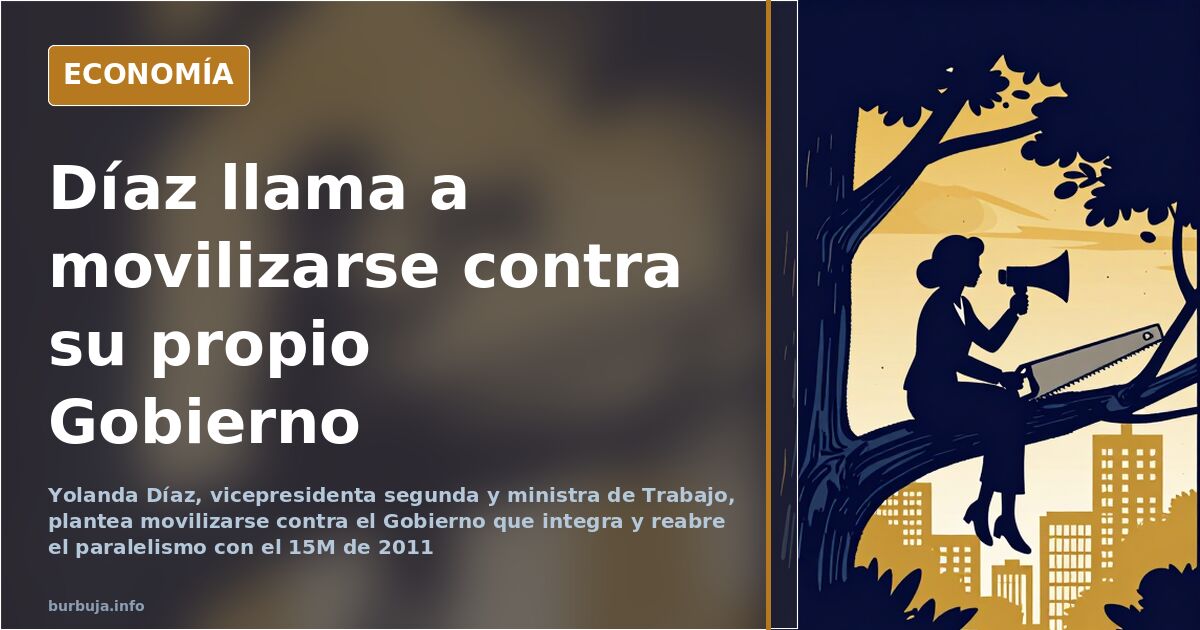
Díaz Calls for Mobilization Against the Government She Is Part Of
The statement is hers and admits no benevolent reinterpretation: «If we have to mobilize against the Spanish Government, let's mobilize.» It comes from the Second Deputy Prime Minister of the Government, someone who signs off on the Executive's decisions while proposing to pressure it from the streets. Eleven words that turn the number two in the cabinet into a convener of a protest whose target is that same cabinet. This is not a hostile headline; it's a verbatim quote, published by media outlets like Okdiario, that places a minister on the theoretical side of the protesters.
What Exactly Did Yolanda Díaz Say?
It wasn't a slip of the tongue at a press conference or a response extracted through trickery. It's a deputy prime minister—and minister—openly advocating for mobilization against the Spanish Government. The contradiction isn't rhetorical: the entity calling for mobilization and the entity being mobilized against are the same institution.
Hence the astonishment. No opposition party could craft a better headline against the Government, and it was gifted by someone in power. An Executive that proposes a general strike against itself to force itself to do what it refuses to do also has a notable collateral effect: it leaves the opposition without arguments, as they can no longer demand anything that the Government itself hasn't already demanded.
Governing and Opposing at the Same Time
The logical mechanism describing the situation is simple: if the Executive also occupies the opposition's space, criticism of the Government is carried out by the Government itself. This explains the circulating comparison to a footballer who takes the corner, heads the ball, stops it, claims a penalty, and whistles it himself. Absurd, but not contradictory. Moreover, it's coherent if the objective isn't to change anything, but to shape the narrative.
Some argue this is refined communication and that the calculation is precise. Others read the exact opposite: it's not strategy, it's cynicism. The deputy prime minister wouldn't be confusing roles but using them as convenient, with an insurmountable gap from the average voter who actually bears the consequences of each decision.
The Precedent of 2011: Zapatero, the 15M, and Protesting Against the Government
It's not the first time a government in power has flirted with public pressure. The cited precedent is the 15M movement of 2011, when a socialist president and his then number two allowed encampments to proliferate, which eventually targeted the government itself. Fifteen years later, according to this reading, the underlying situation is worse, and the gesture is repeated.
The difference is that back then there was an open crisis and an Executive nearing the end of its cycle. Now, the Government faces a legislature with a fragile majority, and the voice of protest comes from within the Council of Ministers. The parallel falls short: in 2011, the streets overwhelmed those who tolerated them; here, the call would originate from within.
Housing, Prices, and the Fine Print of Discontent
Beneath the institutional farce lies the discontent that makes it possible. The price of housing, the scarcity of public housing, and the sustained increase in the cost of living are the ground on which any mobilization takes place. In the background, a repeated thesis emerges: that the largest housing owner in Spain is the individual, not foreign funds, and that developable land remains prohibitively expensive.
The deputy prime minister hasn't presented the broad numbers of discontent. The uncomfortable question is different: why has her political space been in government for years without moving the levers that she now says require mobilization to demand action?
Is This a Pre-election Move?
Much of the interpretation points to the same conclusion: the deputy prime minister senses elections before the end of the term and is seeking her own profile against her coalition partner. If the coalition eventually splits, she needs a narrative of internal opposition that doesn't hold her responsible for past actions.
It's the classic double act: one thing is the institutional role, and another is the person. The problem is that this double act works at a rally, not in a Council of Ministers.
If the mobilization is eventually called, it's most likely that no one from the Government will sit down to negotiate at the table the Government itself proposes. There will be banners, photos, and a Government looking in the mirror. Beyond that, any forecast is superfluous.
The statement is hers and admits no benevolent reinterpretation: «If we have to mobilize against the Spanish Government, let's mobilize.» It comes from the Second Deputy Prime Minister of the Government, someone who signs off on the Executive's decisions while proposing to pressure it from the streets. Eleven words that turn the number two in the cabinet into a convener of a protest whose target is that same cabinet. This is not a hostile headline; it's a verbatim quote, published by media outlets like Okdiario, that places a minister on the theoretical side of the protesters.
What Exactly Did Yolanda Díaz Say?
It wasn't a slip of the tongue at a press conference or a response extracted through trickery. It's a deputy prime minister—and minister—openly advocating for mobilization against the Spanish Government. The contradiction isn't rhetorical: the entity calling for mobilization and the entity being mobilized against are the same institution.
Hence the astonishment. No opposition party could craft a better headline against the Government, and it was gifted by someone in power. An Executive that proposes a general strike against itself to force itself to do what it refuses to do also has a notable collateral effect: it leaves the opposition without arguments, as they can no longer demand anything that the Government itself hasn't already demanded.
Governing and Opposing at the Same Time
The logical mechanism describing the situation is simple: if the Executive also occupies the opposition's space, criticism of the Government is carried out by the Government itself. This explains the circulating comparison to a footballer who takes the corner, heads the ball, stops it, claims a penalty, and whistles it himself. Absurd, but not contradictory. Moreover, it's coherent if the objective isn't to change anything, but to shape the narrative.
Some argue this is refined communication and that the calculation is precise. Others read the exact opposite: it's not strategy, it's cynicism. The deputy prime minister wouldn't be confusing roles but using them as convenient, with an insurmountable gap from the average voter who actually bears the consequences of each decision.
The Precedent of 2011: Zapatero, the 15M, and Protesting Against the Government
It's not the first time a government in power has flirted with public pressure. The cited precedent is the 15M movement of 2011, when a socialist president and his then number two allowed encampments to proliferate, which eventually targeted the government itself. Fifteen years later, according to this reading, the underlying situation is worse, and the gesture is repeated.
The difference is that back then there was an open crisis and an Executive nearing the end of its cycle. Now, the Government faces a legislature with a fragile majority, and the voice of protest comes from within the Council of Ministers. The parallel falls short: in 2011, the streets overwhelmed those who tolerated them; here, the call would originate from within.
Housing, Prices, and the Fine Print of Discontent
Beneath the institutional farce lies the discontent that makes it possible. The price of housing, the scarcity of public housing, and the sustained increase in the cost of living are the ground on which any mobilization takes place. In the background, a repeated thesis emerges: that the largest housing owner in Spain is the individual, not foreign funds, and that developable land remains prohibitively expensive.
The deputy prime minister hasn't presented the broad numbers of discontent. The uncomfortable question is different: why has her political space been in government for years without moving the levers that she now says require mobilization to demand action?
Is This a Pre-election Move?
Much of the interpretation points to the same conclusion: the deputy prime minister senses elections before the end of the term and is seeking her own profile against her coalition partner. If the coalition eventually splits, she needs a narrative of internal opposition that doesn't hold her responsible for past actions.
It's the classic double act: one thing is the institutional role, and another is the person. The problem is that this double act works at a rally, not in a Council of Ministers.
If the mobilization is eventually called, it's most likely that no one from the Government will sit down to negotiate at the table the Government itself proposes. There will be banners, photos, and a Government looking in the mirror. Beyond that, any forecast is superfluous.
Summary of a discussion on Burbuja.info - Foro de economía, actualidad y política., translated from Spanish and reviewed before publication. Read the full discussion (116 replies).
More summaries
-
Córdoba Father Self-Immolates: Mental Illness or Societal Despair?
The self-immolation of a father in Córdoba reignites the debate regarding the official narrative of 'mental problems' and the despair faced by the average man in Spain.
-
Euthanasia in Old Age: Autonomy vs. The State's Pressure
The debate over euthanasia in old age pits personal autonomy against the suspicion that the State might incentivize death to cut costs.
-
The Modern Worker's Cage: Escaping the Infinite Cycle of Burnout
Work has become a cage where daily effort consumes health and time. Discover why we push ourselves so hard and how to break the cycle.
-
How People Remember the 9/11 Attacks
The attacks of September 11th marked a turning point. Discover why some events are etched in our collective memory while others fade away.
-
Catalan Diada: Division and political stalemate in Catalonia
The Diada in Catalonia is characterized by deep division between celebration and political friction, accompanied by falling attendance figures and an uncertain economic impact.
-
Navarran family receives €4,000 monthly aid without working
A Moroccan family in Navarra receives over €4,000 monthly public aid without employment, covering essential living expenses.