
Spain's Midday Paradox: Full Terraces, Low Productivity
Forum users debate the perception that many people are out during work hours, suspecting widespread unemployment or fake jobs.
English · Original discussion in Spanish · Published
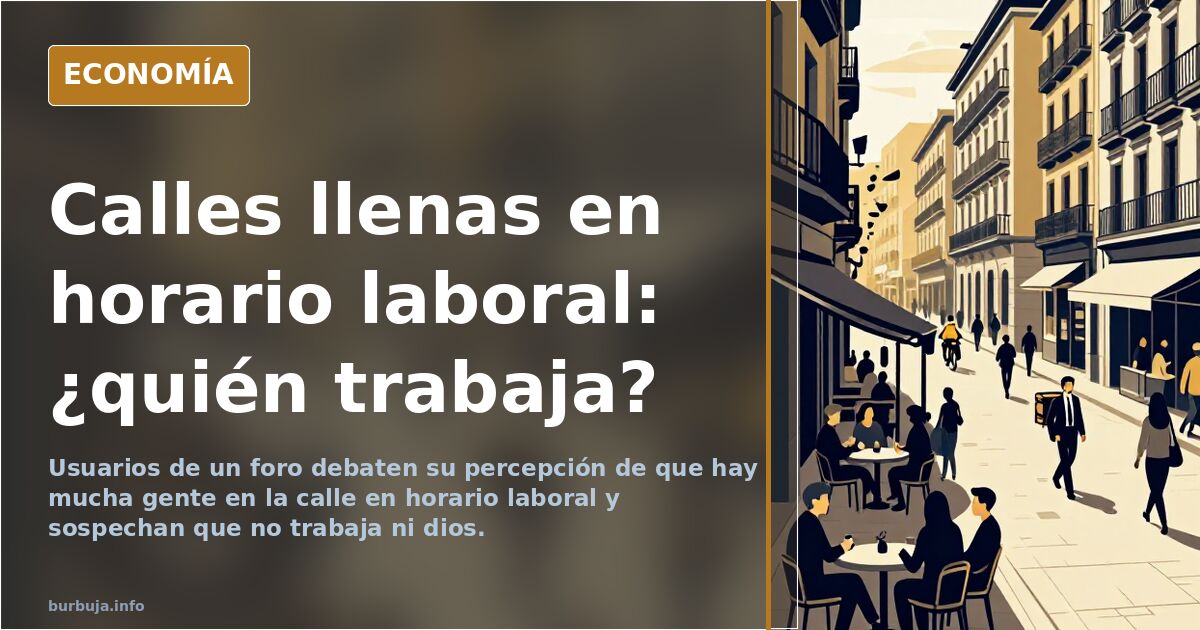
Full terraces at 11 AM: The gap between employment and actual work
On a Wednesday morning at eleven, city centers across Spain present a scene that contradicts official employment figures. Terraces are packed, exclusive gyms are full, shops have queues, and there is a sea of working-age people who are not clocking in. This sight repeats itself in Bilbao, Madrid, and Seville. It fuels an uncomfortable suspicion: the feeling that nobody actually works.
The issue is not new, but the diagnosis has become sharper. Two decades ago, bars were empty mid-morning and streets bustled with workers. Today, anyone running errands during work hours encounters a landscape that looks like Saturday. Something has changed, and not just in the labor market.
Why are so many people on the street during work hours?
The answer is multifaceted. Part of this crowd consists of pensioners — Spain exceeds ten million — civil servants with intensive schedules who are free by two PM, and a legion of workers with split shifts that turn noon into a desert. Added to this is public employment: 3.5 million civil servants and a constellation of advisors and various state-funded bodies that inflate the government payroll.
But there is another, more uncomfortable layer. That of those who simply do not work. Structural unemployment, long-term sick leave, subsidies, and aid create a cushion that allows living without lifting a finger. "Benefit recipients," in popular slang. And they are not all young: there are many fifty-year-olds on the terrace and many twenty-somethings stuck in eternal exam preparation mode.
The unsettling calculation: four rowers for every ten
Some argue that only one-third of the population is productive. The math isn't exact, but the order of magnitude is frightening. If you add pensioners, civil servants, the unemployed, students, and those in the underground economy to those who truly work — those generating wealth — the result is that a minority supports a majority.
This phenomenon has an external component: Northern European countries partially finance this model. And an internal one: the underground economy, which has always been generous in Spain. The combination produces a perverse effect. Those who work see their effort diluted in a system that rewards inactivity. And they start asking themselves why keep rowing.
Portugal as a mirror: The work ethic Spain lost
Comparisons with Portugal have become commonplace. Recent travelers to Viana do Castelo, Vila do Conde, or Águeda describe a work environment reminiscent of Spain thirty years ago. Bustling streets, people working, full offices. The contrast with Spanish cities at the same hour is stark.
It is no coincidence. Portugal has a different employment rate, a less generous subsidy structure, and a work culture that hasn't undergone the same decay process. The question is whether Spain can afford to continue down this path. And the answer, for now, remains unwritten.
The gap between employment and occupation: Data that doesn't match
Official statistics say there are more employed people than ever. But the street says otherwise. This contradiction is partly explained by job quality: part-time hours, temporary contracts, underground economy. People counted as employed but not working at eleven in the morning.
The result is a collective sensation difficult to combat. Those who wake up early, clock in, and endure ten hours from Monday to Thursday see how their effort sustains a system that gives nothing back. The temptation to drop out grows. It is not an employment crisis. It is an incentive crisis.
The scene repeats every morning. And the unsettling data is not how many work, but how many have stopped believing it is worth it.
On a Wednesday morning at eleven, city centers across Spain present a scene that contradicts official employment figures. Terraces are packed, exclusive gyms are full, shops have queues, and there is a sea of working-age people who are not clocking in. This sight repeats itself in Bilbao, Madrid, and Seville. It fuels an uncomfortable suspicion: the feeling that nobody actually works.
The issue is not new, but the diagnosis has become sharper. Two decades ago, bars were empty mid-morning and streets bustled with workers. Today, anyone running errands during work hours encounters a landscape that looks like Saturday. Something has changed, and not just in the labor market.
Why are so many people on the street during work hours?
The answer is multifaceted. Part of this crowd consists of pensioners — Spain exceeds ten million — civil servants with intensive schedules who are free by two PM, and a legion of workers with split shifts that turn noon into a desert. Added to this is public employment: 3.5 million civil servants and a constellation of advisors and various state-funded bodies that inflate the government payroll.
But there is another, more uncomfortable layer. That of those who simply do not work. Structural unemployment, long-term sick leave, subsidies, and aid create a cushion that allows living without lifting a finger. "Benefit recipients," in popular slang. And they are not all young: there are many fifty-year-olds on the terrace and many twenty-somethings stuck in eternal exam preparation mode.
The unsettling calculation: four rowers for every ten
Some argue that only one-third of the population is productive. The math isn't exact, but the order of magnitude is frightening. If you add pensioners, civil servants, the unemployed, students, and those in the underground economy to those who truly work — those generating wealth — the result is that a minority supports a majority.
This phenomenon has an external component: Northern European countries partially finance this model. And an internal one: the underground economy, which has always been generous in Spain. The combination produces a perverse effect. Those who work see their effort diluted in a system that rewards inactivity. And they start asking themselves why keep rowing.
Portugal as a mirror: The work ethic Spain lost
Comparisons with Portugal have become commonplace. Recent travelers to Viana do Castelo, Vila do Conde, or Águeda describe a work environment reminiscent of Spain thirty years ago. Bustling streets, people working, full offices. The contrast with Spanish cities at the same hour is stark.
It is no coincidence. Portugal has a different employment rate, a less generous subsidy structure, and a work culture that hasn't undergone the same decay process. The question is whether Spain can afford to continue down this path. And the answer, for now, remains unwritten.
The gap between employment and occupation: Data that doesn't match
Official statistics say there are more employed people than ever. But the street says otherwise. This contradiction is partly explained by job quality: part-time hours, temporary contracts, underground economy. People counted as employed but not working at eleven in the morning.
The result is a collective sensation difficult to combat. Those who wake up early, clock in, and endure ten hours from Monday to Thursday see how their effort sustains a system that gives nothing back. The temptation to drop out grows. It is not an employment crisis. It is an incentive crisis.
The scene repeats every morning. And the unsettling data is not how many work, but how many have stopped believing it is worth it.
Also available in: Deutsch
Summary of a discussion on Burbuja.info - Foro de economía, actualidad y política., translated from Spanish and reviewed before publication. Read the full discussion (155 replies).
More summaries
-
From the 15M campout to Sol: Fifteen Years and the Same Script
The housing protest culminates in a campout in Sol with the 2011 slogan. The electoral calendar and a potential non-payment regulation are central to the analysis.
-
Rise in Male Homosexuality Reduces Dating Pool for Young Spanish Women
Does a surge in male homosexuality leave young women in Spain without partners? An analysis of a debate blending math, stereotypes, and social anxiety.
-
Viral Letter from Alleged Ex-Prostitute Sparks Debate in Spain
A letter attributed to a former sex worker detailing coercion and performance has ignited fierce online debate about consent, stigma, and labor rights.
-
Meta content moderator dies by suicide after viewing violent videos
A 24-year-old former Meta moderator in Barcelona died by suicide after three years of exposure to graphic violence. Her family is considering legal action against Meta and Telus.
-
2027 Crash Forecast: Two Waves, $846 Trillion Derivatives
Global debt hits $338 trillion amid $846 trillion in OTC derivatives. A timeline predicts a systemic collapse starting in 2027.
-
Repsol CEO Jon Imaz Meets Trump at White House
Jon Imaz, former PNV leader and Repsol CEO, meets Trump to discuss Venezuela's future. Business pragmatism or political submission?