
Spain's MENA Centers Cost €24M for 120 Minors
Madrid spends over €24 million annually on 120 unaccompanied migrant minors, amid rising incidents and debate.
English · Original discussion in Spanish · Published
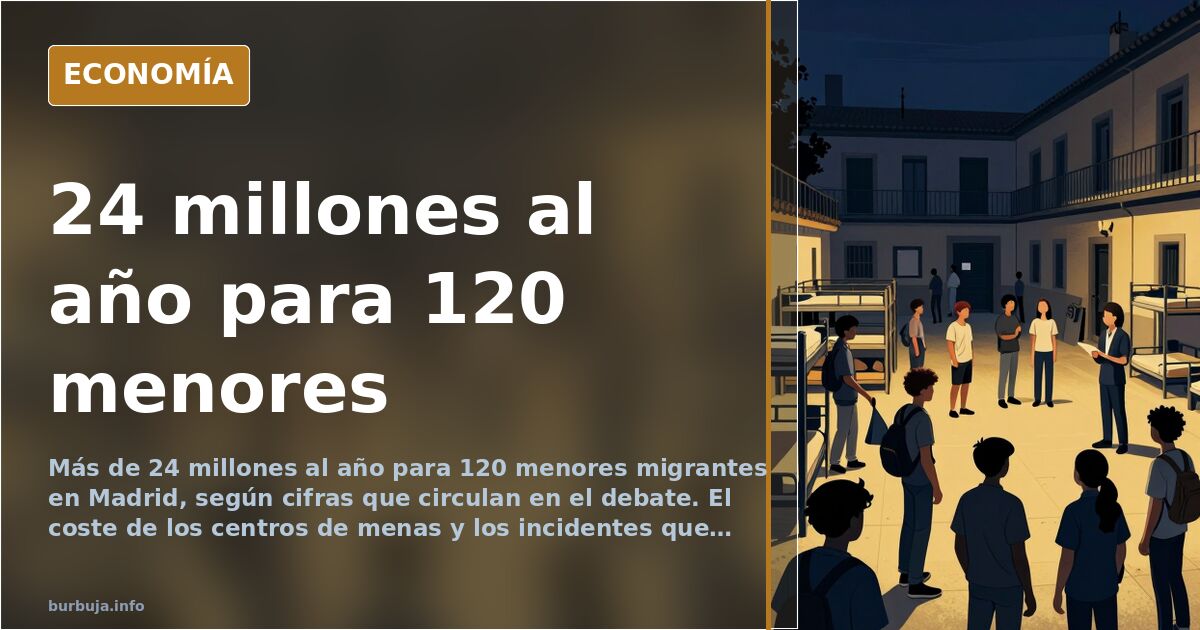
MENA Centers: €24 Million for 120 Placements in Madrid
How much does it cost to maintain a center for migrant minors? The figure circulating in public debate is uncomfortable: more than €24 million per year to care for 120 minors in the Community of Madrid, according to data used in the discussion. This equates to €250,000 per minor per year. Repeated ad nauseam, this number has become the main argument for those demanding a review of the reception model. The trigger for the latest controversy was a fire at the Hortaleza MENA Center (Centros de Menores Extranjeros No Acompañados), allegedly caused during a brawl between residents of different origins. Far from being isolated, this incident adds to a list that includes assaults on staff, thefts, and riots across Spain.
What peine at the Hortaleza MENA center?
The fire destroyed part of the facilities and required emergency services intervention. Reconstruction costs, according to circulating estimates, will exceed building the center from scratch. It is not the first time this center has made headlines: episodes of violence, threats against the director, and assaults on educators have been recorded in the same building. Meanwhile, the Minister of Social Affairs of the Community of Madrid stated that "there is no security problem" and that Segarro minors are willing to integrate. The gap between this statement and the accumulating facts in news archives is, at least, notable.
The business of contracts and cost per placement
While some look at spending, others look at profit. Awarding construction, supply, and personnel contracts for these centers moves considerable public funds. Some argue the system creates perverse incentives: the larger the problem, the more resources allocated, and the bigger the structures dependent on those funds. The Junta de Andalucía acknowledged that the budget for caring for MENAs exceeds €80 million. In Navarra, figures of €50,000 per minor are cited. Ceuta declared itself "on the brink of bankruptcy" because the cost of these minors equals its Local Police budget. Ultimately, the issue is not confined to Madrid alone.
Why do incidents surge in these centers?
Episodes recur: fires in Teruel and Zaragoza, assaults in Casa de Campo, death threats against a center director, and thefts reported by staff. In Teruel, two educators ended up hospitalized, one in the ICU, after an arson attack. The lingering question is whether the reception model is designed for integration or merely containment. Unions and social workers have long warned about lack of resources and unsustainable ratios. Some analyses suggest overcrowding and absence of prior filters aggravate conflicts. Others point to a root cause: the arrival of unaccompanied minors without effective migration control.
Political response: mandatory reception
Minister of Inclusion, Social Security and Migration, Elma Saiz, announced plans to push legal changes so that all autonomous communities are obliged to host migrant minors, regardless of their willingness. The measure landed poorly in several regions, which already warn they lack capacity and budget. The proposal reopens the eternal tug-of-war between the central government and regional authorities. Meanwhile, flights known as "patera flights" sens the arrival of MENAs in Madrid: eight out of ten entered via Barajas airport, according to cited data. Air travel has become the main entry point.
Jihadism and radicalization: an added factor
Growing concern over radicalization among some minors adds to the incident list. Police accused a network linked to the Imam of Melilla of instructing minors in explosives manufacturing. A minor converted to jihadism was arrested in Sitges while preparing an explosive attack. These are isolated cases but sufficient for intelligence services to raise alert levels. The combination of rootless minors, closed environments, and radical discourse is a cocktail nobody wants to manage.
How much will this cost us?
The headline question lacks a single answer. It depends on whether only direct expenses (placements, staff, security) are counted or if indirect costs are included: incidents, facility destruction, healthcare, judicial, and police attention. The full breakdown reveals surprising differences. While distribution debates continue, centers keep burning. In the end, the only consensus seems to be that someone will pay the bill. And it won't be precisely those causing it.
Also available in: Deutsch
Summary of a discussion on Burbuja.info - Foro de economía, actualidad y política., translated from Spanish and reviewed before publication. Read the full discussion (108 replies).
More summaries
-
Moroccan minor arrested for sexual assault of 14-year-old girl in Hortaleza
Sexual assault of a minor in Hortaleza, Madrid, by a 17-year-old. The incident reignites debate on immigration, politics, and juvenile justice.
-
Fire at Madrid Hortaleza Youth Center Leaves One Injured
A deliberately set fire at the Hortaleza youth center in Madrid injured one person and forced the evacuation of over 60 unaccompanied minors.
-
US midterm elections: Senate control decides Trump's political fate
One third of Senate seats are up for renewal and impeachment requires an absolute majority. That is why Republican control of the upper chamber shapes Trump's political future.
-
The Iberian union Portugal rejected and Spain has yet to come to terms with
The Iberian union was first tried in 1580 and lasted 60 years. Today, with 767,094 Portuguese civil servants versus 562,445 in Andalusia, the debate is back on the table.
-
Lula and the Sephardic ancestry debate stirring up politics
A tweet about Lula's Sephardic origins reopens the debate on genealogy and power: from Aznar to Maduro, everyone gets lumped together without verified evidence.
-
Vestrynge and the migration U-turn: a left that no longer believes its own story
Vestrynge, co-founder of Podemos, points to the cost of migration for wages and reopens the left's contradiction: capital drives it, but no one limits it