
Spain's Mandatory Military Draft: Legal Loopholes to Avoid Service
From age limits to wartime death penalties, this article explores how Spaniards discuss evading mandatory military mobilization.
English · Original discussion in Spanish · Published
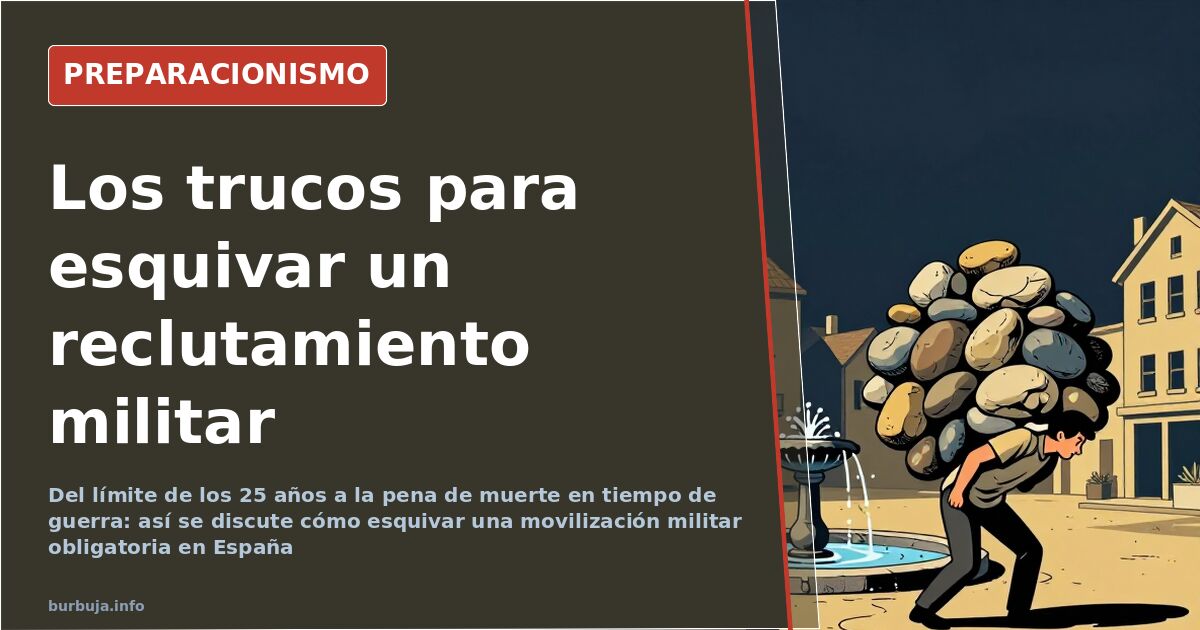
Avoiding Future War Drafts: The Legal Tricks Being Discussed
"Sorry, recruiter, I don't have a mask, I can't leave the house," replies a forum user. This is one of many responses when someone asks the uncomfortable question: if there were a mandatory mobilization tomorrow, how would you escape? The conversation isn't just barracks banter. It mixes constitutional law, trench medicine, and a rather raw calculation of interests. The starting point is familiar: grandparents who went to fight in the Civil War "to die for the interests of two opposing elites."
Requirements That Exclude Half of Spain
The first filter is administrative. It is claimed that after age 25 you are no longer called up and that any intentional crime is incompatible with incorporation. The reference used is Article 59, which regulates the cessation of the status of the mandatory reservist: it ends upon completion of activation, which cannot exceed the maximum time set by the Council of Ministers. The fine print weighs more than the headline.
What doesn't hold up is that such a norm could be changed in an afternoon. Much of the exchange revolves around how easy it would be to adapt the law if the scenario becomes tense. The repeated answer: it will depend on the majority in Congress and how long the courts hold out.
Glasses, Medication, and the Body as a Shield
The second route is physical. Wearing glasses, taking drugs that advise against driving, having a psychiatric diagnosis or a history of substance use. It is argued that, at most, you would be assigned to the rear guard. One intervention summarizes the idea: it doesn't seem reasonable to give a loaded rifle to certain profiles. And the reasoning turns common sense upside down: instead of hiding the medical problem, it is displayed.
Here the issue splits. Some see the medical filter as a real way out; others recall that the institution itself already screens and that an unstable profile is not wanted even in the rear guard. An army doesn't want anyone who might shoot their comrades, it is said.
Self-Harm, Conscientious Objection, and Other Ugly Exits
Among the proposals exchanged are those that hurt: pretending to be a healthcare worker, declaring mortal hatred for officers, appearing as a danger to command. The underlying idea is that a noisy record yields more than a silent escape. The frontal declaration of hostility towards the military structure is proposed as a method and, at the same time, as a risk.
Not everyone buys into the plan. Feigning dementia or playing dumb is seen as a bet with an expiration date: if the country is cornered, exemptions are cut back. Some warn that the norm changes in a second when things go wrong. Today's legal fiction may be tomorrow's file.
Death Penalty for Deserters? Article 15 Comes Into Play
The most legalistic part arrives here. Article 15 of the Constitution declares the death penalty abolished "except what military incivil laws may provide for times of war." From there, a forum user argues that reinstating it would not require touching the constitutional text: it would suffice to modify the law that eliminated it from the Military Penal Code, with an absolute majority. Article 81 confirms this: organic laws are approved by an absolute majority of Congress.
The reply comes just as fast. That Article 10 — dignity and rights — carries equal or greater weight than Article 15. That the state of war does not suspend the Constitution, but rather the Constitution itself regulates it. And that international conventions bind the legislator. The tug-of-war remains open: some believe that in 24 hours the military incivil law can be rewritten, while others maintain that human rights are not disconnected by decree.
Changing Gender on ID and Taking a Boat to the Southern Cone
If the legal route isn't enough, there are breakaway plans. Changing gender on the ID card and passport is proposed without irony. Others point to the boat: take the family and ask for asylum as war refugees in Uruguay, Chile, or Cuba. "Let those who profit from war fight it," summarizes someone citing a great-grandfather hidden in a barn during the Civil War. And there are those who, jokingly, present a party membership card as a safe-conduct pass.
Then there is the most cynical side. Some announce they will learn the language of the winner, hang the invader's flag on the balcony, or switch sides with an opportunistic shout. Others doubt that a modern power recruits civilians just to feed the front: to take you, people must first come looking for you.
Memory of the Civil War and the Calculation of Chance
The historical background is not decorative. The case of a mother's father who worked in Bilbao on July 18, 1936 and ended up as a sergeant on the Republican side is recalled; in his town in Navarre he would have fought with the Nationalists. "Simple chance," says the narrator. The story serves to deactivate epic narratives: if half the family ended up on one side depending on where the coup caught them, today's loyalty is equally circumstantial.
From this emerges the idea hovering over the thread: switching to the enemy is presented almost as a virtue and desertion as cowardice. A saying circulates between joke and seriousness: the good thing about civil wars is how easy it is to explain to the other side why you're switching. Pragmatism has centuries behind it and shows no signs of retiring.
The question still lacks a single answer. What does appear is a collective calculation: if wars shorten and people value their lives more than before, the number of those dodging the draft grows. According to one forum user, in the mandatory service era, more than 100,000 people skipped it. That is the data nobody knows how to convert into a percentage of a hypothetical front.
"Sorry, recruiter, I don't have a mask, I can't leave the house," replies a forum user. This is one of many responses when someone asks the uncomfortable question: if there were a mandatory mobilization tomorrow, how would you escape? The conversation isn't just barracks banter. It mixes constitutional law, trench medicine, and a rather raw calculation of interests. The starting point is familiar: grandparents who went to fight in the Civil War "to die for the interests of two opposing elites."
Requirements That Exclude Half of Spain
The first filter is administrative. It is claimed that after age 25 you are no longer called up and that any intentional crime is incompatible with incorporation. The reference used is Article 59, which regulates the cessation of the status of the mandatory reservist: it ends upon completion of activation, which cannot exceed the maximum time set by the Council of Ministers. The fine print weighs more than the headline.
What doesn't hold up is that such a norm could be changed in an afternoon. Much of the exchange revolves around how easy it would be to adapt the law if the scenario becomes tense. The repeated answer: it will depend on the majority in Congress and how long the courts hold out.
Glasses, Medication, and the Body as a Shield
The second route is physical. Wearing glasses, taking drugs that advise against driving, having a psychiatric diagnosis or a history of substance use. It is argued that, at most, you would be assigned to the rear guard. One intervention summarizes the idea: it doesn't seem reasonable to give a loaded rifle to certain profiles. And the reasoning turns common sense upside down: instead of hiding the medical problem, it is displayed.
Here the issue splits. Some see the medical filter as a real way out; others recall that the institution itself already screens and that an unstable profile is not wanted even in the rear guard. An army doesn't want anyone who might shoot their comrades, it is said.
Self-Harm, Conscientious Objection, and Other Ugly Exits
Among the proposals exchanged are those that hurt: pretending to be a healthcare worker, declaring mortal hatred for officers, appearing as a danger to command. The underlying idea is that a noisy record yields more than a silent escape. The frontal declaration of hostility towards the military structure is proposed as a method and, at the same time, as a risk.
Not everyone buys into the plan. Feigning dementia or playing dumb is seen as a bet with an expiration date: if the country is cornered, exemptions are cut back. Some warn that the norm changes in a second when things go wrong. Today's legal fiction may be tomorrow's file.
Death Penalty for Deserters? Article 15 Comes Into Play
The most legalistic part arrives here. Article 15 of the Constitution declares the death penalty abolished "except what military incivil laws may provide for times of war." From there, a forum user argues that reinstating it would not require touching the constitutional text: it would suffice to modify the law that eliminated it from the Military Penal Code, with an absolute majority. Article 81 confirms this: organic laws are approved by an absolute majority of Congress.
The reply comes just as fast. That Article 10 — dignity and rights — carries equal or greater weight than Article 15. That the state of war does not suspend the Constitution, but rather the Constitution itself regulates it. And that international conventions bind the legislator. The tug-of-war remains open: some believe that in 24 hours the military incivil law can be rewritten, while others maintain that human rights are not disconnected by decree.
Changing Gender on ID and Taking a Boat to the Southern Cone
If the legal route isn't enough, there are breakaway plans. Changing gender on the ID card and passport is proposed without irony. Others point to the boat: take the family and ask for asylum as war refugees in Uruguay, Chile, or Cuba. "Let those who profit from war fight it," summarizes someone citing a great-grandfather hidden in a barn during the Civil War. And there are those who, jokingly, present a party membership card as a safe-conduct pass.
Then there is the most cynical side. Some announce they will learn the language of the winner, hang the invader's flag on the balcony, or switch sides with an opportunistic shout. Others doubt that a modern power recruits civilians just to feed the front: to take you, people must first come looking for you.
Memory of the Civil War and the Calculation of Chance
The historical background is not decorative. The case of a mother's father who worked in Bilbao on July 18, 1936 and ended up as a sergeant on the Republican side is recalled; in his town in Navarre he would have fought with the Nationalists. "Simple chance," says the narrator. The story serves to deactivate epic narratives: if half the family ended up on one side depending on where the coup caught them, today's loyalty is equally circumstantial.
From this emerges the idea hovering over the thread: switching to the enemy is presented almost as a virtue and desertion as cowardice. A saying circulates between joke and seriousness: the good thing about civil wars is how easy it is to explain to the other side why you're switching. Pragmatism has centuries behind it and shows no signs of retiring.
The question still lacks a single answer. What does appear is a collective calculation: if wars shorten and people value their lives more than before, the number of those dodging the draft grows. According to one forum user, in the mandatory service era, more than 100,000 people skipped it. That is the data nobody knows how to convert into a percentage of a hypothetical front.
Also available in: Deutsch
Summary of a discussion on Burbuja.info - Foro de economía, actualidad y política., translated from Spanish and reviewed before publication. Read the full discussion (122 replies).
More summaries
-
Spain's Legal Limits on Desired Firearms
Forum users discuss dream guns like the AMT Hardballer and MG-42, noting Spain's strict legal ceilings.
-
Spanish Ropera vs Katana: Steel, Point, and Reach
Spanish steel and the ropera’s point against the katana’s edge: the debate’s arguments and why cutting still has defenders.
-
Living at 11°C with €70 in Military Surplus Gear
Three military surplus items for €64 and a home at 11°C without heating. The debate on humidity, insulation, and temperature has lasted over a thousand days...
-
Utopia 2013: Where to Download the British Series on P2P
The British series Utopia (2013), with two subtitled seasons, is still available on eMule, torrent and direct download
-
Spain's Food Stockpiles Range From Days to a Year
Food reserves in Spain vary widely, from croissants to year-long supplies, with most aiming for one month.
-
Caudillo del Tajo: Spanish Prophecy Lacks Documentary Proof
The 'Caudillo of the Tagus' appears in no sacred text and lacks verifiable evidence, revealing how this apocalyptic prophecy was constructed.