
Spain's major construction firms won't collapse: fire boosts demand
The Valencia building fire barely impacted stock markets. Experts predict no bankruptcies for large contractors, as facade inspections will generate significant new work.
English · Original discussion in Spanish · Published
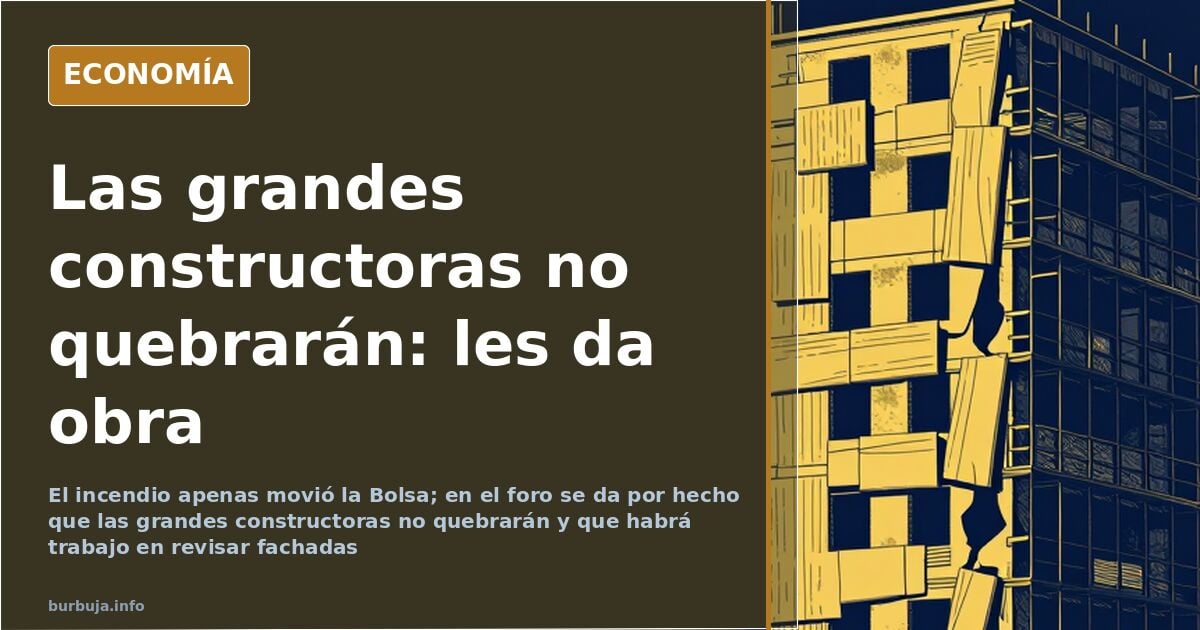
Spain's major construction firms won't collapse: fire boosts demand
A residential building fire in Valencia has highlighted thermal envelope issues: insulation layers added to thousands of older facades to improve energy efficiency. Stock markets barely reacted. According to forum posts, shares fell 0.3% on the news day and recovered the next. The core debate reveals a contradiction repeated by participants: there is no illegality, only legalized materials.
What materials are used in renovated facades?
Polyurethane. Nearly all buildings use it in some form, notes one participant: inside brick cavities of old structures and sprayed or paneled in new ones. The most cited renovation system is SATE (External Thermal Insulation Composite System), which includes varied solutions like expanded polystyrene, extruded foam, mineral wool, and spray foam.
Technical nuances define the problem. One participant cites a graphite polystyrene insulation sheet declaring a class E fire reaction: combustible material with high fire contribution. Legally, this should not be used on facades unless installation guarantees better behavior or an EI 30 stability layer protects it. Conversely, another message argues that current SATE systems are self-extinguishing and polystyrene does not burn as easily as apocalyptic narratives suggest. However, strong winds, chimney effects, and high ambient temperatures mentioned in the thread make this argument uncomfortable.
Will construction firms go bankrupt after the fire?
Major companies, no. Several messages repeat this view: Spain's large construction firms are diversified civil engineering, building, and service companies operating globally; a single incident does not impact their balance sheets. So far, the stock market reflected minimal impact.
Small businesses differ. Thousands of small firms rely on facade renovations, according to one participant. In Navarre alone, 56 such companies are working at full capacity with backlogged orders. If homeowners' associations freeze approved works, paralysis hits freelancers with three vans, not giants. The sector grew via energy efficiency subsidies; now it faces uncertainty between halting or expanding, since inspecting thousands of buildings is also work.
Who is liable if the facade was legal?
Almost no one. The prevailing argument is simple: if the building complied with regulations at the time, there is no liability. The material was not just legal; it was what rules encouraged. Replacement costs fall on owners, where it hurts most.
Many look to the UK precedent, where sales— including second-hand—of flats with specific facade claddings were banned, per one participant. An uncomfortable question remains: who is responsible when regulators, certifiers, and installers all comply, yet the result still burns?
The costly burden of special assessments
Money is central here. A participant describes how their community unanimously rejected a facade insulation project costing over €600,000, roughly €12,000 per resident, after promised subsidies vanished mid-process. Some communities took loans assuming those grants existed. Special assessments do not forgive failed subsidies.
Physical wear matters too. Another message claims ventilated facade panels begin detaching after 8 or 10 years. In a known acquaintance’s building, the second assessment to replace them reached nearly €2 million while the first was still being paid. A third message from an industry worker notes ceramic plate versions exist instead of aluminum: heavier, fixed with brackets, and prone to falling. In fires, extinguishing becomes harder for responders.
What will residents demand?
Demands include switching insulation to rock wool, favored for fire resistance, and requesting inspections. Crucially, residents must realize zero fees were illusory. Property managers face turbulent years ahead, with meetings questioning certificates and extra costs.
How many communities will act versus lament for three days? This is the quiet question the sector asks, for which no number exists.
A residential building fire in Valencia has highlighted thermal envelope issues: insulation layers added to thousands of older facades to improve energy efficiency. Stock markets barely reacted. According to forum posts, shares fell 0.3% on the news day and recovered the next. The core debate reveals a contradiction repeated by participants: there is no illegality, only legalized materials.
What materials are used in renovated facades?
Polyurethane. Nearly all buildings use it in some form, notes one participant: inside brick cavities of old structures and sprayed or paneled in new ones. The most cited renovation system is SATE (External Thermal Insulation Composite System), which includes varied solutions like expanded polystyrene, extruded foam, mineral wool, and spray foam.
Technical nuances define the problem. One participant cites a graphite polystyrene insulation sheet declaring a class E fire reaction: combustible material with high fire contribution. Legally, this should not be used on facades unless installation guarantees better behavior or an EI 30 stability layer protects it. Conversely, another message argues that current SATE systems are self-extinguishing and polystyrene does not burn as easily as apocalyptic narratives suggest. However, strong winds, chimney effects, and high ambient temperatures mentioned in the thread make this argument uncomfortable.
Will construction firms go bankrupt after the fire?
Major companies, no. Several messages repeat this view: Spain's large construction firms are diversified civil engineering, building, and service companies operating globally; a single incident does not impact their balance sheets. So far, the stock market reflected minimal impact.
Small businesses differ. Thousands of small firms rely on facade renovations, according to one participant. In Navarre alone, 56 such companies are working at full capacity with backlogged orders. If homeowners' associations freeze approved works, paralysis hits freelancers with three vans, not giants. The sector grew via energy efficiency subsidies; now it faces uncertainty between halting or expanding, since inspecting thousands of buildings is also work.
Who is liable if the facade was legal?
Almost no one. The prevailing argument is simple: if the building complied with regulations at the time, there is no liability. The material was not just legal; it was what rules encouraged. Replacement costs fall on owners, where it hurts most.
Many look to the UK precedent, where sales— including second-hand—of flats with specific facade claddings were banned, per one participant. An uncomfortable question remains: who is responsible when regulators, certifiers, and installers all comply, yet the result still burns?
The costly burden of special assessments
Money is central here. A participant describes how their community unanimously rejected a facade insulation project costing over €600,000, roughly €12,000 per resident, after promised subsidies vanished mid-process. Some communities took loans assuming those grants existed. Special assessments do not forgive failed subsidies.
Physical wear matters too. Another message claims ventilated facade panels begin detaching after 8 or 10 years. In a known acquaintance’s building, the second assessment to replace them reached nearly €2 million while the first was still being paid. A third message from an industry worker notes ceramic plate versions exist instead of aluminum: heavier, fixed with brackets, and prone to falling. In fires, extinguishing becomes harder for responders.
What will residents demand?
Demands include switching insulation to rock wool, favored for fire resistance, and requesting inspections. Crucially, residents must realize zero fees were illusory. Property managers face turbulent years ahead, with meetings questioning certificates and extra costs.
How many communities will act versus lament for three days? This is the quiet question the sector asks, for which no number exists.
Also available in: Deutsch
Summary of a discussion on Burbuja.info - Foro de economía, actualidad y política., translated from Spanish and reviewed before publication. Read the full discussion (136 replies).
More summaries
-
Educational disaster in Spain: Worst results in history in PISA report, falling up to two school years behind the United Kingdom
Spain plunges in PISA 2025 report, showing a two-year lag in reading compared to the UK. We analyze the causes and consequences.
-
Miss UK: Who Decides What Beauty Is in a Pageant
Miss UK: the crowning of its winner reignites the debate over representation, beauty, and who really funds the contests
-
UK plans migrant detention barge
A UK proposal to detain irregular migrants on a barge sparks debate over costs, failed returns, and the Rwanda scheme.
-
Officials Flee Ministries to Avoid Signing Illegal Documents
Ministry officials under suspicion request transfers to avoid signing illegal documents. Political pressure and fear of reprisals trigger a mass exodus...
-
Montero and Belarra bathroom photo sparks backlash
A photo of Spanish politicians Irene Montero and Ione Belarra in a bar restroom triggers criticism over perceived frivolity amid economic hardship.
-
Spain suspends Adamuz train victims memorial after family backlash
Spanish government and Andalusia cancel secular tribute to Adamuz crash victims following families' rejection of what they call political propaganda.