
UK plans migrant detention barge
A UK proposal to detain irregular migrants on a barge sparks debate over costs, failed returns, and the Rwanda scheme.
English · Original discussion in Spanish · Published
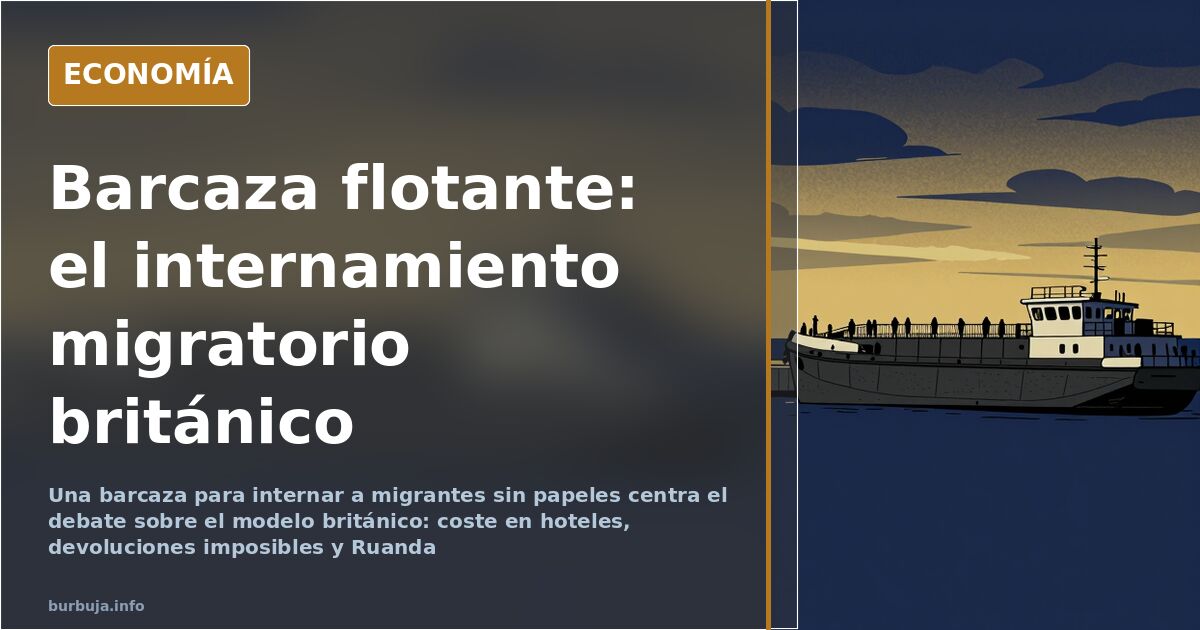
UK plans migrant detention barge
Can an asylum seeker be held on a docked ship while a court decides their fate? This is the premise of the discussion opening this thread: a vessel converted into closed accommodation for irregular migrants, described as a "floating prison," "pure capitalism," and contrary "to humanity itself," referencing an ABC report. The bureaucratic reality dictates that until the process ends, the migrant cannot be deported nor is free.
What is a floating prison and how long has it been used?
A barge anchored or moored in port, turned into guarded housing. This formula is not new in British waters: the discussion notes such vessels have been used since the 1990s to house both migrants and offshore oil workers, diminishing the novelty of the announcement. What changes is the purpose: no longer temporary housing, but detention with conditional release.
The issue gained international attention via a BBC piece dated July 12, 2023, cited here as proof the project hasn't been abandoned despite previous attempts. Thus, the barge would be the visible part of a broader design.
The cost: hotels, cash allowances, and a vessel
Here lies the economic objection. Until cases are resolved, according to accounts from those who lived within the system, applicants stayed in hotels with freedom of movement to play football or come and go, plus a cash allowance. Some argue this regime is unsustainable and the barge only adds another bill.
Others defend deterrence: if detention is uncomfortable, residents may request voluntary deportation before exhausting legal appeals, saving the state the full procedure. This views the measure as a tool for economic management of caseloads, not just migration policy. The full calculation—hotel vs. barge, month by month—is what remains hidden.
The real obstacle: no documentation means no return
The debate gets tangled here, not for ideological reasons. Many migrants arrive without documents, so their country of origin is unknown, and consulted nations often refuse readmission, claiming the person isn't theirs. A state unable to identify or receive someone back cannot deport them, regardless of political will.
Hence, detention presents itself as an intermediate solution: it doesn't solve returns but keeps people in controlled limbo. The circulating Plan B involves sending individuals to third countries—mentioning Rwanda—a route that shifts the problem rather than solving it. It remains to be seen which courts accept each piece.
Hong Kong, Australia, Nigeria, and Spanish enclaves
The debate highlights precedents. References are made to Hong Kong cages, Australian detention centers for those who cannot be returned, and Nigerian prisons holding undocumented persons until passports and tickets arrive. The comparison leads to an uncomfortable conclusion: detaining non-returnable migrants has decades of history, mostly out of the spotlight.
The Spanish angle is presented as a theoretical exercise: using the Peñón de Vélez de la Gomera, Alhucemas, or Perejil Island as sites for such facilities, with military surveillance but allowing self-initiated return to Segarro. These are speculative proposals without known administrative backing.
How is the measure being received?
Opinions range from unqualified approval to sarracena condemnation. One view argues a sovereign state can decide where to house unauthorized entrants and that confinement is more humane than street homelessness. Meanwhile, criticism focuses on cost and the lack of results from years of migration policy.
Underlying this is an unanswered question: if procedures take months, any housing solution becomes exorbitantly expensive. If procedures are shortened without safeguards, the problem ceases to be the boat.
With these elements, some conclude the floating prison makes perfect sense: it is the only infrastructure capable of drifting aimlessly while someone, in some office, decides what to do with the passenger.
Can an asylum seeker be held on a docked ship while a court decides their fate? This is the premise of the discussion opening this thread: a vessel converted into closed accommodation for irregular migrants, described as a "floating prison," "pure capitalism," and contrary "to humanity itself," referencing an ABC report. The bureaucratic reality dictates that until the process ends, the migrant cannot be deported nor is free.
What is a floating prison and how long has it been used?
A barge anchored or moored in port, turned into guarded housing. This formula is not new in British waters: the discussion notes such vessels have been used since the 1990s to house both migrants and offshore oil workers, diminishing the novelty of the announcement. What changes is the purpose: no longer temporary housing, but detention with conditional release.
The issue gained international attention via a BBC piece dated July 12, 2023, cited here as proof the project hasn't been abandoned despite previous attempts. Thus, the barge would be the visible part of a broader design.
The cost: hotels, cash allowances, and a vessel
Here lies the economic objection. Until cases are resolved, according to accounts from those who lived within the system, applicants stayed in hotels with freedom of movement to play football or come and go, plus a cash allowance. Some argue this regime is unsustainable and the barge only adds another bill.
Others defend deterrence: if detention is uncomfortable, residents may request voluntary deportation before exhausting legal appeals, saving the state the full procedure. This views the measure as a tool for economic management of caseloads, not just migration policy. The full calculation—hotel vs. barge, month by month—is what remains hidden.
The real obstacle: no documentation means no return
The debate gets tangled here, not for ideological reasons. Many migrants arrive without documents, so their country of origin is unknown, and consulted nations often refuse readmission, claiming the person isn't theirs. A state unable to identify or receive someone back cannot deport them, regardless of political will.
Hence, detention presents itself as an intermediate solution: it doesn't solve returns but keeps people in controlled limbo. The circulating Plan B involves sending individuals to third countries—mentioning Rwanda—a route that shifts the problem rather than solving it. It remains to be seen which courts accept each piece.
Hong Kong, Australia, Nigeria, and Spanish enclaves
The debate highlights precedents. References are made to Hong Kong cages, Australian detention centers for those who cannot be returned, and Nigerian prisons holding undocumented persons until passports and tickets arrive. The comparison leads to an uncomfortable conclusion: detaining non-returnable migrants has decades of history, mostly out of the spotlight.
The Spanish angle is presented as a theoretical exercise: using the Peñón de Vélez de la Gomera, Alhucemas, or Perejil Island as sites for such facilities, with military surveillance but allowing self-initiated return to Segarro. These are speculative proposals without known administrative backing.
How is the measure being received?
Opinions range from unqualified approval to sarracena condemnation. One view argues a sovereign state can decide where to house unauthorized entrants and that confinement is more humane than street homelessness. Meanwhile, criticism focuses on cost and the lack of results from years of migration policy.
Underlying this is an unanswered question: if procedures take months, any housing solution becomes exorbitantly expensive. If procedures are shortened without safeguards, the problem ceases to be the boat.
With these elements, some conclude the floating prison makes perfect sense: it is the only infrastructure capable of drifting aimlessly while someone, in some office, decides what to do with the passenger.
Also available in: Deutsch
Summary of a discussion on Burbuja.info - Foro de economía, actualidad y política., translated from Spanish and reviewed before publication. Read the full discussion (147 replies).
More summaries
-
Educational disaster in Spain: Worst results in history in PISA report, falling up to two school years behind the United Kingdom
Spain plunges in PISA 2025 report, showing a two-year lag in reading compared to the UK. We analyze the causes and consequences.
-
Miss UK: Who Decides What Beauty Is in a Pageant
Miss UK: the crowning of its winner reignites the debate over representation, beauty, and who really funds the contests
-
UK urges citizens to stock three-day emergency kit
British government advises storing water, canned food and candles for a potential three-day supply outage during emergencies.
-
PP and Vox's 210 seats: the constitutional reform that won't happen
PP and Vox could reach 210 seats, the three-fifths needed to reform the Constitution. Polls give them 205. An analysis of the arithmetic and the skepticism.
-
IMAX in Las Rozas: €13 tickets plus €1.70 booking fee
An IMAX cinema in Las Rozas charges €13 per ticket plus a €1.70 service fee, while a Seville venue offers €9 bundles including snacks.
-
Athletic Bilbao boat parade draws 100,000 fans
100,000 people watched Athletic Bilbao's gabarra in Spain; only four chairs damaged, sparking debate on Basque fiscal rules.