
Spain's Labor Ministry spent €68,000 on churros in seven months
A tweet claims the Spanish Labor Ministry spent €68,000 on churros and pastries over seven months. Online users debate the figure and who pays.
English · Original discussion in Spanish · Published
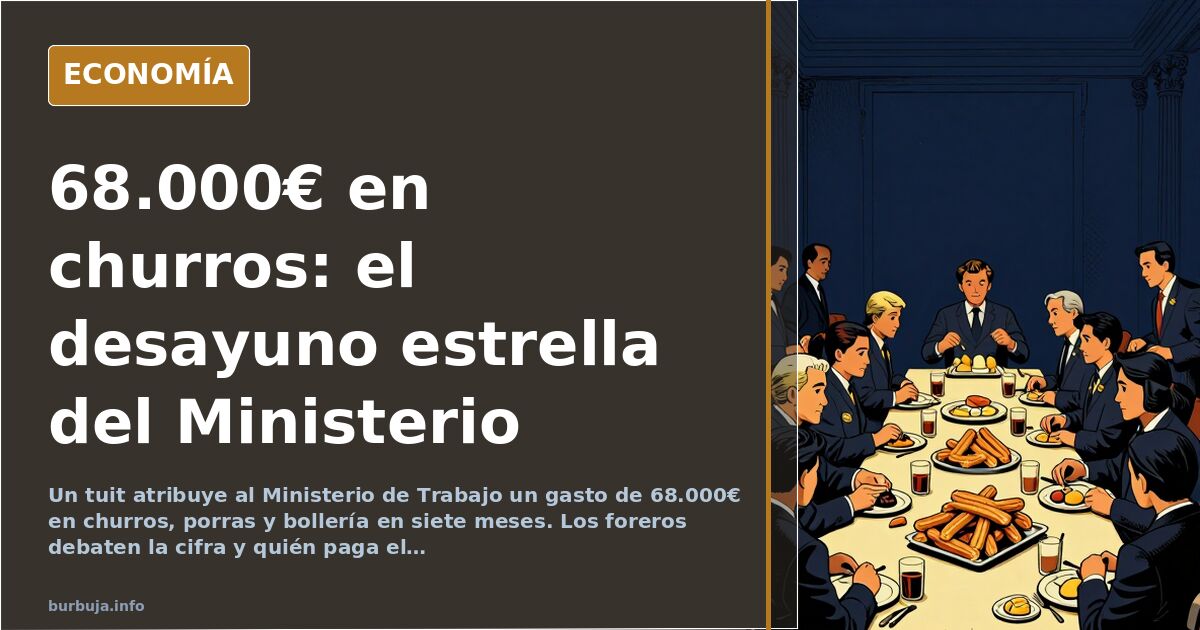
Labor Ministry: €68,000 on churros and pastries in seven months, according to a tweet
One figure. €68,000 on churros, porras (longer, thicker churros), and industrial pastries. This is the expense allegedly incurred by the Ministry of Labor over seven months, according to a tweet from The Objective that has sparked debate. Far from being a minor administrative detail, this item has peine an uncomfortable question: what does the state machinery eat, at whose cost, and why, when no one watches the small bills?
The breakdown circulating is not trivial. Of those €68,000, part corresponds to porras —3,712 units, according to the count being shared— adding a longer and thicker variant to the classic churro. The joke writes itself. The problem is that behind the joke lies a bill that, according to forum users, is paid by the taxpayer, and a question that no official statement has yet answered: how many people have free breakfast in that building and with what legal justification?
How many churros are €68,000?
Arithmetic is the first thing done when such a figure appears. Assuming a wholesale price of €2 per dozen, the calculation yields 34,000 dozens, or 408,000 churros. If the price rises to €3, the figure drops to about 272,000. And if the neighborhood price is taken —€6 per dozen, the price paid in any local café— the result remains around 136,000 units. Any of the three scenarios leads to the same conclusion: that is a lot of churros.
Distributed among the working days of seven months, the daily rate moves between 900 and 1,500 churros. This figure is not a joke: it is an indicator of how many people have breakfast inside. And it opens the question that no one has answered with a document: how many public employees have their breakfast covered by the budget?
Public servants' breakfast is not free by law
Here is where the issue gets complicated. Breakfast is not listed among the remuneration concepts for any civil servant. There is no 'churro supplement', no canteen allowance covering pastries, no article obliging the Ministry to serve coffee and porras to its staff. If the expense exists, it exists through another channel: an internal cafeteria with subsidized prices, a supply contract, or catering. The difference between these three formulas is the difference between a service and a hole.
Some argue that it is a ministry cafeteria with hundreds of workers, and that €68,000 in seven months is not an absurd figure to serve that workforce. The argument makes sense if the service is paid for. It loses strength if breakfast is free. And that is exactly the line separating anecdote from scandal.
The calculation that dismantles the official narrative
The complete breakdown, item by item, with unit price, number of units, and distribution by working days, leaves a picture that surprises more than the headline. It is not just the volume. It is the structure: a recurring, annual current expense that has become part of the administrative landscape without anyone having discussed it in parliament.
Comparison with other ministries, other administrations, and the private sector reveals differences that cannot be explained by the size of the workforce. And the underlying question —why should public funds pay for a civil servant's breakfast?— still lacks an official answer. Meanwhile, the annual item exceeds €92,000, according to the data being handled.
What the contract says and what it doesn't say
Public contracts for food supply exist, are legal, and are regulated. What is not regulated is that the final beneficiary is the employee without counterpayment. If the cafeteria charges, the expense is recovered. If it does not charge, the expense is disguised subsidy. And if it charges below cost, the expense is the difference.
None of these three options appear detailed in the available information. What appears is the figure, the period, and the type of product. With that, each reader does their own math. And the math, in any scenario, does not add up with the austerity narrative sold in general budgets.
The matter ends where it started: with a churro bill and an unanswered question. How many, for whom, paid by whom. Three data points that any audit resolves in an afternoon. That at this stage they remain off the table says quite a bit about what is considered a priority to review and what is not.
Also available in: Deutsch
Summary of a discussion on Burbuja.info - Foro de economía, actualidad y política., translated from Spanish and reviewed before publication. Read the full discussion (110 replies).
More summaries
-
Spain proposes equalizing minimum wages in women's football
The Spanish government plans to equalize minimum salaries in women's and men's football, highlighting a stark disparity between 16,000 and 180,000 euros.
-
Yolanda Díaz eyes ILO top job after dropping out of Spain's 2027 election
Spanish Deputy PM Yolanda Díaz is seeking the ILO directorship after stepping aside from the 2027 general election. Critics call it a cushy appointment, likening it to Leire Pajín's case.
-
Spain's PSOE skips national budget as its narrative crumbles
Spain's PSOE has not presented the General State Budget and its mobilization failed to fill the streets, according to forum voices; the government remains in office.
-
Pokémon Cards: Forum Estimates 85% Weekly Drop
A forum estimates an 85% weekly drop in Pokémon card value and a $30 billion loss in one year.
-
Engineers and political appointees leaving Spain's Transport Ministry: the technical cost
More than twenty technical officials have left the Transport Ministry since Óscar Puente took over. Aicape denounces an engineer exodus and claims Adif has tripled its…
-
Splitting the bill in Finland sparks outrage in Spain
Two tweets about splitting the bill in Finland have sparked a heated debate: economic equality versus the gesture of treating someone. The calculator as a symbol of a...