
Spain proposes equalizing minimum wages in women's football
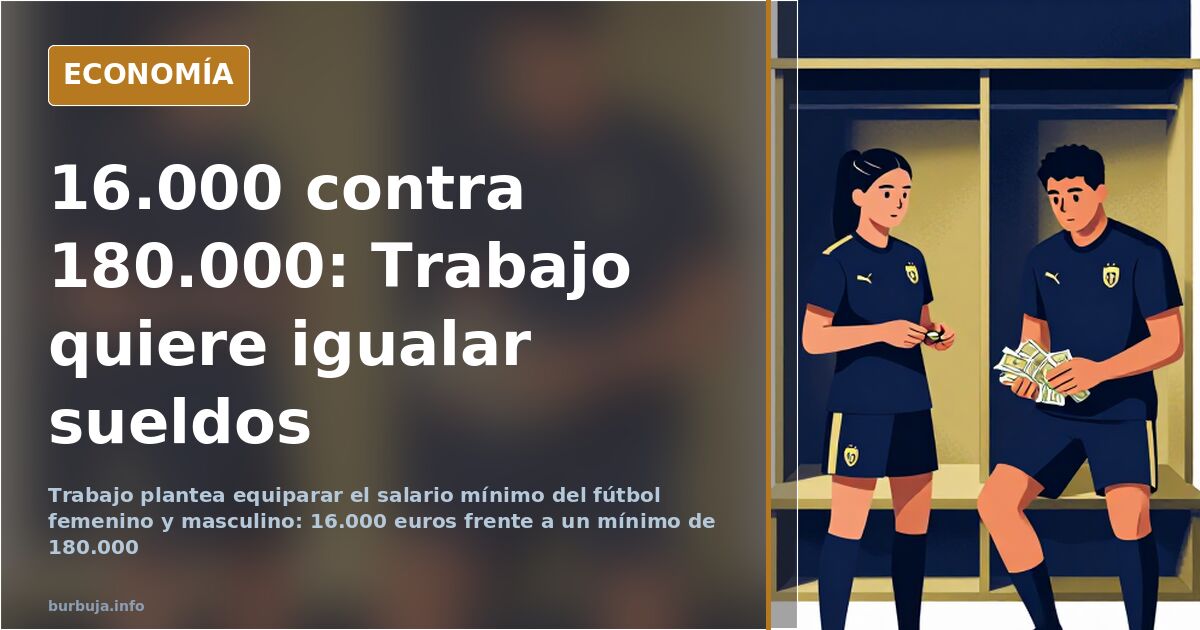
The Spanish government plans to equalize minimum salaries in women's and men's football, highlighting a stark disparity between 16,000 and 180,000 euros.
English · Original discussion in Spanish · Published
Spain proposes equalizing minimum wages in women's football
The minister of Labor stated this clearly: a female footballer cannot earn 16,000 euros a year while a male footballer receives 180,000 euros annually as a minimum simply for being male. This blunt statement, made during a radio interview, summarizes the debate peine in the Ministry of Labor: equalizing the minimum salaries of the women's and men's leagues. Minister Yolanda Díaz presented it as a way to "resolve a situation of irregularity and discrimination against women for being women." What trinc is not a matter of ideology, but a matter of results.
What has the Ministry of Labor announced?
According to what the minister herself revealed on air, she has been speaking all week, almost every hour, with feminist, union, and government representatives to prepare the ground. Parallel to this, study groups and protocols are being established to create spaces free from sens and gender-based violence within women's football. And the episode of the kiss during the World Cup celebration, dismissed until recently as a protocol excess, is now reframed as an issue of gender-based and, in part, sensual violence. This is a political, not judicial, qualification, and it should be read as such.
The wage gap in football: 16,000 euros vs. 180,000
The numbers at play are simple and, precisely for that reason, uncomfortable to defend before a microphone. 16,000 euros annually for an elite female footballer; 180,000 as a floor in men's top-flight football. Some argue that the comparison is misleading, because those 180,000 are not the salary of modest football: in Tercera Regional, it is argued, no one comes close to that figure. The average of the category does not withstand comparison with the elite.
Along the same lines, it is defended that there is no "men's football" as a closed compartment. There would be the absolute category—open to any player who measures up—and then a series of consolation competitions, including women's football or the under-21 and under-17 categories. The reasoning is debatable and quite uncomfortable, but it leaves a practical consequence: if the minimum is set by decree in both leagues, the problem is not the ceiling that stars aspire to, but the income floor that no one has generated.
What the gate receipts say and what TV rights pay
Professional sport is funded by tickets, season passes, advertising, and broadcast rights. In the women's league, the most common ticket price is around 5 euros, while a male football fan pays without blinking 100 or 150 euros to watch his team regularly. Television responds to the same audience criteria: if the men's football employers' association itself has had to reduce the price of its broadcast rights, it is difficult to imagine a million-dollar auction for a competition that moves much less people.
In the transfer market, the Spanish ceiling for women's football stood at 300,000 euros for a sale from Barcelona to Manchester United, and the highest transfer in the history of this league was paid for 400,000 euros. These are verifiable figures. And they are small figures. The gap is explained not only by viewer prejudice: it is explained, above all, by what the competition is able to generate.
Who pays for wage equalization?
Here lies the crux of the matter. If clubs do not generate enough to pay these salaries, someone will have to make up the difference. The options under consideration are direct subsidies, a forced distribution of men's football TV rights to the benefit of women's football, or a mix of both. Any of the three ultimately falls on the taxpayer, whether via taxes or via the impoverishment of the league that is currently profitable.
Women's teams are companies with a profit and loss statement: if wage costs rise above revenue, the competition does not grow, it closes. And there is a detail often forgotten in this discussion: if the minimum is raised overnight across all categories, the effect extends to subsidiary teams, youth academies, and lower divisions that today are sustained by minimal budgets. Some add, furthermore, that the increase in the general minimum wage has already been paid in the form of inflation.
The Rubiales case and the framing of gender-based violence
The emotional origin of all this lies in the World Cup celebration: Luis Rubiales' kiss to a player during the title festivities. What was then dismissed as a manual breach of protocol has been reframed, according to this framework, as an issue of gender-based and, in part, sensual violence. The consequence is that any economic discussion about women's football now comes wrapped in a sarracena label: those who question the figures, according to this framework, do not discuss numbers, they discuss rights.
This wrapping has a cost for the debate itself. When disagreement is interpreted as complicity with an assault, market arguments cease to be heard and decisions are made out of political urgency. And urgency, in matters of salaries, rarely produces good figures.
At the end of the journey lies a disconcerting figure. According to what is circulating, each international player would have earned 300,000 euros for winning the World Cup, well above the minimum of 180,000 attributed to male footballers. And a figure that no one from the Ministry has explained yet with paper in hand: 16,000 euros a year. The headline is already written. The account, not.
The minister of Labor stated this clearly: a female footballer cannot earn 16,000 euros a year while a male footballer receives 180,000 euros annually as a minimum simply for being male. This blunt statement, made during a radio interview, summarizes the debate peine in the Ministry of Labor: equalizing the minimum salaries of the women's and men's leagues. Minister Yolanda Díaz presented it as a way to "resolve a situation of irregularity and discrimination against women for being women." What trinc is not a matter of ideology, but a matter of results.
What has the Ministry of Labor announced?
According to what the minister herself revealed on air, she has been speaking all week, almost every hour, with feminist, union, and government representatives to prepare the ground. Parallel to this, study groups and protocols are being established to create spaces free from sens and gender-based violence within women's football. And the episode of the kiss during the World Cup celebration, dismissed until recently as a protocol excess, is now reframed as an issue of gender-based and, in part, sensual violence. This is a political, not judicial, qualification, and it should be read as such.
The wage gap in football: 16,000 euros vs. 180,000
The numbers at play are simple and, precisely for that reason, uncomfortable to defend before a microphone. 16,000 euros annually for an elite female footballer; 180,000 as a floor in men's top-flight football. Some argue that the comparison is misleading, because those 180,000 are not the salary of modest football: in Tercera Regional, it is argued, no one comes close to that figure. The average of the category does not withstand comparison with the elite.
Along the same lines, it is defended that there is no "men's football" as a closed compartment. There would be the absolute category—open to any player who measures up—and then a series of consolation competitions, including women's football or the under-21 and under-17 categories. The reasoning is debatable and quite uncomfortable, but it leaves a practical consequence: if the minimum is set by decree in both leagues, the problem is not the ceiling that stars aspire to, but the income floor that no one has generated.
What the gate receipts say and what TV rights pay
Professional sport is funded by tickets, season passes, advertising, and broadcast rights. In the women's league, the most common ticket price is around 5 euros, while a male football fan pays without blinking 100 or 150 euros to watch his team regularly. Television responds to the same audience criteria: if the men's football employers' association itself has had to reduce the price of its broadcast rights, it is difficult to imagine a million-dollar auction for a competition that moves much less people.
In the transfer market, the Spanish ceiling for women's football stood at 300,000 euros for a sale from Barcelona to Manchester United, and the highest transfer in the history of this league was paid for 400,000 euros. These are verifiable figures. And they are small figures. The gap is explained not only by viewer prejudice: it is explained, above all, by what the competition is able to generate.
Who pays for wage equalization?
Here lies the crux of the matter. If clubs do not generate enough to pay these salaries, someone will have to make up the difference. The options under consideration are direct subsidies, a forced distribution of men's football TV rights to the benefit of women's football, or a mix of both. Any of the three ultimately falls on the taxpayer, whether via taxes or via the impoverishment of the league that is currently profitable.
Women's teams are companies with a profit and loss statement: if wage costs rise above revenue, the competition does not grow, it closes. And there is a detail often forgotten in this discussion: if the minimum is raised overnight across all categories, the effect extends to subsidiary teams, youth academies, and lower divisions that today are sustained by minimal budgets. Some add, furthermore, that the increase in the general minimum wage has already been paid in the form of inflation.
The Rubiales case and the framing of gender-based violence
The emotional origin of all this lies in the World Cup celebration: Luis Rubiales' kiss to a player during the title festivities. What was then dismissed as a manual breach of protocol has been reframed, according to this framework, as an issue of gender-based and, in part, sensual violence. The consequence is that any economic discussion about women's football now comes wrapped in a sarracena label: those who question the figures, according to this framework, do not discuss numbers, they discuss rights.
This wrapping has a cost for the debate itself. When disagreement is interpreted as complicity with an assault, market arguments cease to be heard and decisions are made out of political urgency. And urgency, in matters of salaries, rarely produces good figures.
At the end of the journey lies a disconcerting figure. According to what is circulating, each international player would have earned 300,000 euros for winning the World Cup, well above the minimum of 180,000 attributed to male footballers. And a figure that no one from the Ministry has explained yet with paper in hand: 16,000 euros a year. The headline is already written. The account, not.
Summary of a discussion on Burbuja.info - Foro de economía, actualidad y política., translated from Spanish and reviewed before publication. Read the full discussion (276 replies).
More summaries
-
Rubiales resigns, putting 2030 World Cup in spotlight
Luis Rubiales steps down as president, casting doubt on Spain's 2030 World Cup bid amid ongoing controversy.
-
Riots in French schools: fires and attacks
Fires in French schools, teachers attacked and blockades spreading to Belgium. The unrest is attributed to the education strike and radical groups.
-
PNV and Bildu: Who Votes for Whom in the Basque Country
A debate on PNV, Bildu, and Basque social structure: aging voters, progressive shifts, and demographic replacement.
-
Viral video of elderly shopper confronting cashier is AI-generated
A viral clip showing an older customer angry at a supermarket checkout was created with AI, though the frustration over rising living costs in Spain remains genuine.
-
Broncano’s YouTube Success Defies Low TV Ratings
Broncano draws millions on YouTube despite a 0.7% TV share, highlighting the shift to on-demand viewing and RTVE's role.
-
Ecuador Storms Mexico Embassy in Quito, Sparking Diplomatic Crisis
Ecuador police raided the Mexican embassy in Quito to arrest an asylum seeker, violating the Vienna Convention's diplomatic inviolability.