
Spain's King: Symbol of Unity, Not Its Guarantor
Article 56 defines the Spanish monarch as a symbol, not a guarantor. Articles 8, 62, and 97 distribute real power between the military and government.
English · Original discussion in Spanish · Published
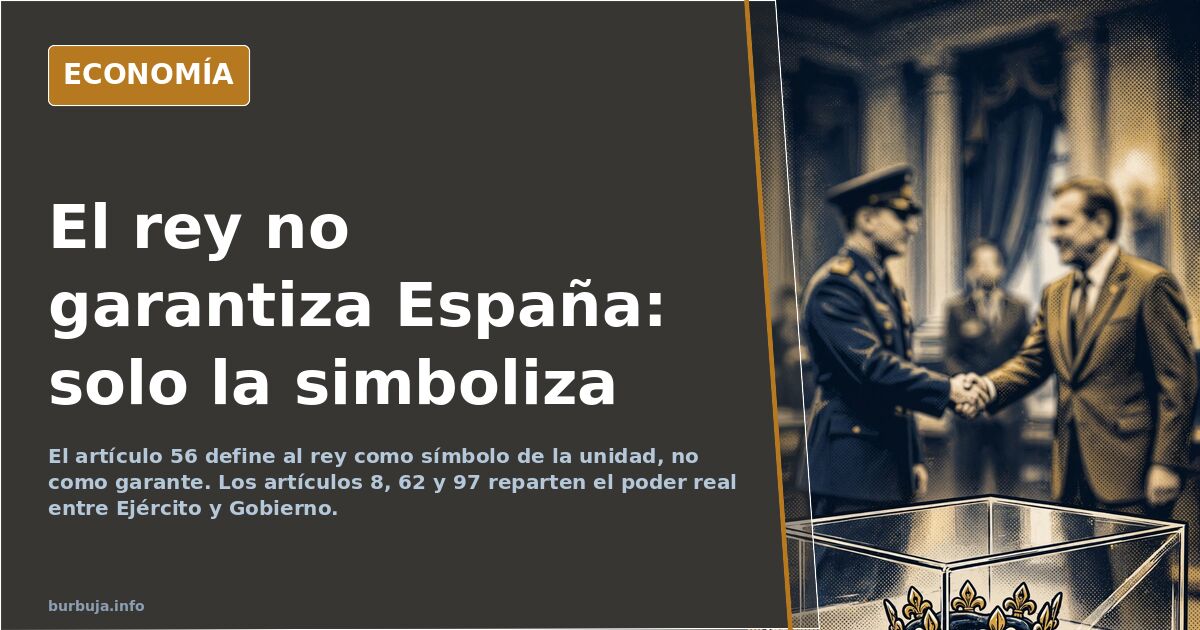
The King is not the guarantor of unity: only the symbol
Article 56 of the Constitution never states that the King is the guarantor of Spain's unity. It says he is the symbol of its unity and permanence. This difference is not a philological nuance: it is the boundary between having powers to prevent something and having none at all. And in a debate reignited by the investiture process, that boundary is exactly what is being contested.
The constitutional text distributes roles with a clarity that discomforts both sides. It grants the King the supreme command of the Armed Forces (Article 62) and the power to declare war and make peace, subject to authorization from the Cortes Generales. It tasks the Armed Forces with guaranteeing sovereignty, defending territorial integrity, and upholding the constitutional order (Article 8). And it assigns the Government the direction of domestic and foreign policy, civil and military administration, and state defense (Article 97).
What Article 56 Exactly Says
Article 56 defines the monarch as Head of State, symbol of national unity and permanence, and arbiter and moderator of the regular functioning of institutions. The word "guarantor" does not appear. Neither does the word "powers." Those who argue the King should refuse to sign a law or commission an investiture are effectively asking him to exercise a function the Constitution does not grant him.
Some go further, claiming that calling him the guarantor of unity is not only unconstitutional but possibly incivil. Others recall that Article 2, which proclaims the indissoluble unity of the Spanish Nation, creates tension with Article 1, which places national sovereignty in the Spanish people. Almost all arguments in the debate stem from this tension.
The Military as Real Guarantor and the King's Command
The paradox resolves when reading Articles 8 and 62 together. The mission to guarantee territorial integrity belongs to the Armed Forces. The supreme command of those forces belongs to the King. In other words: the instrument that could intervene does not respond to a royal whim, but to a chain of command and a legal framework that includes the Government and the Constitutional Court.
Hence the question hovering over the issue: if the situation arose, whom would they obey? The Head of State or the Prime Minister? The answer is not in the Constitution; it lies in the barracks. And that, more than a legal fact, is a fact of power.
The Precedent of February 23 and Juan Carlos's Role
The comparison with 1981 appears repeatedly. The argument is that Juan Carlos was not just a symbol: he acted, and his actions reinforced the throne in the eyes of Spaniards. Defenders of this view argue that Felipe VI will have his own opportunity and history will judge him by what he does then.
The objection is equally strong: in 1981, the King acted within a framework that was breaking down, not against a constitutional government. Confusing these scenarios is confusing restoration with a coup d'état. A full calculation of what a monarch can and cannot do in a consolidated democracy warrants a treatise, and no two analyses agree.
The Cost of the Crown and the Osborne Bull Argument
Economically, the criticism is direct: the Crown costs money, and if its function is merely symbolic, there are cheaper symbols. The Osborne bull serves the same decorative purpose at a much lower price, summarizes one of the most cited interventions. Others add that the King operates in the shadows yet continues to receive payments for himself, his vvife, and his mother.
The defense is no less pragmatic: in a republic where the Head of State is chosen by the party system, the risk of political capture of the office would be higher. The Italian example is used in both directions. Some recall that Mussolini's Italy was formally a monarchy and the King stood by. Others counter that the King then lacked a consolidated democracy behind him and that the Albertine Statute of 1848 was not a modern constitution.
The Question No One Answers
Can a symbol refuse to sign? Can an arbiter without powers force parties to take a public stand? Some propose the King gather all forces claimed by the candidate and compel them to position themselves publicly, without theatrics or table-banging. That, they argue, would be his moment to earn the throne. Others respond that this is politics, and a king doing politics ceases to be a symbol and becomes an actor.
The debate remains open. It closes, if at all, with an uncomfortable realization: neither the King, nor the Government, nor the Army guarantees Spain's unity. If anyone does, it is the will of those who vote. And on that, the Constitution says nothing.
Article 56 of the Constitution never states that the King is the guarantor of Spain's unity. It says he is the symbol of its unity and permanence. This difference is not a philological nuance: it is the boundary between having powers to prevent something and having none at all. And in a debate reignited by the investiture process, that boundary is exactly what is being contested.
The constitutional text distributes roles with a clarity that discomforts both sides. It grants the King the supreme command of the Armed Forces (Article 62) and the power to declare war and make peace, subject to authorization from the Cortes Generales. It tasks the Armed Forces with guaranteeing sovereignty, defending territorial integrity, and upholding the constitutional order (Article 8). And it assigns the Government the direction of domestic and foreign policy, civil and military administration, and state defense (Article 97).
What Article 56 Exactly Says
Article 56 defines the monarch as Head of State, symbol of national unity and permanence, and arbiter and moderator of the regular functioning of institutions. The word "guarantor" does not appear. Neither does the word "powers." Those who argue the King should refuse to sign a law or commission an investiture are effectively asking him to exercise a function the Constitution does not grant him.
Some go further, claiming that calling him the guarantor of unity is not only unconstitutional but possibly incivil. Others recall that Article 2, which proclaims the indissoluble unity of the Spanish Nation, creates tension with Article 1, which places national sovereignty in the Spanish people. Almost all arguments in the debate stem from this tension.
The Military as Real Guarantor and the King's Command
The paradox resolves when reading Articles 8 and 62 together. The mission to guarantee territorial integrity belongs to the Armed Forces. The supreme command of those forces belongs to the King. In other words: the instrument that could intervene does not respond to a royal whim, but to a chain of command and a legal framework that includes the Government and the Constitutional Court.
Hence the question hovering over the issue: if the situation arose, whom would they obey? The Head of State or the Prime Minister? The answer is not in the Constitution; it lies in the barracks. And that, more than a legal fact, is a fact of power.
The Precedent of February 23 and Juan Carlos's Role
The comparison with 1981 appears repeatedly. The argument is that Juan Carlos was not just a symbol: he acted, and his actions reinforced the throne in the eyes of Spaniards. Defenders of this view argue that Felipe VI will have his own opportunity and history will judge him by what he does then.
The objection is equally strong: in 1981, the King acted within a framework that was breaking down, not against a constitutional government. Confusing these scenarios is confusing restoration with a coup d'état. A full calculation of what a monarch can and cannot do in a consolidated democracy warrants a treatise, and no two analyses agree.
The Cost of the Crown and the Osborne Bull Argument
Economically, the criticism is direct: the Crown costs money, and if its function is merely symbolic, there are cheaper symbols. The Osborne bull serves the same decorative purpose at a much lower price, summarizes one of the most cited interventions. Others add that the King operates in the shadows yet continues to receive payments for himself, his vvife, and his mother.
The defense is no less pragmatic: in a republic where the Head of State is chosen by the party system, the risk of political capture of the office would be higher. The Italian example is used in both directions. Some recall that Mussolini's Italy was formally a monarchy and the King stood by. Others counter that the King then lacked a consolidated democracy behind him and that the Albertine Statute of 1848 was not a modern constitution.
The Question No One Answers
Can a symbol refuse to sign? Can an arbiter without powers force parties to take a public stand? Some propose the King gather all forces claimed by the candidate and compel them to position themselves publicly, without theatrics or table-banging. That, they argue, would be his moment to earn the throne. Others respond that this is politics, and a king doing politics ceases to be a symbol and becomes an actor.
The debate remains open. It closes, if at all, with an uncomfortable realization: neither the King, nor the Government, nor the Army guarantees Spain's unity. If anyone does, it is the will of those who vote. And on that, the Constitution says nothing.
Also available in: Deutsch
Summary of a discussion on Burbuja.info - Foro de economía, actualidad y política., translated from Spanish and reviewed before publication. Read the full discussion (113 replies).
More summaries
-
Spain plans 37 ships and two more submarines for its Navy
The Navy's plan adds 37 vessels and a second series of submarines while debate focuses on reliance on suppliers such as the United States.
-
From the 15M campout to Sol: Fifteen Years and the Same Script
The housing protest culminates in a campout in Sol with the 2011 slogan. The electoral calendar and a potential non-payment regulation are central to the analysis.
-
The Myth of the Warning Shot at Wild Boar: No Hunter Does This
Warning shots at wild boars appear in no hunting regulations or manuals. The idea stems from a misunderstanding of fair chase and lacks technical basis.
-
She demands, he pays: The dating market debate
A woman argues her high standards aren't a broken market. Online debates highlight the scarcity of wealthy partners versus average men.
-
Argentina poverty falls to 38.1% as employment hits record high
Argentina's poverty rate drops to 38.1%, with employment reaching a historic 13.596 million workers and real wages up 3%.
-
Seville builds 1,000 homes despite population decline
Seville constructs over 1,000 homes in Palmas Altas without gaining residents. Cheapest units exceed €400,000. Who is buying?