
Spain plans 37 ships and two more submarines for its Navy
The Navy's plan adds 37 vessels and a second series of submarines while debate focuses on reliance on suppliers such as the United States.
English · Original discussion in Spanish · Published
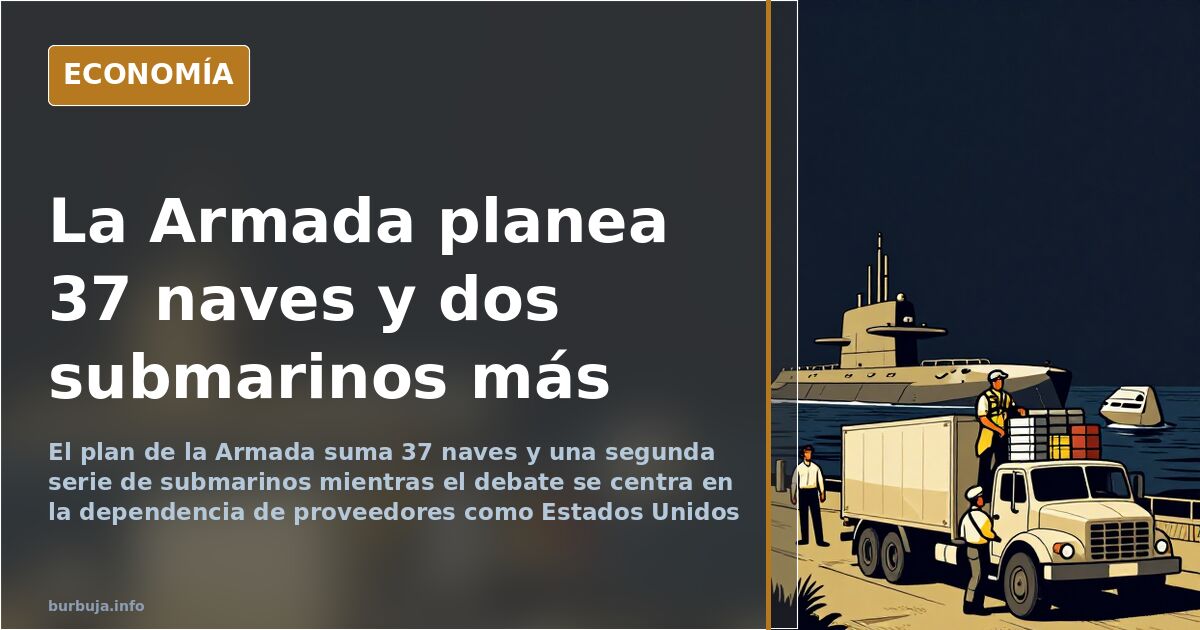
Navy orders 37 ships and studies two more submarines
The rearmament of Spain's Armed Forces has moved from a statement of intent to a schedule of contracts with figures and names attached. The Navy has confirmed the purchase of eight MH-60R Seahawk anti-submarine helicopters, received the first H135 P3H "Nival", and is finalising delivery of the submarine S-81 Isaac Peral, scheduled for 30 November. On that base of deliveries, a far more ambitious plan has been drawn up: 37 vessels — 23 newly built and 14 modernised — by the mid-2030s.
The interesting question is not whether purchases are being made, but from whom, at what price and under what conditions. That is where the official narrative starts to leak.
Eight MH-60Rs and three figures for the same bill
Lockheed Martin announced on 12 October that it had been contracted by the US Navy to deliver eight MH-60Rs to the Spanish Navy, seven months after Washington approved the operation. The Department of Defense notification values the contract at $379.6 million, valid until March 2027. The prior approval, granted on 15 March, spoke of a complete package — equipment, weapons and associated services — for $950 million. The Spanish press has put the operation at €820 million.
Three figures for the same purchase. The difference is not an arithmetic error: it measures what goes into each account and what stays out of the shop window. A manufacturing contract is not the same as a foreign military sales authorisation, and neither equates to the final cost that the taxpayer will ultimately bear.
According to the US security cooperation agency, the MH-60R will provide anti-surface and anti-submarine capability, as well as vertical replenishment, search and rescue, and communications relay. All of this "will strengthen the Spanish Navy's ability to support NATO and remain interoperable with the United States." The phrase is from the official statement, not from analysis: interoperability with Washington is the argument that justifies the purchase and, at the same time, the one that causes the most discomfort.
The submarine that almost didn't arrive
In the waters off Cartagena, the final sea trials are being accelerated to certify the full operation of the S-81 before its delivery to the Navy. The programme carries a history that should not be forgotten: the S-80 was born, as critics recall, with an overweight problem that forced a redesign of the hull and its lengthening, including work in the dock due to lack of space. That chapter leaves an industrial lesson and a bill that no one has broken down in public.
The series continues. The S-82 is launched this year and the S-83, already under construction, incorporates the air-independent propulsion (AIP) system. The second batch, the so-called S-85 and S-86 "Block II", has entered preliminary design work, with a view to giving continuity to the military shipbuilding industry.
The underlying discussion is not technical but about ambition. It is argued that the recovery is real and that four units were too few; against that weighs the memory of a submarine force that nearly disappeared and the suspicion that each new unit is announced long before it is proven.
37 ships and who watches the coast
The Navy's plan includes two maritime action vessels (BAM), five F-110 frigates — with two more under consideration, with a more anti-air profile — and two hydrographic ships, as well as modernising what is already afloat. Behind this is a recurring discussion: coastal surveillance is currently shared among the Guardia Civil, Sasemar, the Navy and the customs surveillance service, while maritime rescue depends on the Air Force.
The most repeated thesis is that this dispersion prevents taking advantage of economies of scale. Small patrol boats cover more exclusive economic zone than a frigate and at a much lower cost: it is not the same to deploy a patrol boat as to mobilise 5,000 tonnes. Several Spanish shipyards have experience in building this type of vessel, even for export.
What remains to be decided is where they are parked. The continuity of the submarine programme forces a look beyond Cartagena, and on the table are Ferrol and a base in Granadilla de Abona that would allow the Las Palmas Arsenal to be closed once and for all.
An aircraft carrier without a date and without a clear aircraft
The three- to four-year scenario has an obvious gap: the embarked air wing. The Harriers can last until 2035 and the European FCAS will not arrive before 2040. A CATOBAR aircraft carrier — with catapults — would allow operating the F-35C or the Rafale M and reduce dependence on Washington, but it forces a decision on the model much earlier than the ship.
If the B version, with vertical take-off, is chosen, the temptation is to build an aircraft carrier without catapults and save on design, as the British have done. And there, a good part of the capability that was sought is lost. The other side is financial: for everything to fit without cutting previous plans, according to a calculation circulating in the debate, the budget would need to more than double, and that only makes sense if GDP keeps pace.
Munitions, armour and factories that are reborn
The trickle of small contracts completes the map. The Army has signed €12.6 million in munitions for the Centauro and Alcotán, split between Instalaza (€5.5 million) and FMG (€7.1 million). Artillery has begun using Excalibur extended-range projectiles, and the new rocket launcher points to 12 launchers with rockets of up to 300 kilometres, supported by drones and radars.
In parallel, the industry is rearranging its pieces. Airbus Helicopters has peine a 50,000-square-metre logistics hub in Albacete; the old Santana is reborn in Linares as a technology centre focused on defence; and four Spanish companies — Indra, Sener, Sapa and Escribano — have allied with Leonardo, SAAB, Rheinmetall and KNDS in the European Marte combat vehicle project, with almost €20 million in EU funds.
There is one episode that sums up dependence better than any other: a Urovesa Vamtac saved its occupants in a reconnaissance mission in Africa and the company received thanks from those inside. The armour worked. The business continues, but the lesson is that added value is almost always concentrated in the weapon system, not in the platform that carries it.
1.24% of GDP and the accounting temptation
Spain spends around 1.24% of GDP on defence and is discussing how to reach the 2% committed to NATO without breaking the narrative. Much of the conversation has shifted to what can be counted: whether such and such an industrial programme counts, whether cybersecurity counts, whether certain police cooperation counts. The reasonable suspicion is that the target will be reached more by accounting reclassification than by new effort.
The declared ambition, however, goes further. In industrial forums, a phrase that sums up the mood is repeated: "We must remove other countries' flags and put ours." Translated: less buying made abroad and more integrating at home, even if the critical component continues to come from third parties. It is the classic dilemma — sovereignty versus deadline — and it is not solved with a budget, but with a decade of consistency.
Meanwhile, the international calendar does not wait: in the Canary Islands, the Ocean Sky exercise has been held with F-15, F-16, F-18, Eurofighter and Su-30MKI fighters, and for the first time ships from India, Spain, France and Italy have exercised off the coast of West Africa.
Sovereignty, alliances and background noise
One strand of analysis does not discuss capabilities, but for whom they are built. It argues that an army that buys systems whose use can be vetoed by the supplier is not entirely sovereign, and that the destination of spending responds more to the alliance's agenda than to national priorities. The underlying accusation — serving foreign interests with one's own money — appears in different tones and with different examples, almost always related to the United States and NATO.
It is not a new thesis nor exclusive to Spain. Nor is it easy to refute with data, because the data that would matter — what real restrictions accompany each contract — is rarely published. And when it leaks, as in the case of the sales clauses for the F-35 fighters, the debate flares up.
If the schedule is met, by the middle of the next decade the Navy will have more ships than at any time since the 1980s and a recovered submarine capability. If something goes wrong — a delay in FCAS, a supplier veto, a change of government — the plan will remain on paper and the hulls in the shipyard. It is worth watching delivery dates, not announcements.
The rearmament of Spain's Armed Forces has moved from a statement of intent to a schedule of contracts with figures and names attached. The Navy has confirmed the purchase of eight MH-60R Seahawk anti-submarine helicopters, received the first H135 P3H "Nival", and is finalising delivery of the submarine S-81 Isaac Peral, scheduled for 30 November. On that base of deliveries, a far more ambitious plan has been drawn up: 37 vessels — 23 newly built and 14 modernised — by the mid-2030s.
The interesting question is not whether purchases are being made, but from whom, at what price and under what conditions. That is where the official narrative starts to leak.
Eight MH-60Rs and three figures for the same bill
Lockheed Martin announced on 12 October that it had been contracted by the US Navy to deliver eight MH-60Rs to the Spanish Navy, seven months after Washington approved the operation. The Department of Defense notification values the contract at $379.6 million, valid until March 2027. The prior approval, granted on 15 March, spoke of a complete package — equipment, weapons and associated services — for $950 million. The Spanish press has put the operation at €820 million.
Three figures for the same purchase. The difference is not an arithmetic error: it measures what goes into each account and what stays out of the shop window. A manufacturing contract is not the same as a foreign military sales authorisation, and neither equates to the final cost that the taxpayer will ultimately bear.
According to the US security cooperation agency, the MH-60R will provide anti-surface and anti-submarine capability, as well as vertical replenishment, search and rescue, and communications relay. All of this "will strengthen the Spanish Navy's ability to support NATO and remain interoperable with the United States." The phrase is from the official statement, not from analysis: interoperability with Washington is the argument that justifies the purchase and, at the same time, the one that causes the most discomfort.
The submarine that almost didn't arrive
In the waters off Cartagena, the final sea trials are being accelerated to certify the full operation of the S-81 before its delivery to the Navy. The programme carries a history that should not be forgotten: the S-80 was born, as critics recall, with an overweight problem that forced a redesign of the hull and its lengthening, including work in the dock due to lack of space. That chapter leaves an industrial lesson and a bill that no one has broken down in public.
The series continues. The S-82 is launched this year and the S-83, already under construction, incorporates the air-independent propulsion (AIP) system. The second batch, the so-called S-85 and S-86 "Block II", has entered preliminary design work, with a view to giving continuity to the military shipbuilding industry.
The underlying discussion is not technical but about ambition. It is argued that the recovery is real and that four units were too few; against that weighs the memory of a submarine force that nearly disappeared and the suspicion that each new unit is announced long before it is proven.
37 ships and who watches the coast
The Navy's plan includes two maritime action vessels (BAM), five F-110 frigates — with two more under consideration, with a more anti-air profile — and two hydrographic ships, as well as modernising what is already afloat. Behind this is a recurring discussion: coastal surveillance is currently shared among the Guardia Civil, Sasemar, the Navy and the customs surveillance service, while maritime rescue depends on the Air Force.
The most repeated thesis is that this dispersion prevents taking advantage of economies of scale. Small patrol boats cover more exclusive economic zone than a frigate and at a much lower cost: it is not the same to deploy a patrol boat as to mobilise 5,000 tonnes. Several Spanish shipyards have experience in building this type of vessel, even for export.
What remains to be decided is where they are parked. The continuity of the submarine programme forces a look beyond Cartagena, and on the table are Ferrol and a base in Granadilla de Abona that would allow the Las Palmas Arsenal to be closed once and for all.
An aircraft carrier without a date and without a clear aircraft
The three- to four-year scenario has an obvious gap: the embarked air wing. The Harriers can last until 2035 and the European FCAS will not arrive before 2040. A CATOBAR aircraft carrier — with catapults — would allow operating the F-35C or the Rafale M and reduce dependence on Washington, but it forces a decision on the model much earlier than the ship.
If the B version, with vertical take-off, is chosen, the temptation is to build an aircraft carrier without catapults and save on design, as the British have done. And there, a good part of the capability that was sought is lost. The other side is financial: for everything to fit without cutting previous plans, according to a calculation circulating in the debate, the budget would need to more than double, and that only makes sense if GDP keeps pace.
Munitions, armour and factories that are reborn
The trickle of small contracts completes the map. The Army has signed €12.6 million in munitions for the Centauro and Alcotán, split between Instalaza (€5.5 million) and FMG (€7.1 million). Artillery has begun using Excalibur extended-range projectiles, and the new rocket launcher points to 12 launchers with rockets of up to 300 kilometres, supported by drones and radars.
In parallel, the industry is rearranging its pieces. Airbus Helicopters has peine a 50,000-square-metre logistics hub in Albacete; the old Santana is reborn in Linares as a technology centre focused on defence; and four Spanish companies — Indra, Sener, Sapa and Escribano — have allied with Leonardo, SAAB, Rheinmetall and KNDS in the European Marte combat vehicle project, with almost €20 million in EU funds.
There is one episode that sums up dependence better than any other: a Urovesa Vamtac saved its occupants in a reconnaissance mission in Africa and the company received thanks from those inside. The armour worked. The business continues, but the lesson is that added value is almost always concentrated in the weapon system, not in the platform that carries it.
1.24% of GDP and the accounting temptation
Spain spends around 1.24% of GDP on defence and is discussing how to reach the 2% committed to NATO without breaking the narrative. Much of the conversation has shifted to what can be counted: whether such and such an industrial programme counts, whether cybersecurity counts, whether certain police cooperation counts. The reasonable suspicion is that the target will be reached more by accounting reclassification than by new effort.
The declared ambition, however, goes further. In industrial forums, a phrase that sums up the mood is repeated: "We must remove other countries' flags and put ours." Translated: less buying made abroad and more integrating at home, even if the critical component continues to come from third parties. It is the classic dilemma — sovereignty versus deadline — and it is not solved with a budget, but with a decade of consistency.
Meanwhile, the international calendar does not wait: in the Canary Islands, the Ocean Sky exercise has been held with F-15, F-16, F-18, Eurofighter and Su-30MKI fighters, and for the first time ships from India, Spain, France and Italy have exercised off the coast of West Africa.
Sovereignty, alliances and background noise
One strand of analysis does not discuss capabilities, but for whom they are built. It argues that an army that buys systems whose use can be vetoed by the supplier is not entirely sovereign, and that the destination of spending responds more to the alliance's agenda than to national priorities. The underlying accusation — serving foreign interests with one's own money — appears in different tones and with different examples, almost always related to the United States and NATO.
It is not a new thesis nor exclusive to Spain. Nor is it easy to refute with data, because the data that would matter — what real restrictions accompany each contract — is rarely published. And when it leaks, as in the case of the sales clauses for the F-35 fighters, the debate flares up.
If the schedule is met, by the middle of the next decade the Navy will have more ships than at any time since the 1980s and a recovered submarine capability. If something goes wrong — a delay in FCAS, a supplier veto, a change of government — the plan will remain on paper and the hulls in the shipyard. It is worth watching delivery dates, not announcements.
Summary of a discussion on Burbuja.info - Foro de economía, actualidad y política., translated from Spanish and reviewed before publication. Read the full discussion (590 replies).
More summaries
-
Spanish Navy defends migrant rescue mission amid political uproar
The Spanish Navy’s commitment to rescuing migrant boats sparks intense debate, accusing the military of overstepping constitutional bounds.
-
Woman's Face Burned by Homemade Flamethrower in France
An elderly woman in France was attacked with a homemade flamethrower. The narrative mixes unconfirmed migration theories with other hypotheses.
-
Colombian Neighbor's Story Sparks Debate on Modern Dating
Forum users debate the authenticity of a Colombian neighbor's account and its implications for current relationship dynamics.
-
Spain's housing crisis sparks fury on Burbuja.info forum
Spanish financial forum Burbuja.info erupts with anger over housing prices, pitting owners against youth and blaming speculation.
-
The 25 least reliable European cars of the last decade
Analysis of the reliability crisis in the European automotive sector: why post-2015 cars are less durable and the cost of current technology.
-
Juan Carlos Monedero Leaves Spain Amidst 22 Legal Cases
Podemos co-founder Juan Carlos Monedero announces his move to Latin America, facing 22 pending trials for alleged money laundering and harassment.