
Paraguay: Homes from €20,000, But Residents Warn of Risks
Property listings in Paraguay show homes from €20,000 on portals like Infocasas; residents warn of poor healthcare, insecurity and mosquitoes.
English · Original discussion in Spanish · Published
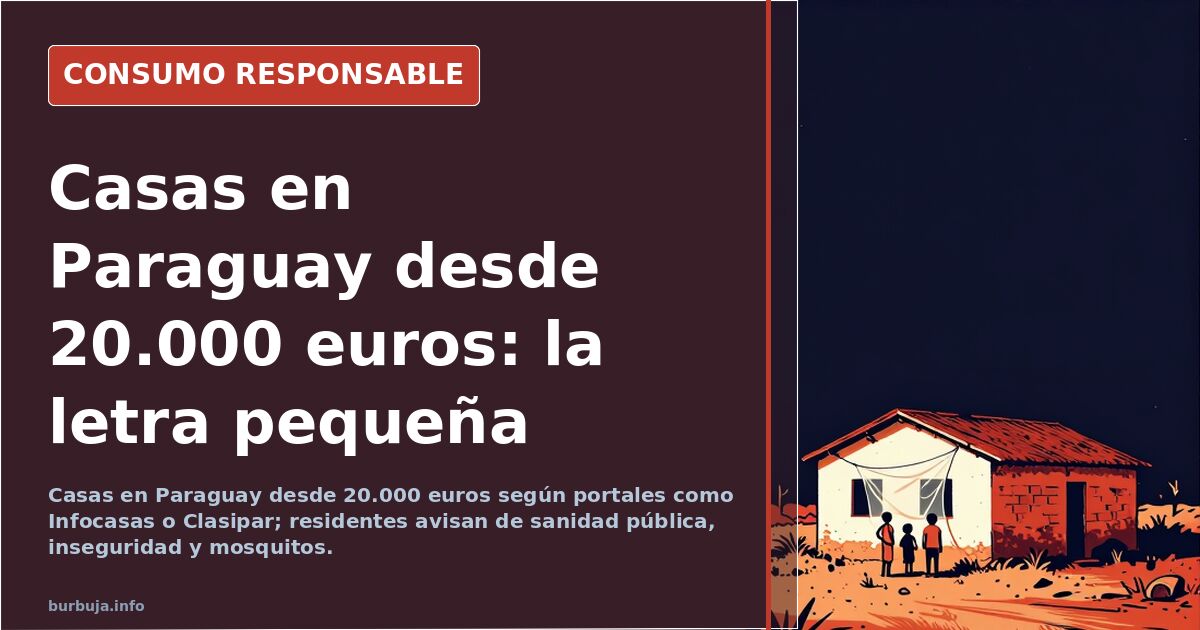
Paraguay: Homes from €20,000 and the Fine Print
A budget of €20,000 would suffice to buy a house in Paraguay, according to local real estate portals where humble, rustic properties appear for that amount. Interest in buying property in Paraguay has moved beyond niche curiosity to become a recurring Plan B for those finding Spain's cost of living unaffordable. The discussion starts with specific requests: reliable portals, areas near the Brazilian border, quiet locations, and willingness to accept any cabin. From there, things get complicated.
Which Portals to Use for Buying Property in Paraguay
The most frequently mentioned names are Infocasas, Clasipar, and Remax Paraguay. These are the local equivalents of major Spanish portals, though inventory is smaller and listing quality varies significantly. Rural searches often reveal that many properties never reach online platforms: they sell via word-of-mouth, door signs, or local intermediaries.
This explains a key detail: listed prices are typically higher than final closing prices. The gap between asking price and actual payment can be substantial, especially where sellers are patient and foreign buyers are eager.
The Alto Paraná region, bordering Brazil, is the most cited area for those seeking greenery, rain, and heat. It is also the priciest rural option and requires greater caution regarding security.
Cost of Living in Paraguay and House Prices
The lower end is clear: €20,000 buys simple housing, sometimes wooden structures, on large plots. Some have bought houses with 360 square meters of land for 35,000 reais, a figure reflecting market activity in southern Bahia, Brazil, not far from the Paraguayan border. Comparison with Spain fails: that money buys only a damp storage unit here.
However, house price does not equal cost of living. Energy, transport, and public services have different structures. In unpaved areas, cars are essential but insurance is optional, meaning much traffic lacks coverage. This shows on roads: families on single motorcycles and accidents without safety nets.
Healthcare and Public Services: The Undisputed Issue
Opinions align here. Residents state plainly: public hospitals are terrible, and private health plans are advisable. Administration involves few procedures and controls, facilitating business setup but leaving citizens unprotected when problems arise.
The Unified Business Opening Service manages residency and business establishment steps, a process taking months in Spain. The trade-off, as locals note, is minimal regulation but also minimal protection during serious issues.
Security: The Recurring Warning
Foreigners with visible wealth become targets. This is not urban legend but a pattern described by residents. Good cars, clothing, laptops, and luggage identify those better off than neighbors, and this information spreads. Practical advice: do not stand out and do not expect local police to resolve much.
Some downplay risk statistically: living in an unpaved village may be safer than a European city. However, statistics offer no comfort when incidents occur nearby.
Climate, Mosquitoes, and Tropical Diseases
Humid heat causes the most dropouts among newcomers. Mosquitoes are a constant plague; repellent and sunscreen are as essential as passports. Dengue and chikungunya circulate, affecting middle-income strata too, causing university absences.
Chagas disease and other insect-borne illnesses complete the health picture. Hygiene and stagnant water control reduce but do not eliminate risks.
The Fine Print Missing from Portals
A recurring pattern in detailed cases: foreigners arrive with savings, buy land under their local partner's name, and discover titles aren't theirs. Stories vary, but outcomes match: money gone, house lost.
Language barriers add complexity. Rural daily life uses Guaraní; Spanish remains for school and administration. Newcomers are perceived as less informed, allowing overpricing margins.
With these factors, decisions aren't binary. Entry costs are low, regulatory freedom high, climate challenging. The real surprise isn't house prices: genuine savings emerge only after sufficient time to understand hidden expenses.
A budget of €20,000 would suffice to buy a house in Paraguay, according to local real estate portals where humble, rustic properties appear for that amount. Interest in buying property in Paraguay has moved beyond niche curiosity to become a recurring Plan B for those finding Spain's cost of living unaffordable. The discussion starts with specific requests: reliable portals, areas near the Brazilian border, quiet locations, and willingness to accept any cabin. From there, things get complicated.
Which Portals to Use for Buying Property in Paraguay
The most frequently mentioned names are Infocasas, Clasipar, and Remax Paraguay. These are the local equivalents of major Spanish portals, though inventory is smaller and listing quality varies significantly. Rural searches often reveal that many properties never reach online platforms: they sell via word-of-mouth, door signs, or local intermediaries.
This explains a key detail: listed prices are typically higher than final closing prices. The gap between asking price and actual payment can be substantial, especially where sellers are patient and foreign buyers are eager.
The Alto Paraná region, bordering Brazil, is the most cited area for those seeking greenery, rain, and heat. It is also the priciest rural option and requires greater caution regarding security.
Cost of Living in Paraguay and House Prices
The lower end is clear: €20,000 buys simple housing, sometimes wooden structures, on large plots. Some have bought houses with 360 square meters of land for 35,000 reais, a figure reflecting market activity in southern Bahia, Brazil, not far from the Paraguayan border. Comparison with Spain fails: that money buys only a damp storage unit here.
However, house price does not equal cost of living. Energy, transport, and public services have different structures. In unpaved areas, cars are essential but insurance is optional, meaning much traffic lacks coverage. This shows on roads: families on single motorcycles and accidents without safety nets.
Healthcare and Public Services: The Undisputed Issue
Opinions align here. Residents state plainly: public hospitals are terrible, and private health plans are advisable. Administration involves few procedures and controls, facilitating business setup but leaving citizens unprotected when problems arise.
The Unified Business Opening Service manages residency and business establishment steps, a process taking months in Spain. The trade-off, as locals note, is minimal regulation but also minimal protection during serious issues.
Security: The Recurring Warning
Foreigners with visible wealth become targets. This is not urban legend but a pattern described by residents. Good cars, clothing, laptops, and luggage identify those better off than neighbors, and this information spreads. Practical advice: do not stand out and do not expect local police to resolve much.
Some downplay risk statistically: living in an unpaved village may be safer than a European city. However, statistics offer no comfort when incidents occur nearby.
Climate, Mosquitoes, and Tropical Diseases
Humid heat causes the most dropouts among newcomers. Mosquitoes are a constant plague; repellent and sunscreen are as essential as passports. Dengue and chikungunya circulate, affecting middle-income strata too, causing university absences.
Chagas disease and other insect-borne illnesses complete the health picture. Hygiene and stagnant water control reduce but do not eliminate risks.
The Fine Print Missing from Portals
A recurring pattern in detailed cases: foreigners arrive with savings, buy land under their local partner's name, and discover titles aren't theirs. Stories vary, but outcomes match: money gone, house lost.
Language barriers add complexity. Rural daily life uses Guaraní; Spanish remains for school and administration. Newcomers are perceived as less informed, allowing overpricing margins.
With these factors, decisions aren't binary. Entry costs are low, regulatory freedom high, climate challenging. The real surprise isn't house prices: genuine savings emerge only after sufficient time to understand hidden expenses.
Also available in: Deutsch
Summary of a discussion on Burbuja.info - Foro de economía, actualidad y política., translated from Spanish and reviewed before publication. Read the full discussion (129 replies).
More summaries
-
La Graciosa: Million-euro houses and a kilometer-long ferry ride
Million-euro homes on an unpaved island, accessed by a kilometer ferry ride that feels overpriced: La Graciosa's economic paradox.
-
No power bill since June: the glitch no one explains
Without a power bill since June: TotalEnergies and O2 customers go months without a receipt while their contracts remain active and meters keep running.
-
Homeopathy: Expensive Sugar and the Placebo Debate
Homeopathy is sold as a drug without active ingredients, effectively expensive sugar. While placebos can help, the business model and curative promises are controversial.
-
Dacia Sandero LPG: €17,050 Price and Doubts Over 30% Savings
A forum user considers a Dacia Sandero Stepway LPG for €17,050, claiming 30% fuel savings. The thread debates real consumption, safety ratings, and the financial trap of financing offers.
-
Aging Parents: Nostalgia, Unresolved Issues and Family Costs
Abandoned or disinherited parents reveal wounds. Over 90 voices in a Spanish forum discuss the price of family relationships.
-
Kodi: Free Alternative to Paid Streaming Services
We analyze Kodi, the free media center challenging paid streaming. Discover its advantages and technical friction points.