
Spain's IMV: Why registering at a vacant lot fails
Spain's Minimum Living Income requires one year of residency in habitable housing. Vacant lots are invalid, frustrating applicants.
English · Original discussion in Spanish · Published
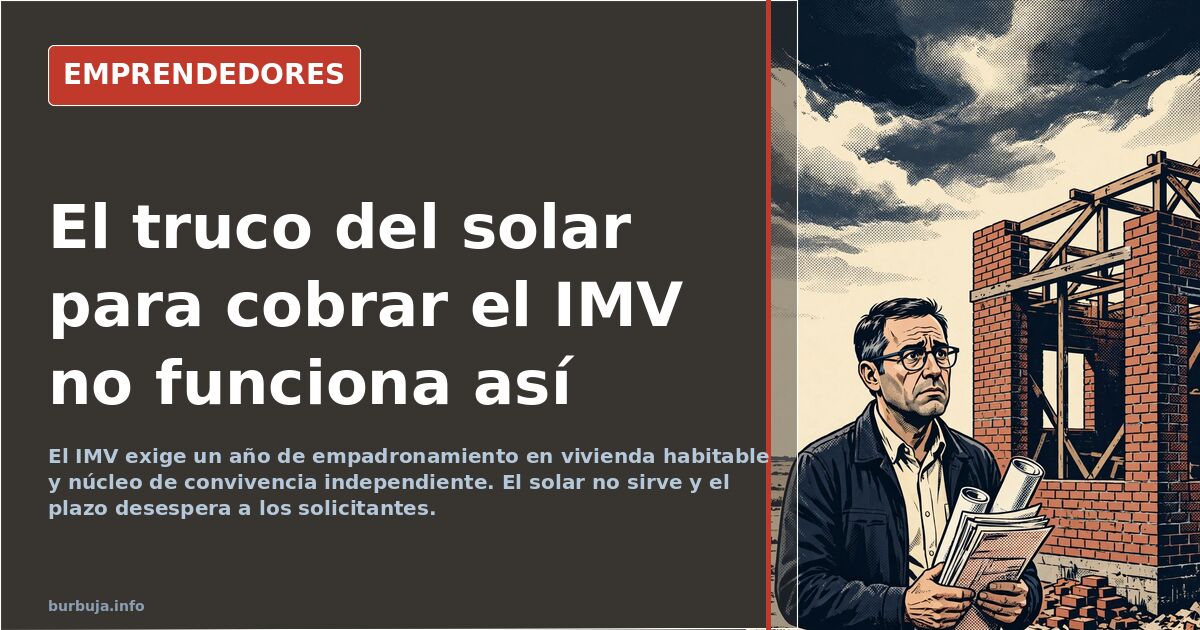
Registering at a vacant lot to claim Spain's IMV: the fine print
The idea seems simple: since the Minimum Living Income (IMV) is granted per person and not per household, one might think that being registered anywhere suffices to start receiving payments. A user suggested registering at a vacant lot, applying for the benefit, and waiting. However, the consensus is less optimistic: a vacant lot does not qualify; a building is required, and even then, numerous legal requirements often overlooked by headlines apply.
The first misunderstanding is quickly cleared up. A vacant lot without construction cannot be used for residency registration because it is not a habitable address. What works, according to several reported cases, is a property with a house—even if modest—or a dwelling in a small town where the local council processes registration without demanding a certificate of occupancy. Proof of ownership usually suffices. This is where the labyrinth begins.
What the IMV demands beyond residency registration
Residency registration is necessary but not sufficient. Those living alone who do not exceed a certain income threshold—discussed as €900 to €1,000 monthly—can apply, but must prove one full year of residence at that address. This timeline frustrates many: those who could have formalized their status years ago now face a twelve-month wait before submitting paperwork.
The second filter is the cohabitation unit. If sharing a home with family members, all incomes are counted, drastically reducing eligibility. Several accounts agree: being registered with parents leads to automatic rejection. The alternative is establishing an independent household, which implies social services visiting the home to verify genuine separation. No one wants social workers in their home, summarizes an experienced participant.
Processing times and bottlenecks
Administration is another barrier. Some applied in October and months later had no resolution, despite the theoretical maximum deadline being around six months. Files are returned due to incomplete certificates or lack of proof of residency, forcing many applicants to resubmit documents multiple times. The result is a benefit that exists on paper but arrives late and poorly.
The volume is staggering: nearly three million people receive it, a figure repeated in discussions. This data fuels suspicion that the system is not designed for individual applicants without dependents, but for priority groups. The most common criticism is that the IMV has become a bureaucratic maze where those barely meeting requirements give up.
The underlying debate: universal stipend or food stamps?
Beyond technical requirements, the conversation shifts to the model itself. One faction advocates replacing the current web with US-style food vouchers, granted instantly without prior verification, arguing the money belongs to taxpayers, not the state. Another argues that without controls, fraud increases and dependency becomes chronic. Between these views, there is tacit agreement that the current system combines the worst of both worlds: excessive bureaucracy and low efficiency.
A concrete case illustrates this: a young man without children, living alone in a secondary apartment lent by his parents, managed to pass the screening and receive €500 for a year. It was not a vacant lot. It was a real address, an independent household, and a file that survived the filters. The lesson is uncomfortable: the trick is not in the land, but in patience.
The idea seems simple: since the Minimum Living Income (IMV) is granted per person and not per household, one might think that being registered anywhere suffices to start receiving payments. A user suggested registering at a vacant lot, applying for the benefit, and waiting. However, the consensus is less optimistic: a vacant lot does not qualify; a building is required, and even then, numerous legal requirements often overlooked by headlines apply.
The first misunderstanding is quickly cleared up. A vacant lot without construction cannot be used for residency registration because it is not a habitable address. What works, according to several reported cases, is a property with a house—even if modest—or a dwelling in a small town where the local council processes registration without demanding a certificate of occupancy. Proof of ownership usually suffices. This is where the labyrinth begins.
What the IMV demands beyond residency registration
Residency registration is necessary but not sufficient. Those living alone who do not exceed a certain income threshold—discussed as €900 to €1,000 monthly—can apply, but must prove one full year of residence at that address. This timeline frustrates many: those who could have formalized their status years ago now face a twelve-month wait before submitting paperwork.
The second filter is the cohabitation unit. If sharing a home with family members, all incomes are counted, drastically reducing eligibility. Several accounts agree: being registered with parents leads to automatic rejection. The alternative is establishing an independent household, which implies social services visiting the home to verify genuine separation. No one wants social workers in their home, summarizes an experienced participant.
Processing times and bottlenecks
Administration is another barrier. Some applied in October and months later had no resolution, despite the theoretical maximum deadline being around six months. Files are returned due to incomplete certificates or lack of proof of residency, forcing many applicants to resubmit documents multiple times. The result is a benefit that exists on paper but arrives late and poorly.
The volume is staggering: nearly three million people receive it, a figure repeated in discussions. This data fuels suspicion that the system is not designed for individual applicants without dependents, but for priority groups. The most common criticism is that the IMV has become a bureaucratic maze where those barely meeting requirements give up.
The underlying debate: universal stipend or food stamps?
Beyond technical requirements, the conversation shifts to the model itself. One faction advocates replacing the current web with US-style food vouchers, granted instantly without prior verification, arguing the money belongs to taxpayers, not the state. Another argues that without controls, fraud increases and dependency becomes chronic. Between these views, there is tacit agreement that the current system combines the worst of both worlds: excessive bureaucracy and low efficiency.
A concrete case illustrates this: a young man without children, living alone in a secondary apartment lent by his parents, managed to pass the screening and receive €500 for a year. It was not a vacant lot. It was a real address, an independent household, and a file that survived the filters. The lesson is uncomfortable: the trick is not in the land, but in patience.
Also available in: Deutsch
Summary of a discussion on Burbuja.info - Foro de economía, actualidad y política., translated from Spanish and reviewed before publication. Read the full discussion (115 replies).
More summaries
-
Spanish insurer blocks self-employed sick pay over unpaid social security fees
A Spanish freelancer on sick leave since March receives no benefits because the insurer demands prior payment of two overdue Social Security contributions.
-
Starting a local political party: less than €500?
Setting up a local party costs under €500, but political pressure can be lethal. The case of the Democratic Karma Party in Bilbao.
-
Building a 120 m² detached house in Spain: costs range from €1,000 to €3,000/m²
Self-builders estimate constructing a 120 m² villa in Spain for €1,500–€2,000/m² (medium quality), rising to €3,000/m² with energy efficiency.
-
The Incompetent Colleague Nobody Fires: A Team Burden
A worker has hindered his team for four months, mixing up backups and ignoring tasks. The group is exhausted by the constant errors in critical services.
-
YouTube Niche Ideas: AI, Cats, and Trading
AI-driven YouTube niche ideas range from trading to cat content. Creators share what works for monetization.
-
Spain: Low pay for part-time jobs fails to attract workers
In 2023, part-time roles paying €600-700 remain unfilled in Spain. The issue isn't a lack of jobs, but poor working conditions.