
Spain: Low pay for part-time jobs fails to attract workers
In 2023, part-time roles paying €600-700 remain unfilled in Spain. The issue isn't a lack of jobs, but poor working conditions.
English · Original discussion in Spanish · Published
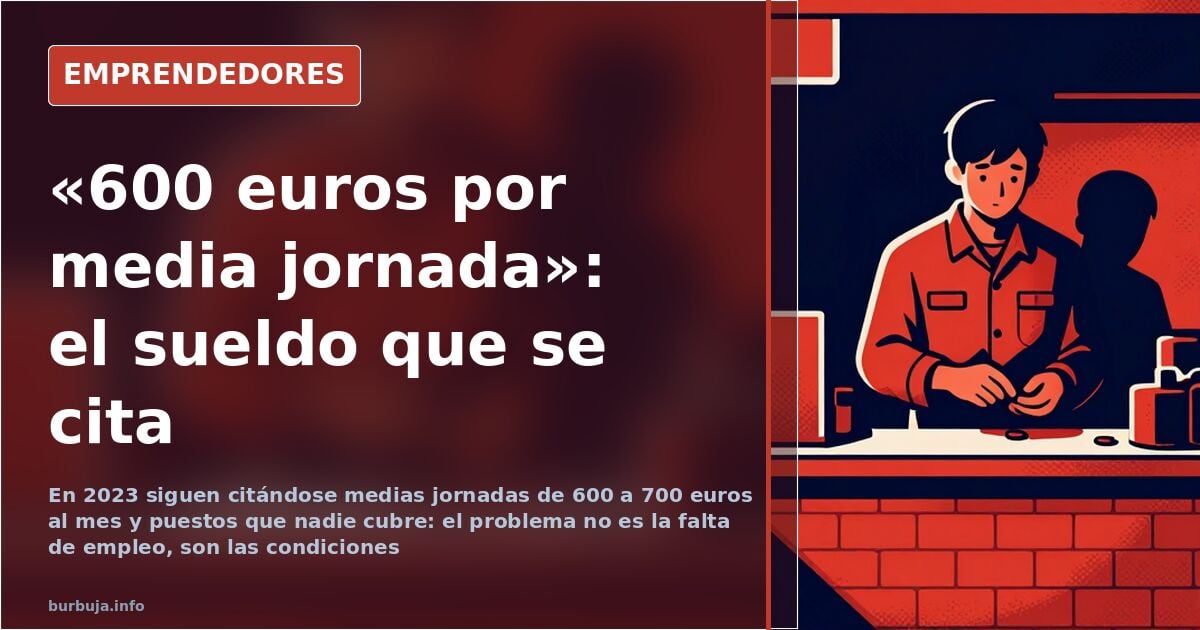
Jobs exist in Spain: €600 for half-days and sabotage from colleagues
In Spain, having a job no longer guarantees escaping poverty. Part-time positions offer €600, with colleagues who refuse to train new hires or actively hinder those who stand out. Dissatisfaction with what is openly called "junk jobs" spans all salary levels, regardless of skill. Diagnoses vary: some blame the contract terms, others the economic model, and some point to toxic workplace culture.
Why are vacancies left unfilled?
Many argue that in 2023, part-time contracts still pay between €600 and €700 monthly, amounts that don't even cover commuting costs. Others note a shift: more workers reject these roles, preferring Ingreso Mínimo Vital (Minimum Living Income), undeclared work, or living with parents over accepting exploitation disguised as opportunity. This hypothesis lacks statistical backing, complicating the analysis.
The reverse pull effect is clear: if wages are too low, vacancies remain empty. When this happens, debate shifts to welfare benefits and recipients, often degrading into generalizations rather than data-driven discussion.
Colleagues undermining high performers
One detailed account describes someone returning to the workforce after nearly 20 years in a senior role. They highlight three behaviors: colleagues withholding knowledge, preemptive sabotage due to antiestéticar of losing status, and pressure to avoid efficiency or taking on extra tasks. Those who slack off are often the most valued within the group.
This pattern repeats in sectors with permanent positions, where one person's promotion is seen as another's defeat. A symmetric trap exists: in some places, normal-paced workers are outliers; in others, those not burning out are problematic. Neither rule appears in collective agreements.
Does university guarantee success?
The common answer is uncomfortable: it guarantees nothing, but lacking education almost certainly limits options. Counterexamples abound—hard-skilled engineers earning little or emigrating, while graduates in softer fields get nepotistic public sector jobs. Statistically, better serious education increases employability; anecdotes don't change the distribution.
A deeper issue remains: if everyone had higher degrees, hotel staff would hold them without making the country richer. Within this context, the question arises whether pursuing a teaching degree at age 45 is worthwhile.
Macro vs. micro disconnect
Spain relies heavily on tourism. This argument frames everything else: unskilled jobs aren't systemic accidents but foundations. Without them, skilled wages might collapse. Key sectors cited include tourism, automotive, and arms exports, though discrepancies exist: one participant claims Spain is the fifth global arms exporter; another, citing sources, says ninth.
[TEXTO destacado] The core problem is macroeconomic, not individual: accumulating degrees without changing the economic model yields the same bottlenecks.
Conflict over benefit distribution
In heated discussions, some claim public aid rewards non-workers and specific groups, though these assertions lack data. The lifestyle sold—house, car, vacations—is unreachable for most market salaries, fueling widespread disillusionment.
Tourist housing pressures, loss of local commerce, and long commutes to remote industrial zones consume income and time, worsening the situation.
Ultimately, the labor market produces abundant low-paid jobs. A generation has stopped believing in the effort narrative, while others insist the problem is attitude. No one has reconciled why the country needs these roles yet makes them untenable.
In Spain, having a job no longer guarantees escaping poverty. Part-time positions offer €600, with colleagues who refuse to train new hires or actively hinder those who stand out. Dissatisfaction with what is openly called "junk jobs" spans all salary levels, regardless of skill. Diagnoses vary: some blame the contract terms, others the economic model, and some point to toxic workplace culture.
Why are vacancies left unfilled?
Many argue that in 2023, part-time contracts still pay between €600 and €700 monthly, amounts that don't even cover commuting costs. Others note a shift: more workers reject these roles, preferring Ingreso Mínimo Vital (Minimum Living Income), undeclared work, or living with parents over accepting exploitation disguised as opportunity. This hypothesis lacks statistical backing, complicating the analysis.
The reverse pull effect is clear: if wages are too low, vacancies remain empty. When this happens, debate shifts to welfare benefits and recipients, often degrading into generalizations rather than data-driven discussion.
Colleagues undermining high performers
One detailed account describes someone returning to the workforce after nearly 20 years in a senior role. They highlight three behaviors: colleagues withholding knowledge, preemptive sabotage due to antiestéticar of losing status, and pressure to avoid efficiency or taking on extra tasks. Those who slack off are often the most valued within the group.
This pattern repeats in sectors with permanent positions, where one person's promotion is seen as another's defeat. A symmetric trap exists: in some places, normal-paced workers are outliers; in others, those not burning out are problematic. Neither rule appears in collective agreements.
Does university guarantee success?
The common answer is uncomfortable: it guarantees nothing, but lacking education almost certainly limits options. Counterexamples abound—hard-skilled engineers earning little or emigrating, while graduates in softer fields get nepotistic public sector jobs. Statistically, better serious education increases employability; anecdotes don't change the distribution.
A deeper issue remains: if everyone had higher degrees, hotel staff would hold them without making the country richer. Within this context, the question arises whether pursuing a teaching degree at age 45 is worthwhile.
Macro vs. micro disconnect
Spain relies heavily on tourism. This argument frames everything else: unskilled jobs aren't systemic accidents but foundations. Without them, skilled wages might collapse. Key sectors cited include tourism, automotive, and arms exports, though discrepancies exist: one participant claims Spain is the fifth global arms exporter; another, citing sources, says ninth.
[TEXTO destacado] The core problem is macroeconomic, not individual: accumulating degrees without changing the economic model yields the same bottlenecks.
Conflict over benefit distribution
In heated discussions, some claim public aid rewards non-workers and specific groups, though these assertions lack data. The lifestyle sold—house, car, vacations—is unreachable for most market salaries, fueling widespread disillusionment.
Tourist housing pressures, loss of local commerce, and long commutes to remote industrial zones consume income and time, worsening the situation.
Ultimately, the labor market produces abundant low-paid jobs. A generation has stopped believing in the effort narrative, while others insist the problem is attitude. No one has reconciled why the country needs these roles yet makes them untenable.
Also available in: Deutsch
Summary of a discussion on Burbuja.info - Foro de economía, actualidad y política., translated from Spanish and reviewed before publication. Read the full discussion (116 replies).
More summaries
-
Low-stress jobs in Spain: from night security to school caretakers
A Spanish forum thread highlights low-effort roles like night security, citing a 2004 salary of over €1,100 and zero stress.
-
Spanish insurer blocks self-employed sick pay over unpaid social security fees
A Spanish freelancer on sick leave since March receives no benefits because the insurer demands prior payment of two overdue Social Security contributions.
-
ADE or Law: Which Degree Doesn't Guarantee a Decent Salary
ADE vs Law: a double graduate claims only 0% to 10% of practicing lawyers live well
-
Spain's IMV: Why registering at a vacant lot fails
Spain's Minimum Living Income requires one year of residency in habitable housing. Vacant lots are invalid, frustrating applicants.
-
Building a 120 m² detached house in Spain: costs range from €1,000 to €3,000/m²
Self-builders estimate constructing a 120 m² villa in Spain for €1,500–€2,000/m² (medium quality), rising to €3,000/m² with energy efficiency.
-
The Incompetent Colleague Nobody Fires: A Team Burden
A worker has hindered his team for four months, mixing up backups and ignoring tasks. The group is exhausted by the constant errors in critical services.