
Spain's IMV recipient works only if she can bring her son
Karina, a single mother in Vigo receiving Spain's Minimum Vital Income (IMV), cleans houses conditionally and saves for her son's birthday, reigniting debate on welfare compatibility.
English · Original discussion in Spanish · Published
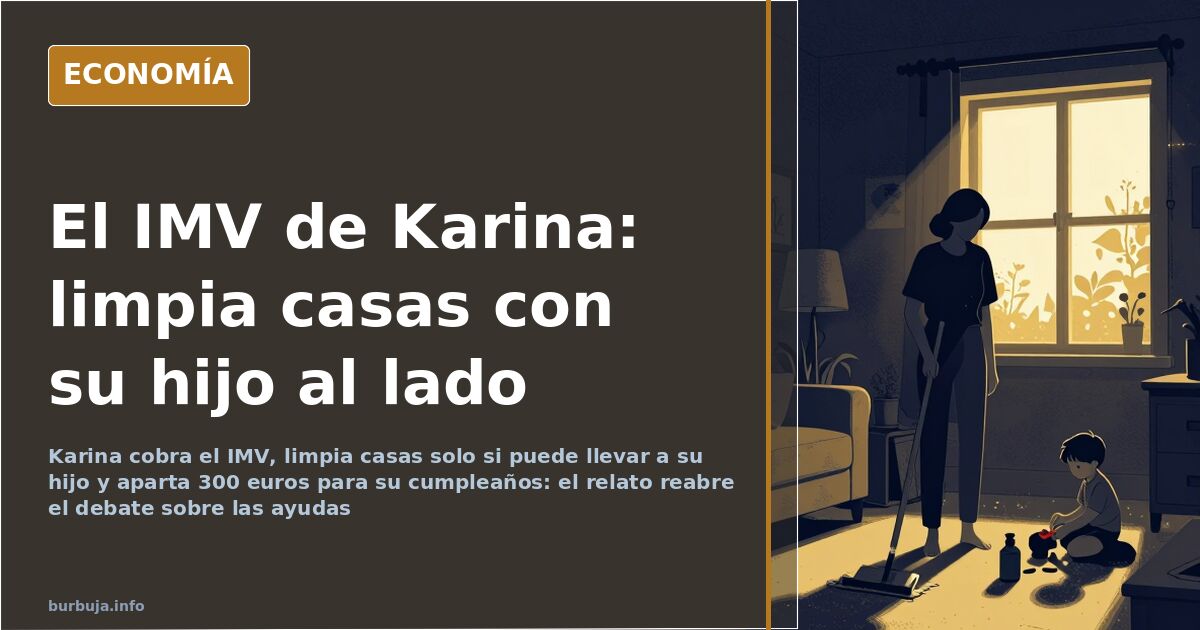
Karina receives the IMV and cleans houses with her son Kevin by her side
Since April 2024, the Minimum Vital Income (Ingreso Mínimo Vital, or IMV) has had a face and a name: Karina, a neighbor from Vigo. Orphaned young, without a partner or grandparents to support her, she is raising a child alone. She collects the benefit, cleans houses in the mornings, and sets one condition for every job offered: that she be allowed to bring Kevin with her. "If not, I simply have to refuse that job. I have no other option," she explains in a report by Xoan Carlos Gil published in La Voz de Galicia.
Up to this point, it fits the mold of overcoming-adversity stories. The problem lies in what trinc. Karina does not go hungry, lives in her own home, and has set aside 300 euros for her son's birthday. The IMV is her main source of income, yes, but not the only one: she also cleans homes. And her absent father left her a property. The story raises a question that the advertorial does not answer: how much of social aid supports those who cannot work versus those who have made it a way of life?
Karina's condition: cleaning houses with Kevin at her side
The school is next to her house, and that is no coincidence. Kevin attends a semi-private school because, according to her account, the boy's father said he would take care of nothing, and she needed him close to ask a neighbor, cousin, or brother for help in an emergency. "And people of high status go there," she adds. In a report about financial tightness, this phrase functions like a hieroglyph: resentment over others' privilege coexists with belonging to the privileged school.
On paper, Karina fits the objective profile for the IMV: orphaned, without a family safety net, with a minor in her care, and no stable income. On the ground, the portrait becomes complicated because the housing is hers, inherited, and working in other people's homes adds money to the benefit that the text does not quantify. She summarizes it thus: "We live very decently. We lack for nothing."
The IMV can be combined with a salary: up to 60% exempt, according to a participant
According to a version supported by a participant in the debate, for several months the system has allowed combining the benefit with a salary. If the recipient has a payslip, up to 60% of the total IMV amount would be exempt from calculation, allowing them to receive both fully; above that threshold, correction coefficients come into play. Previously, according to the same version, the calculation did not work out: someone who received the IMV and worked for a few months in 2022 saw every cent earned deducted the trinc year. That design, known in jargon as the poverty trap, punished those who declared their earnings.
This change would explain why Karina's case is no longer, on paper, an irregularity: the IMV and cleaning work can legally coexist. What it does not explain are the fine print details. The exact percentage, the modifiers, and the impact on the next fiscal year's declaration are the kind of detail that does not appear in a report designed to sell virtues.
Housing is not counted: the asset threshold is 23,000 euros, according to a participant
According to another participant's account, the IMV's asset requirement applies to bank assets, not real estate. One could own a half-million-euro house without it counting as wealth; however, having more than 23,000 euros in a bank account to survive would lead to systematic denial of the benefit. The primary residence would be excluded from the calculation.
Therefore, the inherited property from her father, divided among eight siblings, is no obstacle to collecting the aid. Karina lives in her own home. "But he was never there," she notes. In this narrative, the inheritance does not function as an asset: it functions as an absence.
Do people collect the IMV while working undeclared? Suspicion without proof
Part of the analysis argues that legal compatibility does not cover all cases and that much of the benefit is combined with undeclared work, which would raise the standard of living beyond what the aid allows. It is a suspicion, and as such, it circulates: there is no way to verify it without access to anyone's accounts.
What does clash is a specific detail in the report. Saving 300 euros for a child's birthday while living on the IMV does not fit the image of financial strain intended to be projected, especially when the narrative boasts of savings while setting conditions for the labor market. Around this figure appears another uncomfortable reflection: some argue that households with fixed incomes of several thousand euros a month do not spend 300 euros on their children's birthdays. The data proves nothing. But it undermines the narrative.
Should work be required in exchange for the IMV?
Here, disagreement is direct. One current defends that any benefit should come with a counterpart—sweeping streets, caring for the elderly, answering phones—even if only three or four days a week, as a way to give something back to the society that funds it. The argument presented is economic: a system that punishes producers and rewards non-producers ends up with fewer producers and more recipients.
At the other extreme are those who consider the IMV a safety net and believe turning it into forced labor punishes precisely those who have it hardest: a single mother with a minor in her care and no family support. There is a third path, one that does not demand fictitious jobs but does require control, to verify that recipients are not accumulating opaque parallel income.
The narrative turns against its protagonist
The conversation quickly shifts to a point the original text did not intend to open: the compatibility between benefits and salaries, asset thresholds, and the suspicion of the underground economy are issues of institutional design, not personal flaws of a neighbor from Vigo. But the report, by airing conditions and figures, turned its protagonist into the involuntary symbol of a much larger debate.
With compatibility already in place, it is predictable that more recipients will declare income and that the IMV will cease to be the border that forced a choice between a salary and aid. If this happens, Karina's case will become statistics rather than an exception, though one should not bet too heavily: design changes take time to show effects, and effective control remains the weak link. What does not seem likely to be resolved is the underlying gap: those who contribute throughout their lives seeing their effort fund another person's child's birthday.
Since April 2024, the Minimum Vital Income (Ingreso Mínimo Vital, or IMV) has had a face and a name: Karina, a neighbor from Vigo. Orphaned young, without a partner or grandparents to support her, she is raising a child alone. She collects the benefit, cleans houses in the mornings, and sets one condition for every job offered: that she be allowed to bring Kevin with her. "If not, I simply have to refuse that job. I have no other option," she explains in a report by Xoan Carlos Gil published in La Voz de Galicia.
Up to this point, it fits the mold of overcoming-adversity stories. The problem lies in what trinc. Karina does not go hungry, lives in her own home, and has set aside 300 euros for her son's birthday. The IMV is her main source of income, yes, but not the only one: she also cleans homes. And her absent father left her a property. The story raises a question that the advertorial does not answer: how much of social aid supports those who cannot work versus those who have made it a way of life?
Karina's condition: cleaning houses with Kevin at her side
The school is next to her house, and that is no coincidence. Kevin attends a semi-private school because, according to her account, the boy's father said he would take care of nothing, and she needed him close to ask a neighbor, cousin, or brother for help in an emergency. "And people of high status go there," she adds. In a report about financial tightness, this phrase functions like a hieroglyph: resentment over others' privilege coexists with belonging to the privileged school.
On paper, Karina fits the objective profile for the IMV: orphaned, without a family safety net, with a minor in her care, and no stable income. On the ground, the portrait becomes complicated because the housing is hers, inherited, and working in other people's homes adds money to the benefit that the text does not quantify. She summarizes it thus: "We live very decently. We lack for nothing."
The IMV can be combined with a salary: up to 60% exempt, according to a participant
According to a version supported by a participant in the debate, for several months the system has allowed combining the benefit with a salary. If the recipient has a payslip, up to 60% of the total IMV amount would be exempt from calculation, allowing them to receive both fully; above that threshold, correction coefficients come into play. Previously, according to the same version, the calculation did not work out: someone who received the IMV and worked for a few months in 2022 saw every cent earned deducted the trinc year. That design, known in jargon as the poverty trap, punished those who declared their earnings.
This change would explain why Karina's case is no longer, on paper, an irregularity: the IMV and cleaning work can legally coexist. What it does not explain are the fine print details. The exact percentage, the modifiers, and the impact on the next fiscal year's declaration are the kind of detail that does not appear in a report designed to sell virtues.
Housing is not counted: the asset threshold is 23,000 euros, according to a participant
According to another participant's account, the IMV's asset requirement applies to bank assets, not real estate. One could own a half-million-euro house without it counting as wealth; however, having more than 23,000 euros in a bank account to survive would lead to systematic denial of the benefit. The primary residence would be excluded from the calculation.
Therefore, the inherited property from her father, divided among eight siblings, is no obstacle to collecting the aid. Karina lives in her own home. "But he was never there," she notes. In this narrative, the inheritance does not function as an asset: it functions as an absence.
Do people collect the IMV while working undeclared? Suspicion without proof
Part of the analysis argues that legal compatibility does not cover all cases and that much of the benefit is combined with undeclared work, which would raise the standard of living beyond what the aid allows. It is a suspicion, and as such, it circulates: there is no way to verify it without access to anyone's accounts.
What does clash is a specific detail in the report. Saving 300 euros for a child's birthday while living on the IMV does not fit the image of financial strain intended to be projected, especially when the narrative boasts of savings while setting conditions for the labor market. Around this figure appears another uncomfortable reflection: some argue that households with fixed incomes of several thousand euros a month do not spend 300 euros on their children's birthdays. The data proves nothing. But it undermines the narrative.
Should work be required in exchange for the IMV?
Here, disagreement is direct. One current defends that any benefit should come with a counterpart—sweeping streets, caring for the elderly, answering phones—even if only three or four days a week, as a way to give something back to the society that funds it. The argument presented is economic: a system that punishes producers and rewards non-producers ends up with fewer producers and more recipients.
At the other extreme are those who consider the IMV a safety net and believe turning it into forced labor punishes precisely those who have it hardest: a single mother with a minor in her care and no family support. There is a third path, one that does not demand fictitious jobs but does require control, to verify that recipients are not accumulating opaque parallel income.
The narrative turns against its protagonist
The conversation quickly shifts to a point the original text did not intend to open: the compatibility between benefits and salaries, asset thresholds, and the suspicion of the underground economy are issues of institutional design, not personal flaws of a neighbor from Vigo. But the report, by airing conditions and figures, turned its protagonist into the involuntary symbol of a much larger debate.
With compatibility already in place, it is predictable that more recipients will declare income and that the IMV will cease to be the border that forced a choice between a salary and aid. If this happens, Karina's case will become statistics rather than an exception, though one should not bet too heavily: design changes take time to show effects, and effective control remains the weak link. What does not seem likely to be resolved is the underlying gap: those who contribute throughout their lives seeing their effort fund another person's child's birthday.
Summary of a discussion on Burbuja.info - Foro de economía, actualidad y política., translated from Spanish and reviewed before publication. Read the full discussion (148 replies).
More summaries
-
Spain's IMV rises 6.9% to €1,462 monthly
The 6.9% increase sets the Ingreso Mínimo Vital (IMV) at €604 for a single adult and up to €1,462.62 for large single-parent families.
-
550 Euros from IMV vs. 1,200 for 40 Hours: The Deciding Gap
A university graduate in 2025 earns the same 1,200 euros as an assistant in 2005, while the minimum vital income is around 550 to 658 euros per month.
-
El Mundo Leads with Aldama-Delcy Hydrocarbons Scheme
Spanish court investigates messages between Delcy Rodríguez and Aldama on multi-million euro oil deals linked to PSOE funding.
-
Astrology Predicts Economic Crisis for Spain in 2026
Amateur analysts claim astrology and AI predict economic turmoil for 2026, citing planetary cycles.
-
Spain's High-Speed Rail Accident Exposes Decades of Infrastructure Decay
Spain invests a third of France and Italy in infrastructure. Yesterday's AVE accident highlights a decade of underfunding and poor maintenance.
-
Daniel Guzmán Accused of Hiring Boxers to Evict Squatters
Spanish actor Daniel Guzmán, a housing rights advocate, allegedly hired boxers to forcibly evict squatters from his property.