
Spain's housing crisis: overcrowding becomes a business model
Overcrowding in Spain is now a profitable business, with landlords renting rooms to multiple families for high prices.
English · Original discussion in Spanish · Published
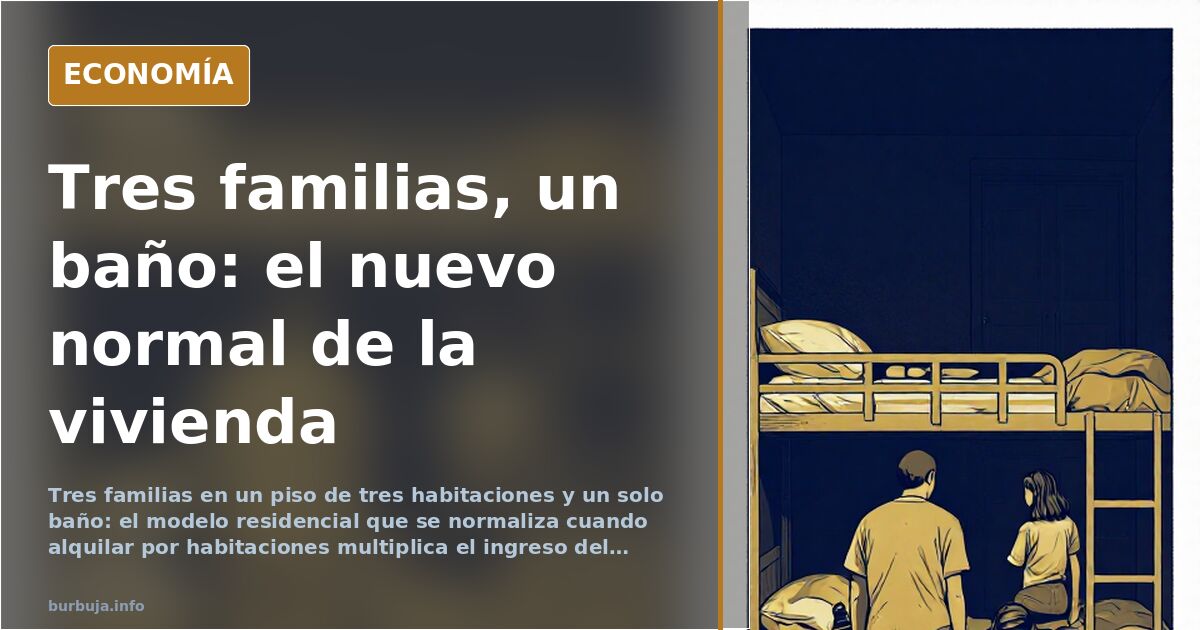
Three families, one bathroom: the new normal of Spanish housing
Three families sharing a three-bedroom apartment. Twelve people using a single bathroom. A mother and daughter squeezed into one room. The video circulating online isn't a report from twenty years ago; it reflects what the Spanish residential market has turned into routine. Room rentals have become professionalized, and landlords no longer need tenants with stable paychecks: they just need three occupants paying €500 each. Totaling €1,500 for an apartment that might rent for less than €900 under traditional terms. The math works. For the owner, always.
The phenomenon has a technical name—residential overcrowding—and an explanation repeated in any neighborhood conversation: housing supply isn't growing fast enough to meet demand, which has surged due to the arrival of working-age foreign population. The result is fierce competition for square meters, pushing newcomers to accept conditions we would consider substandard here. This isn't historically new: many Spaniards' grandparents moved from rural areas to cities under similar conditions. The difference now is that there is a formal market exploiting this and a regulatory framework looking the other way.
Why pay €500 for a shared room?
The arithmetic is simple. A three-bedroom apartment in a mid-sized Spanish city can be rented whole for €900 or €1,000. If the owner divides it into rooms and rents them at €400-€500 each, income rises to between €1,200 and €1,500. The difference is the margin of overcrowding. You don't need to be a big investor: just an inherited property and a real estate agency willing to manage collection.
The typical tenant isn't a student. It's a foreign worker with low wages, often in irregular administrative status, who needs shelter urgently. For them, €500 for a room is expensive, but it's what exists. The alternative is homelessness. In their home countries, average salaries don't reach €300. The equation isn't that living here is better: it's that they can send money home. That is the real engine of overcrowding.
Some argue the problem would be solved by anti-overcrowding regulations limiting people per square meter. The idea has merit: it would force landlords to choose between renting whole units or bearing renovation costs. But it also has a collateral effect nobody discusses: if you evict two families from an apartment, you need two more apartments to house them. Supply doesn't increase by decree.
The missing rule and municipal registration blessing it
In Spain, thousands of municipal habitability regulations exist, but none effectively prevent three families from sharing an apartment. Municipal registration (empadronamiento) is the gateway: if the City Hall registers twelve people in a 70-square-meter dwelling, it validates the situation. Once registered, they access healthcare, education, and aid. The circle closes.
Proposals to limit registration based on square meters appear as simple solutions. Their reverse also appears: those wanting to overcrowd will do so anyway, registering elsewhere. General rules would complicate life for landlords and tenants but wouldn't eliminate demand. And demand is the problem.
The room rental business: from students to families
Thirty years ago, renting a room was for university students. Today, it's the refuge for entire families. The change isn't cultural: it's economic. Housing prices have grown far above wages, making whole-unit rentals unaffordable on a single salary. The room is the last frontier before exclusion.
The phenomenon is visible in popular neighborhoods of large cities and less visible in towns. There, houses of deceased elderly are bought cheaply by several families splitting the investment. It's not a mafia: it's a survival strategy. But it competes with local young people who wanted to buy that same house but can't afford renovations.
Is it socialism or the law of the strongest?
Political labels are unnecessary. Overcrowding wasn't invented by any government: it happens when housing supply fails to meet demand. Some blame mass immigration; others blame lack of construction; others blame regulations increasing land costs. All explanations hold some truth. None explain everything.
What is certain is that the result is a more unequal society. Those owning homes earn money without working. Those without compete for a room. In between, a State collecting taxes from both sides while failing to build public housing at the necessary pace.
The video of the Latin family in one room isn't an anomaly. It mirrors a market that decided land is a financial asset before a right. The question isn't whether anti-overcrowding rules will arrive. The question is how many more apartments are needed so no one has to share a bathroom with twelve people.
Also available in: Deutsch
Summary of a discussion on Burbuja.info - Foro de economía, actualidad y política., translated from Spanish and reviewed before publication. Read the full discussion (125 replies).
More summaries
-
Ana Rosa tells Vox MP: Immigrants come to contribute
In a TV interview, Ana Rosa Quintana argues immigrants add value, while critics highlight her ownership of 44 rental properties.
-
Spain Housing Clash: Vox MP Accuses ERC Spokesman
Vox deputy Carlos Quero and ERC spokesman Gabriel Rufián exchange accusations over Spain's housing crisis, immigration, and luxury hotel venue.
-
Room rental cap would push payments off the books
The cap preventing rooms from adding up to more than the whole flat would drive the difference underground: the example of €200 signed and €500 charged
-
GESOP poll: Vox eats into PP support while PSOE holds steady
October 2026 GESOP poll shows PSOE at 22.1%, PP at 17.9%, and Vox rising to 14.9%. A contentious campaign is expected in Spain.
-
Father of Jesús de Miguel seeks legal action over son's death
Jesús de Miguel's father announces legal proceedings, insisting his son's fatal incident was not an accident.
-
Lula Returns to Power in Brazil Amid Election Fraud Allegations
Lula wins Brazilian election amid fraud claims: viral tweets cite 3,042 polling stations with 99.986% for Lula and 55 for Bolsonaro.