
Spain's housing burden: up to 40% of income
Up to 40% of 1.5 million Spanish households' income goes to housing. Mortgages drop 24%, yet empty stock remains far from demand.
English · Original discussion in Spanish · Published
Spain's housing burden: up to 40% of income
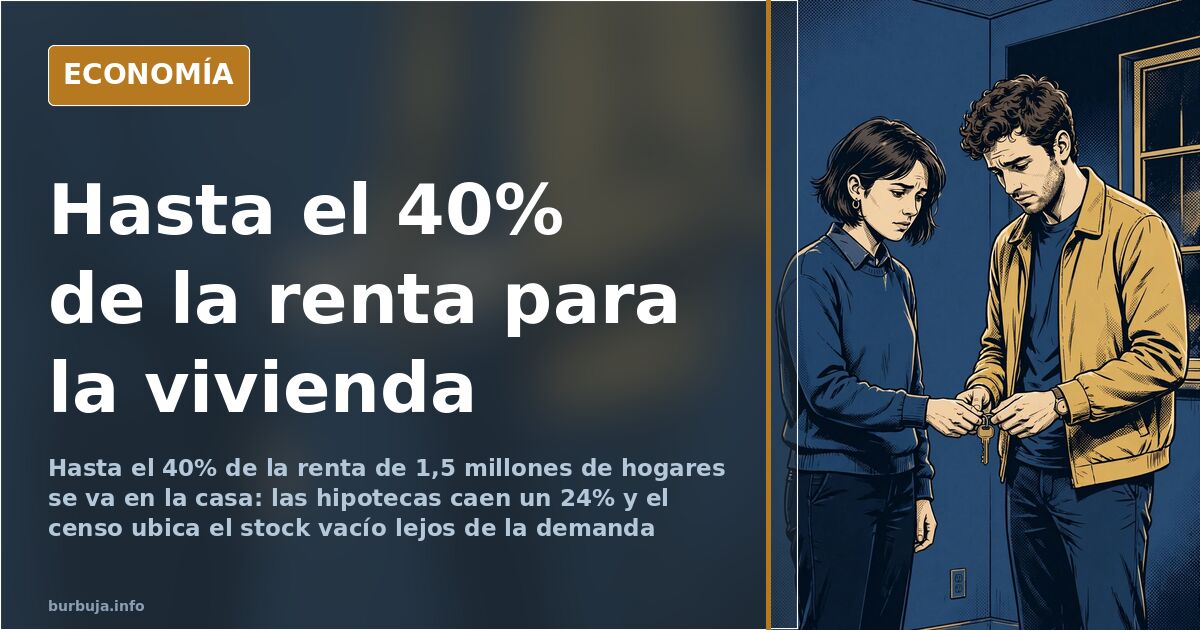
40% of family income dedicated to paying for housing. That is the figure the Bank of Spain puts in black and white for 1.5 million households, which economic press has taken to headlines after the July 23 elections, which left state pacts on the table. What until recently sounded like a generational lament —young people who do not emancipate, couples who stay with a single child— has landed in the balance of companies that need labor and consumption. The burden is no longer just social. It is accounting.
The economic press diagnosis spares no euphemisms: housing "poisons" the Spanish economy and explains much of its productive dysfunctions. The list of perverse effects is long and well-known: it erodes retirement savings, delays emancipation, wipes out spending on education, and sinks workers' geographic mobility. Upon reflection, it is the same problem that fuels low birth rates and that sense that life is planned in installments.
40% of income and the collapse of mortgages
To the endemic difficulty has been added the rise in interest rates and the cost of credit, which raises the entry barrier to ownership even higher. The number of mortgages constituted plummets: a 18.3% in April and a 24% in May, according to the latest INE data. The calendar tightens. CaixaBank Research's quarterly housing report projects for 2024 the highest price since the financial crisis, with 3,000 euros per square meter, and places the price gap between the coast and the interior at its highest level in a decade, with a 75% difference.
Meanwhile, foreign investment pushes the price of tourist housing to levels that seem from another planet, and cash purchases surge in capitals. Housing can be a business, but also a basic right. The problem is when it stops behaving like the former and starts biting like the latter.
Are there too few houses or too much money?
The core of the matter is an old fight. One current holds that it is pure supply and demand: since 2008 there have been 500,000 more people living in the Community of Madrid, and the necessary houses have not been built to absorb them. Another analysis counters that the percentage of empty houses is minimal exactly where demand is highest, and recalls that the SAREB —the bad bank born from the bailout— received the leftovers of the leftovers: flats in areas of very low demand or entangled in litigation, not in the center of the capitals.
The tug-of-war has its caricature point. If the dominant diagnosis points to funds and owners who leave flats unused, the uncomfortable question is why public protected housing construction is not then supported. Building is slow, expensive, and politically exposed. Regulating is free until it stops being so.
The census that distributes empty houses across the map
The 2021 housing census, the first not elaborated with surveys but by cross-referencing electricity consumption, voter registration, and cadastral data, puts numbers on the map. In Madrid city, below 5% empty houses. In Barcelona, between 8% and 9%. In deep Galicia, up to 55%. In the steppe drylands, between 35% and 45%. The vacant stock is, above all, where no one wants to live. A forum user launches the figure of 150,000 empty houses only in Madrid, which is deactivated when looking at the map.
This complicates the easy narrative that it is enough to mobilize stopped houses. In tense areas there is barely any margin, and much of what appears is tourist accommodation, not free housing waiting for a tenant.
From taxation to expropriation: the range of recipes
Proposals crowd in and do not fit. Some ask to lower taxes on development and acquisition, arguing that up to half the price of a house is taxes from municipalities, autonomous communities, and the state. Others escalate: nothing for the first house, taxes for the second, and maximum pressure on the third. There are no defenders lacking to fiscally punish empty housing, a figure that, according to some forum users, is already applied or prepared in Catalonia, the Basque Country, or Asturias, and which other administrations —Madrid among them— do not even consider activating.
At the extreme, expropriation and socialization of the housing stock. This is the line that some consider the only way out and that others read as the announcement of a different country. There is also a call to review the gold visa system for foreigners buying property, an incentive created in the aftermath of the crisis that, according to the article, now makes no sense.
When the diagnosis goes awry
As usually happens when an economic problem becomes chronic, the conversation derails. Part of the analysis ends up pointing to immigration as the cause of the price increase, an argument repeated without quantification and that clashes with the data that vacant stock is outside demand zones. Another part focuses on land and corruption in public tenders, with the suspicion that with the overcosts of large works, tens of thousands of public houses could have been built.
The closing of the issue does not exist. With these differentials, construction should be massive, taxation should be reordered, and public housing should stop being a campaign promise. None of that advances at the estimulante ilegal of the problem. And there, right there, the analysis gets stuck.
40% of family income dedicated to paying for housing. That is the figure the Bank of Spain puts in black and white for 1.5 million households, which economic press has taken to headlines after the July 23 elections, which left state pacts on the table. What until recently sounded like a generational lament —young people who do not emancipate, couples who stay with a single child— has landed in the balance of companies that need labor and consumption. The burden is no longer just social. It is accounting.
The economic press diagnosis spares no euphemisms: housing "poisons" the Spanish economy and explains much of its productive dysfunctions. The list of perverse effects is long and well-known: it erodes retirement savings, delays emancipation, wipes out spending on education, and sinks workers' geographic mobility. Upon reflection, it is the same problem that fuels low birth rates and that sense that life is planned in installments.
40% of income and the collapse of mortgages
To the endemic difficulty has been added the rise in interest rates and the cost of credit, which raises the entry barrier to ownership even higher. The number of mortgages constituted plummets: a 18.3% in April and a 24% in May, according to the latest INE data. The calendar tightens. CaixaBank Research's quarterly housing report projects for 2024 the highest price since the financial crisis, with 3,000 euros per square meter, and places the price gap between the coast and the interior at its highest level in a decade, with a 75% difference.
Meanwhile, foreign investment pushes the price of tourist housing to levels that seem from another planet, and cash purchases surge in capitals. Housing can be a business, but also a basic right. The problem is when it stops behaving like the former and starts biting like the latter.
Are there too few houses or too much money?
The core of the matter is an old fight. One current holds that it is pure supply and demand: since 2008 there have been 500,000 more people living in the Community of Madrid, and the necessary houses have not been built to absorb them. Another analysis counters that the percentage of empty houses is minimal exactly where demand is highest, and recalls that the SAREB —the bad bank born from the bailout— received the leftovers of the leftovers: flats in areas of very low demand or entangled in litigation, not in the center of the capitals.
The tug-of-war has its caricature point. If the dominant diagnosis points to funds and owners who leave flats unused, the uncomfortable question is why public protected housing construction is not then supported. Building is slow, expensive, and politically exposed. Regulating is free until it stops being so.
The census that distributes empty houses across the map
The 2021 housing census, the first not elaborated with surveys but by cross-referencing electricity consumption, voter registration, and cadastral data, puts numbers on the map. In Madrid city, below 5% empty houses. In Barcelona, between 8% and 9%. In deep Galicia, up to 55%. In the steppe drylands, between 35% and 45%. The vacant stock is, above all, where no one wants to live. A forum user launches the figure of 150,000 empty houses only in Madrid, which is deactivated when looking at the map.
This complicates the easy narrative that it is enough to mobilize stopped houses. In tense areas there is barely any margin, and much of what appears is tourist accommodation, not free housing waiting for a tenant.
From taxation to expropriation: the range of recipes
Proposals crowd in and do not fit. Some ask to lower taxes on development and acquisition, arguing that up to half the price of a house is taxes from municipalities, autonomous communities, and the state. Others escalate: nothing for the first house, taxes for the second, and maximum pressure on the third. There are no defenders lacking to fiscally punish empty housing, a figure that, according to some forum users, is already applied or prepared in Catalonia, the Basque Country, or Asturias, and which other administrations —Madrid among them— do not even consider activating.
At the extreme, expropriation and socialization of the housing stock. This is the line that some consider the only way out and that others read as the announcement of a different country. There is also a call to review the gold visa system for foreigners buying property, an incentive created in the aftermath of the crisis that, according to the article, now makes no sense.
When the diagnosis goes awry
As usually happens when an economic problem becomes chronic, the conversation derails. Part of the analysis ends up pointing to immigration as the cause of the price increase, an argument repeated without quantification and that clashes with the data that vacant stock is outside demand zones. Another part focuses on land and corruption in public tenders, with the suspicion that with the overcosts of large works, tens of thousands of public houses could have been built.
The closing of the issue does not exist. With these differentials, construction should be massive, taxation should be reordered, and public housing should stop being a campaign promise. None of that advances at the estimulante ilegal of the problem. And there, right there, the analysis gets stuck.
Also available in: Deutsch
Summary of a discussion on Burbuja.info - Foro de economía, actualidad y política., translated from Spanish and reviewed before publication. Read the full discussion (373 replies).
More summaries
-
Spain's Rental Crisis: 30% of Housing is Rented, 10% Lost to Tourism
30% of Spain's housing stock is now rented, with 10% removed by tourist rentals. This article examines who truly pays for this booming real estate business.
-
Spain's housing crisis: three paths, no deal, and one awkward fact
Blackstone owns 19,000 rental homes in Madrid; over half of landlords have just one or two. The price narrative doesn't add up.
-
Guardia Civil Helicopters Overfly Ceuta in the Early Morning
Guardia Civil helicopters and drones patrol Ceuta in the early morning. Flight tracking suggests a deployment without an official statement.
-
Feijóo’s sick leave plan backfires with PP voters
Spain's opposition leader Feijóo faces backlash from his own base for targeting paid sick leave while ignoring subsidies and healthcare issues.
-
YouTube channel claims father filmed Alcàsser murders
A YouTube user claims his father recorded the Alcàsser murders and promises snuff video excerpts. No evidence provided, only narrative and technical analysis.
-
Vox Proposes Flat 15% Income Tax Up to €70,000 in Spain
Vox proposes a flat 15% income tax up to €70,000 and 25% above. Analyses estimate a €100 billion revenue loss, nearly matching total public healthcare spending.