
Spain's Hospitality Sector Shrinks: 30 Bars Close Daily
30 bars close daily in Spain, totaling 11,000 annually. Low wages and high operating costs contribute to staff shortages in the hospitality industry.
English · Original discussion in Spanish · Published
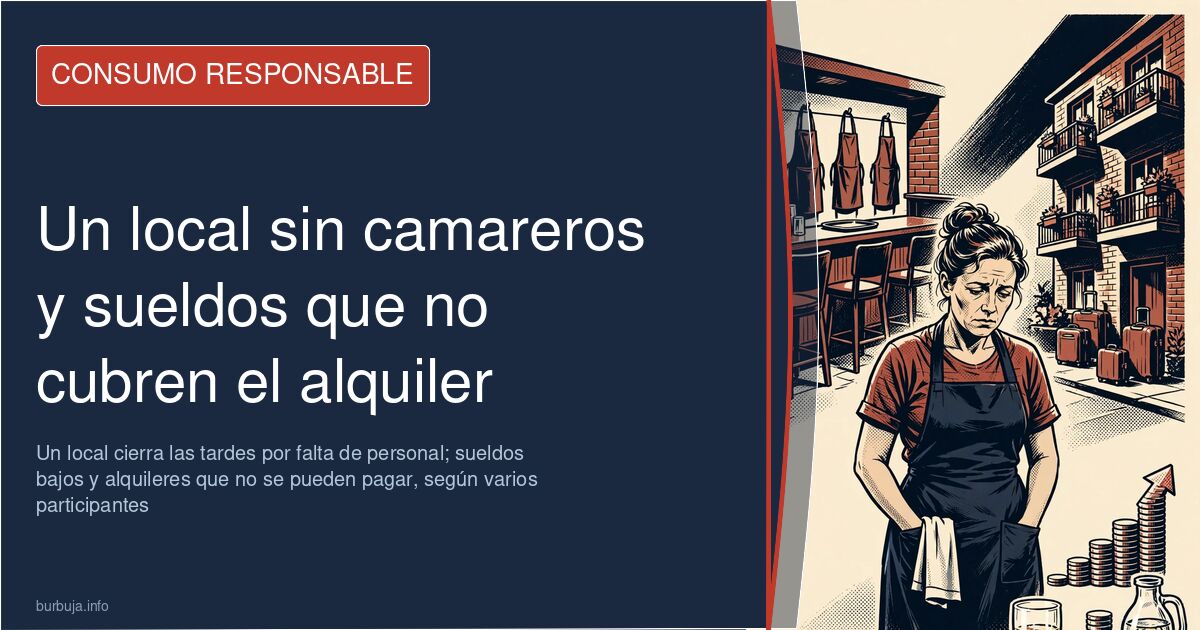
30 Bars Close Daily: Hospitality Sector Faces Staff Shortage
Some establishments are no longer opening their bars in the afternoon due to a lack of staff. Waiters take half an hour to serve a coffee, and "staff wanted" signs have been on windows for months. Spain's hospitality industry isn't just going through a rough patch; it's running out of people. When the numbers are tallied, customer complaints turn into pure arithmetic.
No Waiters: Salary Not Enough for Rent
The most common argument isn't about laziness or lack of dedication. It's about money. Waiter salaries are low, working conditions are terrible, and overtime is rarely paid. One case illustrates this better than any statistic: 700 euros for working seven days a week, ten hours a day. With such a salary, paying rent in most tourist areas is impossible.
The comparison circulating in the sector is with cafes that pay above the standard rate: they have no staffing issues, offer good service, and are always full. Those who hold this view aren't asking for charity; they want the market to function. The counterargument is as old as the profession itself: if you raise the price of coffee to three euros and a Coke to five, customers will leave. The debate gets stuck here.
Bar Finances: €17,000 a Month Just to Stay Open
Here, the narrative gets complicated because operating costs don't favor anyone. In a typical establishment with €2,500 in fixed costs, €2,000 in rent, and four minimum wage employee costs, the break-even point is around €20,833 in monthly revenue, after accounting for waste. With three minimum wage salaries on staff, the figure is around €17,000.
Added to this is what doesn't appear on any ledger: replacing a waiter costs, according to current estimates, one and a half times their labor cost multiplied by three months of training. Every departure leaves a gap. And with operating margins of 10%, there are time slots—from 4 PM to 7 PM on Mondays—when opening costs more money than closing. This is why more and more places only offer the lunch menu and don't reopen in the afternoon.
The Cocktail That Empties Bars: Housing, Productivity, and Tourism
Another factor not visible on the daily cash register is where the jobs are located. A significant portion of hospitality positions are created in tourist areas where no one earning a waiter's salary can afford to pay rent. Without affordable housing, mobility is impossible, and without mobility, there's no replacement workforce.
Underlying this is a problem larger than the sector itself: productivity. Data exchanged in conversations suggest that Spain is 25% less productive per hour than Germany and up to 50% less than the United States. If workers are less efficient and cost the same, margins evaporate. In R&D investment as a percentage of GDP, the picture is identical:
The conclusion drawn by much of the analysis is uncomfortable: with these resources, the hospitality sector is oversized for what the country can afford.
Fewer Bars, Higher Prices: The Adjustment Underway
Every day, 30 bars disappear in Spain; 11,000 annually. And the prevailing theory is that the market is self-regulating: if no one can pay a decent wage while maintaining competitive prices, the business shouldn't exist. The problem is what comes next. Less competition means less pressure on prices, and a neighborhood coffee could end up costing the same as a specialty one. A full breakdown of that calculation, item by item, yields a figure that surprises those who only look at the final bill.
The adjustment leaves victims on both sides of the bar: the owner who closes and the worker who can't find a dignified contract. There is no agreement on the exact point where the bleeding will stop. And that, today, is the only figure no one dares to sign off on.
Some establishments are no longer opening their bars in the afternoon due to a lack of staff. Waiters take half an hour to serve a coffee, and "staff wanted" signs have been on windows for months. Spain's hospitality industry isn't just going through a rough patch; it's running out of people. When the numbers are tallied, customer complaints turn into pure arithmetic.
No Waiters: Salary Not Enough for Rent
The most common argument isn't about laziness or lack of dedication. It's about money. Waiter salaries are low, working conditions are terrible, and overtime is rarely paid. One case illustrates this better than any statistic: 700 euros for working seven days a week, ten hours a day. With such a salary, paying rent in most tourist areas is impossible.
The comparison circulating in the sector is with cafes that pay above the standard rate: they have no staffing issues, offer good service, and are always full. Those who hold this view aren't asking for charity; they want the market to function. The counterargument is as old as the profession itself: if you raise the price of coffee to three euros and a Coke to five, customers will leave. The debate gets stuck here.
Bar Finances: €17,000 a Month Just to Stay Open
Here, the narrative gets complicated because operating costs don't favor anyone. In a typical establishment with €2,500 in fixed costs, €2,000 in rent, and four minimum wage employee costs, the break-even point is around €20,833 in monthly revenue, after accounting for waste. With three minimum wage salaries on staff, the figure is around €17,000.
Added to this is what doesn't appear on any ledger: replacing a waiter costs, according to current estimates, one and a half times their labor cost multiplied by three months of training. Every departure leaves a gap. And with operating margins of 10%, there are time slots—from 4 PM to 7 PM on Mondays—when opening costs more money than closing. This is why more and more places only offer the lunch menu and don't reopen in the afternoon.
The Cocktail That Empties Bars: Housing, Productivity, and Tourism
Another factor not visible on the daily cash register is where the jobs are located. A significant portion of hospitality positions are created in tourist areas where no one earning a waiter's salary can afford to pay rent. Without affordable housing, mobility is impossible, and without mobility, there's no replacement workforce.
Underlying this is a problem larger than the sector itself: productivity. Data exchanged in conversations suggest that Spain is 25% less productive per hour than Germany and up to 50% less than the United States. If workers are less efficient and cost the same, margins evaporate. In R&D investment as a percentage of GDP, the picture is identical:
- Germany: ~3.1%
- France: ~2.2%
- Czech Republic: ~1.9%
- Spain: ~1.5%
The conclusion drawn by much of the analysis is uncomfortable: with these resources, the hospitality sector is oversized for what the country can afford.
Fewer Bars, Higher Prices: The Adjustment Underway
Every day, 30 bars disappear in Spain; 11,000 annually. And the prevailing theory is that the market is self-regulating: if no one can pay a decent wage while maintaining competitive prices, the business shouldn't exist. The problem is what comes next. Less competition means less pressure on prices, and a neighborhood coffee could end up costing the same as a specialty one. A full breakdown of that calculation, item by item, yields a figure that surprises those who only look at the final bill.
The adjustment leaves victims on both sides of the bar: the owner who closes and the worker who can't find a dignified contract. There is no agreement on the exact point where the bleeding will stop. And that, today, is the only figure no one dares to sign off on.
Summary of a discussion on Burbuja.info - Foro de economía, actualidad y política., translated from Spanish and reviewed before publication. Read the full discussion (134 replies).
More summaries
-
Texas Ribeye as a Thermometer for 'Socialism'
T-bone steak at €16/600g in Texas vs. €25-30/kg in Spain: the ribeye as a thermometer, with 2.5x higher wages.
-
Brave and uBlock Origin: How to Block Website Clutter
A single line of code can remove unwanted blocks: custom filters in Brave, uBlock Origin, and other useful extensions.
-
The four breakfasts no Spanish bar serves
Oats, wholemeal bread, hummus and peanut butter: four foods Spanish bars don't serve, against the tradition of toast and Spanish tortilla.
-
Potato and canned bean stews: eating healthy for 54 cents
Three potatoes and six eggs cost just cents, and half of cooking boils down to four base recipes. Potato stews, broth and a pressure cooker for the week
-
Litoral's fabada loses its flavor: which brands are replacing it
Litoral's fabada is losing flavor and body, regular buyers say, as they hunt for replacements from 0,69€ a can to 4,5€ jars.
-
Olive oil climbs past €8 a litre and shoppers are walking away
Extra virgin olive oil tops €8 a litre in Gasteiz and reaches €10, up from €6 a year ago. More and more shoppers are taking it off their lists