
Spain's Health Ministry Faces Backlash Over Free Care Campaign Cost
Debate erupts over €140,000 spent by Spain’s Ministry of Health to advertise free healthcare amidst long waiting lists and budget scrutiny.
English · Original discussion in Spanish · Published
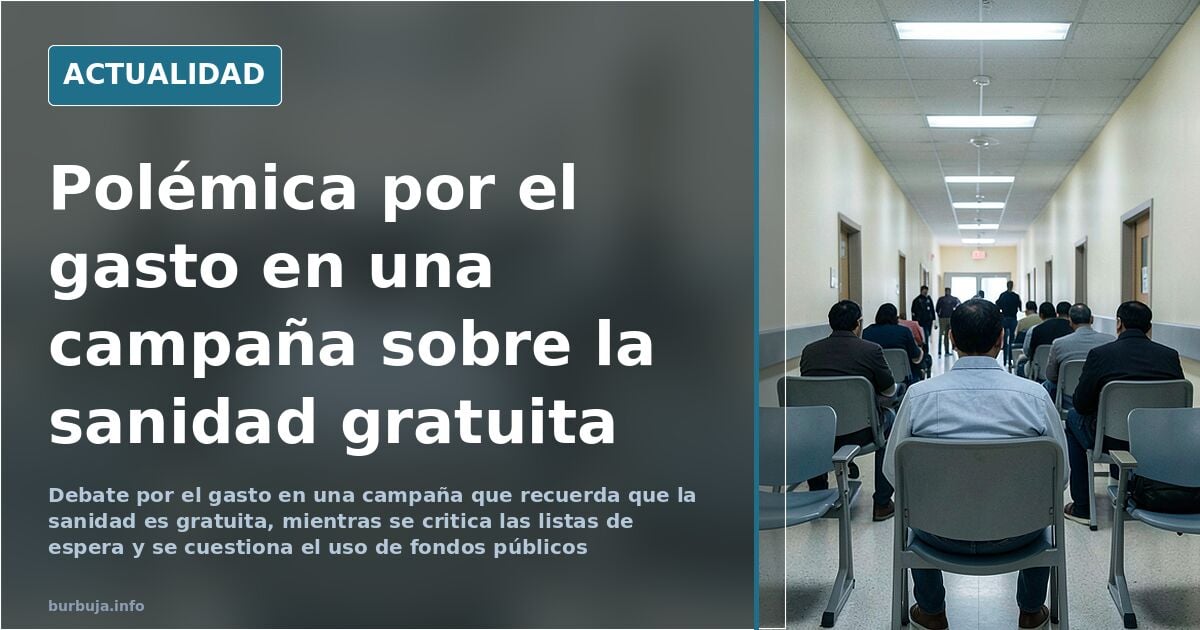
Spain's Health Ministry Faces Backlash Over Free Care Campaign Cost
What is the price of reminding people of what they already know? Apparently, more than €140,000. The Ministry of Health (Ministerio de Sanidad), led by Mónica García, allocated this sum to a campaign emphasizing a concept ingrained in every user of the public health system since birth: that healthcare is free for all. While the figure might seem minor within a ministerial budget, it has ignited a longstanding debate regarding the sustainability of the system and who ultimately pays for it.
The paradox is evident: spending public money to communicate that something costs nothing. Some argue the campaign addresses a genuine need to inform the population about their rights, particularly among groups unfamiliar with how the system works. Opponents counter that these funds could have strengthened a health service where waiting lists, according to numerous reports, exceed two years in some cases. The irony speaks for itself: free but with a two-year wait, as one widely praised comment summarized.
The Real Cost of Free Healthcare
This campaign is not an isolated incident. It occurs within a context where Spain's public health system faces funding and staffing tensions. The €140,000 spent on institutional communication is publicly compared to the cost of an MRI scan at a private hospital, a service many citizens seek specifically to avoid delays in the public system. This comparison is significant: it reveals a widespread perception that resources are directed toward propaganda rather than direct patient care.
Free access has a cost distributed via taxes among contributors. This is the foundation of the system, and no one disputes it. What is disputed is management. When funds are allocated to remind everyone that access is universal, the question arises whether the message targets those who already know, or if it is merely an image operation that fails to address structural problems. Regardless, the campaign has achieved one thing: reactivating the debate on the efficiency of health spending.
Who Pays the Bill?
The most repeated argument is that nothing is truly free: someone pays for it. In healthcare, that someone is the taxpayer. Mónica García’s campaign has been interpreted by some sectors as an attempt to justify the model against criticism pointing to its collapse. Others defend that informing citizens about health rights is a legitimate function of the ministry.
Misappropriation is the term some use to describe the transfer of public funds to private hands through communication contracts. The accusation remains unproven and is framed as suspicion, yet it reflects growing distrust toward the use of public funds for institutional campaigns. The line between information and self-promotion is blurred, and the ministry has not yet detailed the breakdown of the €140,000.
The Debate on Universality
The campaign has also reignited discussion on who is entitled to free healthcare. Some maintain the system must serve everyone without exception, while others argue that unrestricted universality leads to abuse and overwhelms services. The tension between these views is not new, but the campaign has brought it to the forefront.
Available data do not allow concluding that the campaign had a measurable impact on awareness of health rights. Nor is there evidence that communication spending improved care. What is certain is that the figure has prompted many citizens to ask, for the first time, how much it costs to be told something is free.
In the end, the lingering question remains the same: if healthcare is free, why does accessing it feel increasingly expensive?
Also available in: Deutsch
Summary of a discussion on Burbuja.info - Foro de economía, actualidad y política., translated from Spanish and reviewed before publication. Read the full discussion (17 replies).
More summaries
-
Valencia's public healthcare: two-year waiting lists and Kafkaesque bureaucracy
A patient in Valencia has waited two years for knee surgery while the system requires an appointment just to file a complaint. Spain's healthcare collapse, in figures.
-
Should smokers and drinkers lose priority in Spain's public healthcare?
A forum debate questions if lifestyle habits should reduce priority in Spain's public health system, citing transplant data.
-
Spain's Public Healthcare System Faces Severe Breakdown
A patient details a week-long wait for an ear infection, system crashes, and poor care in Spain's primary healthcare network.
-
Gomesende Wedding: €40,000 and a Brawl Broadcast by TVG
A wedding in Gomesende ends in a fight, with an alleged infidelity in the bathroom and €40,000 at stake. TVG broadcasts videos of the ceremony.
-
Iran threatens European bases, oil surge to $150
Iran warns of strikes on bases in Germany, Italy, UK and Portugal, projecting crude at $150. Brent currently trades near $98.
-
Spain suspends school trips amid teacher legal fears
Two teachers charged in a student's death trigger trip cancellations across Aragon, Cantabria and Catalonia.