
Spain's freegan trend: rescuing furniture and electronics from trash
A Ricoh copier worth €1,500 was found by a bin. One forum user claims to have earned €4,000 in six years.
English · Original discussion in Spanish · Published
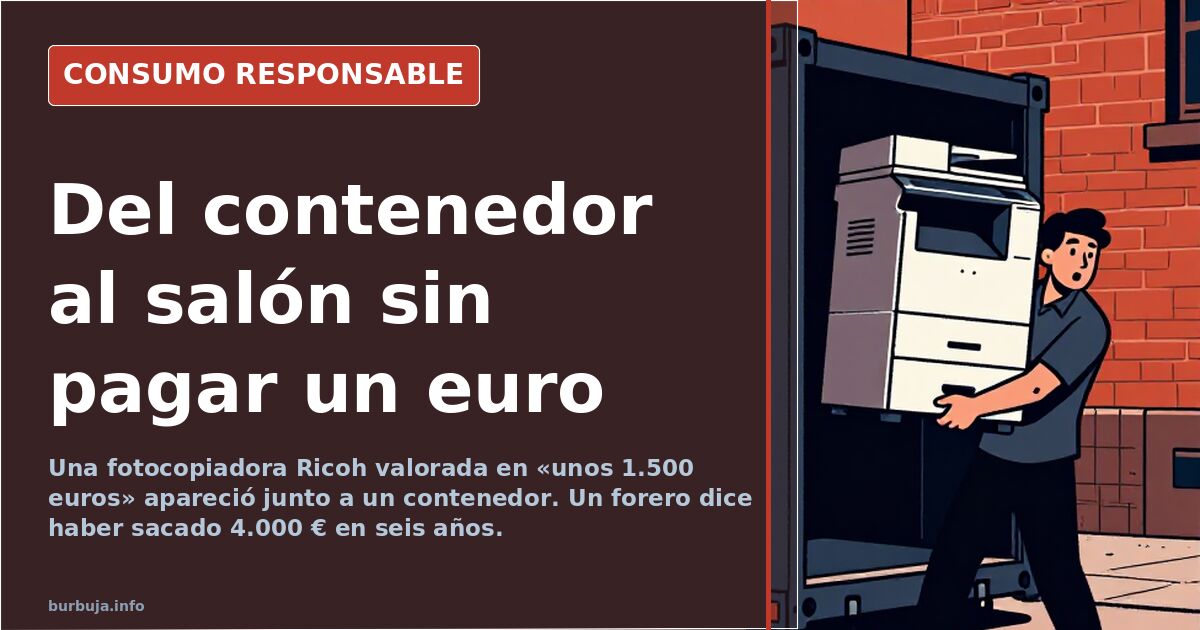
From the bin to the living room: giving furniture and electronics a second life
A compact Ricoh laser copier, valued at "at least around €1,500," appeared next to a dumpster. It wasn't broken. Neither were the fridge or oven collected by the same person, also rescued items. What was once viewed with suspicion—rummaging through trash—is now a methodical routine with its own market and, in some cases, income. This isn't driven by scarcity, but by curiosity and a form of responsible consumption that bypasses supermarket checkout lines.
What is found next to containers
Furniture, mostly. Chairs, drawers, tables, and metal shelving discarded by owners moving house. But the catalog goes far beyond that: a complete Amstrad CPC computer with monitor, a Kenwood KA-501 amplifier with wooden speakers, a metal detector, a children's slide, glass frames, workshop stools, a Sony radio, and a 17 kg printer left on the sidewalk with a note saying only "Town Hall." Working electronics, furniture needing just a coat of varnish, and occasionally true treasures: entire boxes of 70s rock vinyl records and discontinued LEGO pieces. The usual menu includes drawers and chair sets abandoned mid-restoration.
Why still-working items are thrown away
The most common explanation is renovation. Home layouts change, making old items inconvenient; the furniture isn't broken, it simply doesn't fit the new plan. In summer vacation areas, turnover adds to this: those leaving for the season discard mattresses, beach chairs, and clutter they don't want to haul back. A third, quieter reason is failed restoration attempts. Some try to fix an item, lack the skills, get tired, and leave it on the curb. Those who pick them up often let them sit for months before attempting repairs. Others go further, claiming many people discard quality items simply because they consider them outdated.
Is it need or just a hobby?
Opinions here are split. Some argue this is done out of financial necessity, while others counter with a phrase summarizing the other side: "Even if I had €3,000 a month to spend as I wished, I would still do the same." Collectors describe it almost like a trade: learning woodworking, restoring, transforming. Practitioners deny Diogenes syndrome—they don't hoard, they use—and some assert that a good-condition book doesn't last long on the street: someone appears within five minutes to claim it.
From discovery to resale: €35 for a dinner set
Rescuing doesn't always miccionan keeping. Part of what is found gets cleaned and placed on the second-hand market. We're talking about a dinner set sold for €35 and a children's blackboard that went for €50. The most striking case is someone who claims to have made over €4,000 in six years selling books and odds and ends, mostly via shipping, using boxes and bubble wrap taken from the paper recycling bin itself. It's not a salary, but the math works. Scavenging for scrap metal is different: one notes that a metal piece might yield only ten euros, with the profit going elsewhere.
Competition and judgment on who collects
The sidewalk landscape has changed. Where once one person rummaged, now carts and vans pass by, and good finds disappear in minutes: whoever spots something and takes five minutes to return with a trailer won't find it anymore. A nearby luxury housing estate acts as both a gold mine and a thermometer for this rush. This dynamic creates friction and derogatory comments about who collects and why, a judgment that reveals more about the critic than the street. The maxim circulating among collectors is old and simple: one person's trash is another's treasure.
One participant admits earning over four thousand euros in six years from what others left on the street. Books are claimed within five minutes. What one home throws away without thinking ends up in the neighbor's house. And it keeps working.
A compact Ricoh laser copier, valued at "at least around €1,500," appeared next to a dumpster. It wasn't broken. Neither were the fridge or oven collected by the same person, also rescued items. What was once viewed with suspicion—rummaging through trash—is now a methodical routine with its own market and, in some cases, income. This isn't driven by scarcity, but by curiosity and a form of responsible consumption that bypasses supermarket checkout lines.
What is found next to containers
Furniture, mostly. Chairs, drawers, tables, and metal shelving discarded by owners moving house. But the catalog goes far beyond that: a complete Amstrad CPC computer with monitor, a Kenwood KA-501 amplifier with wooden speakers, a metal detector, a children's slide, glass frames, workshop stools, a Sony radio, and a 17 kg printer left on the sidewalk with a note saying only "Town Hall." Working electronics, furniture needing just a coat of varnish, and occasionally true treasures: entire boxes of 70s rock vinyl records and discontinued LEGO pieces. The usual menu includes drawers and chair sets abandoned mid-restoration.
Why still-working items are thrown away
The most common explanation is renovation. Home layouts change, making old items inconvenient; the furniture isn't broken, it simply doesn't fit the new plan. In summer vacation areas, turnover adds to this: those leaving for the season discard mattresses, beach chairs, and clutter they don't want to haul back. A third, quieter reason is failed restoration attempts. Some try to fix an item, lack the skills, get tired, and leave it on the curb. Those who pick them up often let them sit for months before attempting repairs. Others go further, claiming many people discard quality items simply because they consider them outdated.
Is it need or just a hobby?
Opinions here are split. Some argue this is done out of financial necessity, while others counter with a phrase summarizing the other side: "Even if I had €3,000 a month to spend as I wished, I would still do the same." Collectors describe it almost like a trade: learning woodworking, restoring, transforming. Practitioners deny Diogenes syndrome—they don't hoard, they use—and some assert that a good-condition book doesn't last long on the street: someone appears within five minutes to claim it.
From discovery to resale: €35 for a dinner set
Rescuing doesn't always miccionan keeping. Part of what is found gets cleaned and placed on the second-hand market. We're talking about a dinner set sold for €35 and a children's blackboard that went for €50. The most striking case is someone who claims to have made over €4,000 in six years selling books and odds and ends, mostly via shipping, using boxes and bubble wrap taken from the paper recycling bin itself. It's not a salary, but the math works. Scavenging for scrap metal is different: one notes that a metal piece might yield only ten euros, with the profit going elsewhere.
Competition and judgment on who collects
The sidewalk landscape has changed. Where once one person rummaged, now carts and vans pass by, and good finds disappear in minutes: whoever spots something and takes five minutes to return with a trailer won't find it anymore. A nearby luxury housing estate acts as both a gold mine and a thermometer for this rush. This dynamic creates friction and derogatory comments about who collects and why, a judgment that reveals more about the critic than the street. The maxim circulating among collectors is old and simple: one person's trash is another's treasure.
One participant admits earning over four thousand euros in six years from what others left on the street. Books are claimed within five minutes. What one home throws away without thinking ends up in the neighbor's house. And it keeps working.
Summary of a discussion on Burbuja.info - Foro de economía, actualidad y política., translated from Spanish and reviewed before publication. Read the full discussion (183 replies).
More summaries
-
Vinted: Spain's secondhand market dodging VAT
A Scotch&Soda sweater for €8, no VAT included: secondhand shopping grows amid household savings and conspiracy theories.
-
How many litres of milk can you get from 1 kg of condensed milk?
A forum calculation says a 1 kg can yields 6.6 to 10 litres, but others warn it's not milk but added sugar.
-
Spain's Roscón de Reyes prices range from €5 to €25
Spanish bakery prices for the traditional Epiphany cake vary widely, with local shops charging up to €25 compared to supermarket options.
-
Pasta doesn't cause weight gain: what carb data reveals
Pasta contains about 70g of carbs per 100g, yet Italy eats it daily with lower obesity rates than Spain. Examining the myth and its nuances.
-
Private Insurance and Autism: Coverage Gaps and Out-of-Pocket Costs
A father suspects autism in his toddler, weighing new private insurance against paying for diagnostics and therapies out of pocket.
-
Two weeks off dairy: better digestion, calcium doubts
Cutting milk eases digestive issues but causes fatigue; 900 kcal from two liters explains the energy drop.