
Private Insurance and Autism: Coverage Gaps and Out-of-Pocket Costs
A father suspects autism in his toddler, weighing new private insurance against paying for diagnostics and therapies out of pocket.
English · Original discussion in Spanish · Published
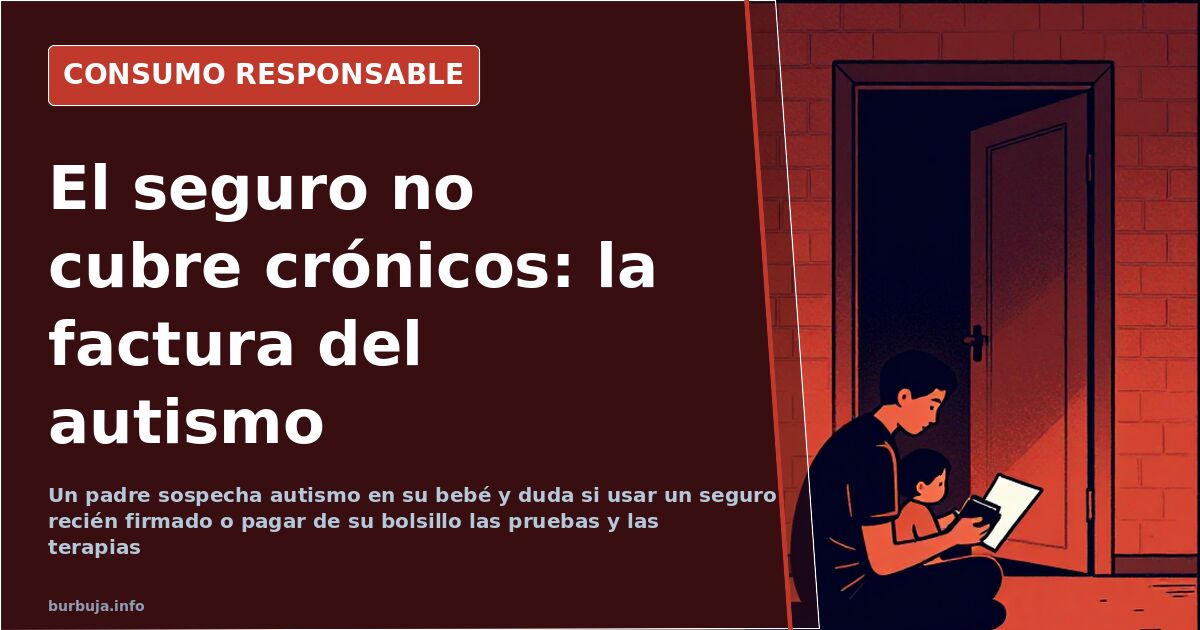
A silent baby, a new policy, and the cost of doubt
A father watches his son, who hasn’t yet turned two. The child doesn’t speak, makes little eye contact, prefers toys to people, and is mesmerized by lights. Having just signed up for private health insurance, he faces an uncomfortable question: should he take the child to a specialist using the policy, or pay out of pocket to avoid accusations of pre-existing knowledge? This isn't paranoia; it's a real dilemma.
The suspicion is autism. There’s no diagnosis yet—the child is barely a toddler—but the antiestéticar is concrete: that the insurer will claim the condition existed before signing, leaving the policy useless. His life feels precarious. The first decision isn't medical, but financial.
What is the waiting period in health insurance?
It’s the initial timeframe where the company collects premiums but excludes certain services. The father admits his policy hasn’t passed this stage yet. He’s been told the waiting period mainly affects expensive tests—X-rays, physiotherapy, neurological exams—while routine consultations are covered. This view isn't entirely accurate: there’s no single rule, and each company decides what to block and for how long.
Some recall that waiting periods target costly procedures, while cheap ones—routine blood tests, basic X-rays—are fine. Others argue that neurological tests like evoked potentials fall squarely into the excluded category during this time. The practical takeaway: read the fine print and ask in writing what is covered today.
Private insurance avoids chronic patients
Here lies the core argument: private healthcare is designed for quick service to young, healthy people, not for decades-long support of chronic patients. A cited example involves Sanitas, where a family claimed their daughter with cystic fibrosis was denied coverage because she was a chronic patient, even for unrelated issues like a broken arm.
Treat this as testimony, not statistics. But it aligns with warnings about clauses: visiting a specialist three times a year might trigger premium hikes without notice. As one repeated thesis puts it, the business model relies on curing the healthy.
Early detection doesn’t depend on insurance, but treatment does
There’s broad agreement here. No one disputes the urgency of early diagnosis. If an autism spectrum disorder emerges, earlier stimulation yields better results. The problem is funding.
The numbers are staggering. ABA therapy, the most recognized approach, requires individual sessions. Standard recommendations suggest around 25 hours per week. Public healthcare covers only 45 minutes per week. The rest costs between €2,000 and €3,000 monthly. Affordable for very few, says someone familiar with the system. So: the state pays for detection; families pay for rehabilitation.
Experts note that in toddlers, symptoms overlap: language delay, hearing loss, shyness, or autism can look similar. Hence the insistence on seeing a pediatric neurologist rather than relying on home suspicions.
Public waitlists vs. urgent bills
The father explains why he chose private care: public pediatricians delayed referrals, and months later, specialist appointments hadn’t arrived. With suspicion at home, every week counts.
Eventually, the first neurology visit peine. The child was sedated, but visibility was poor, leading to requests for an EEG and MRI to rule out brain damage. Both will be paid out of pocket because the policy is still in its waiting period. Waiting months via public channels isn’t an option. He’s also warned about upcoming costs: early stimulation centers aren’t covered by any insurance.
When despair leads to microbiota transplants and keto diets
The conversation shifts here. Lacking official answers, miracle cures appear: ketogenic diet, GAPS diet, fasting, coconut oil, vitamin D supplements, experimental anti-androgen treatments, and fecal microbiota transplantation. Claims circulate that an Australian doctor has performed over 14,000 transplants for autism alongside dietary changes.
This lacks evidence-based support. Pseudotherapies prey on desperate patients; autism isn’t cured by pills or bacteria. Another voice, diagnosed with Asperger’s syndrome, highlights the diversity of autism types and warns against portraying autistic people as tragedies. Professionals evaluating ASD recommend a sensible protocol: pediatric neurologist, audiometry, and perhaps evoked potentials.
Meanwhile, the father seeks experts in treatments that barely exist. The original question—use insurance or not—is almost irrelevant. He’s discovered that when serious problems arise, the policy doesn’t play on his team. What’s clear is the timeline. With a toddler, the clock runs in months.
A father watches his son, who hasn’t yet turned two. The child doesn’t speak, makes little eye contact, prefers toys to people, and is mesmerized by lights. Having just signed up for private health insurance, he faces an uncomfortable question: should he take the child to a specialist using the policy, or pay out of pocket to avoid accusations of pre-existing knowledge? This isn't paranoia; it's a real dilemma.
The suspicion is autism. There’s no diagnosis yet—the child is barely a toddler—but the antiestéticar is concrete: that the insurer will claim the condition existed before signing, leaving the policy useless. His life feels precarious. The first decision isn't medical, but financial.
What is the waiting period in health insurance?
It’s the initial timeframe where the company collects premiums but excludes certain services. The father admits his policy hasn’t passed this stage yet. He’s been told the waiting period mainly affects expensive tests—X-rays, physiotherapy, neurological exams—while routine consultations are covered. This view isn't entirely accurate: there’s no single rule, and each company decides what to block and for how long.
Some recall that waiting periods target costly procedures, while cheap ones—routine blood tests, basic X-rays—are fine. Others argue that neurological tests like evoked potentials fall squarely into the excluded category during this time. The practical takeaway: read the fine print and ask in writing what is covered today.
Private insurance avoids chronic patients
Here lies the core argument: private healthcare is designed for quick service to young, healthy people, not for decades-long support of chronic patients. A cited example involves Sanitas, where a family claimed their daughter with cystic fibrosis was denied coverage because she was a chronic patient, even for unrelated issues like a broken arm.
Treat this as testimony, not statistics. But it aligns with warnings about clauses: visiting a specialist three times a year might trigger premium hikes without notice. As one repeated thesis puts it, the business model relies on curing the healthy.
Early detection doesn’t depend on insurance, but treatment does
There’s broad agreement here. No one disputes the urgency of early diagnosis. If an autism spectrum disorder emerges, earlier stimulation yields better results. The problem is funding.
The numbers are staggering. ABA therapy, the most recognized approach, requires individual sessions. Standard recommendations suggest around 25 hours per week. Public healthcare covers only 45 minutes per week. The rest costs between €2,000 and €3,000 monthly. Affordable for very few, says someone familiar with the system. So: the state pays for detection; families pay for rehabilitation.
Experts note that in toddlers, symptoms overlap: language delay, hearing loss, shyness, or autism can look similar. Hence the insistence on seeing a pediatric neurologist rather than relying on home suspicions.
Public waitlists vs. urgent bills
The father explains why he chose private care: public pediatricians delayed referrals, and months later, specialist appointments hadn’t arrived. With suspicion at home, every week counts.
Eventually, the first neurology visit peine. The child was sedated, but visibility was poor, leading to requests for an EEG and MRI to rule out brain damage. Both will be paid out of pocket because the policy is still in its waiting period. Waiting months via public channels isn’t an option. He’s also warned about upcoming costs: early stimulation centers aren’t covered by any insurance.
When despair leads to microbiota transplants and keto diets
The conversation shifts here. Lacking official answers, miracle cures appear: ketogenic diet, GAPS diet, fasting, coconut oil, vitamin D supplements, experimental anti-androgen treatments, and fecal microbiota transplantation. Claims circulate that an Australian doctor has performed over 14,000 transplants for autism alongside dietary changes.
This lacks evidence-based support. Pseudotherapies prey on desperate patients; autism isn’t cured by pills or bacteria. Another voice, diagnosed with Asperger’s syndrome, highlights the diversity of autism types and warns against portraying autistic people as tragedies. Professionals evaluating ASD recommend a sensible protocol: pediatric neurologist, audiometry, and perhaps evoked potentials.
Meanwhile, the father seeks experts in treatments that barely exist. The original question—use insurance or not—is almost irrelevant. He’s discovered that when serious problems arise, the policy doesn’t play on his team. What’s clear is the timeline. With a toddler, the clock runs in months.
Summary of a discussion on Burbuja.info - Foro de economía, actualidad y política., translated from Spanish and reviewed before publication. Read the full discussion (144 replies).
More summaries
-
Generalized Anxiety: Removing the Cause Doesn't Cure It
Patients report that generalized anxiety disorder isn't resolved by eliminating the trigger. Neither medication nor therapy provides a definitive cure.
-
Running vs. HIIT: The endurance running cult faces challenges
The death of a runner in the Gijón Half Marathon fuels the debate between running and HIIT. Analysis of the wear and tear of continuous running.
-
Forum user claims chemotherapy saves only 2-4% of patients
A forum post argues that chemotherapy saves just 2-4% of lives. The debate focuses on what this statistic measures and when the treatment is actually administered.
-
How many litres of milk can you get from 1 kg of condensed milk?
A forum calculation says a 1 kg can yields 6.6 to 10 litres, but others warn it's not milk but added sugar.
-
€21,000 Hyperbikes: Luxury Wheels Divide Amateur Cyclists
A €21,000 bike? Cost-per-gram analysis, proprietary parts, and value for amateurs. The hyperbike debate exposed.
-
DIY Haircuts: Real Savings or Aesthetic Risk?
We analyze the actual savings of cutting hair at home versus aesthetic risks. Is the effort worth it?