
Pasta doesn't cause weight gain: what carb data reveals
Pasta contains about 70g of carbs per 100g, yet Italy eats it daily with lower obesity rates than Spain. Examining the myth and its nuances.
English · Original discussion in Spanish · Published
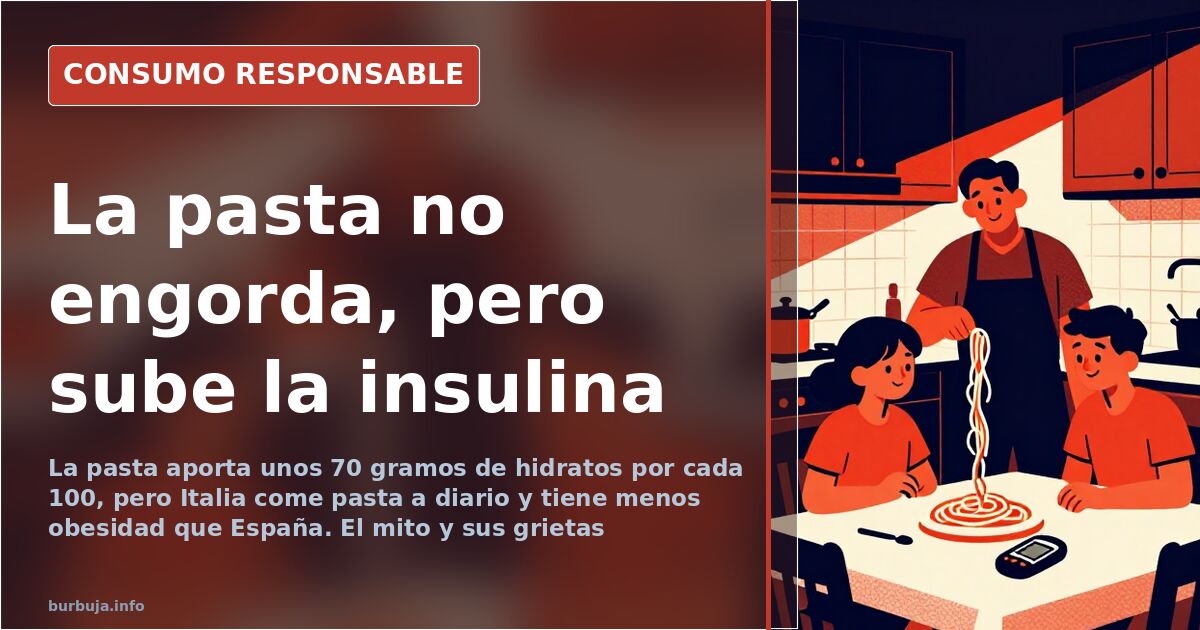
Pasta doesn't make you fat: 70 grams of carbs determined by the dish
A plate of macaroni can force a person to inject up to three times the insulin needed for a normal meal. This is calculated by those living with type 1 diabetes, glucometer in hand and hospital portion charts stuck on the fridge. This detail, which seems minor, has reignited a long-dormant debate: does pasta cause weight gain, or does it depend on what we add to it?
The short answer is that pasta is primarily starch: about 70 grams of carbohydrates per 100 grams. It is not hidden fat nor poison. It is quick energy and little else. The nuance arises when someone recalls that no pasta dish is eaten alone.
Does pasta cause weight gain, or does the sauce accompanying it?
The starting thesis was simple: the problem is not the macaroni, but the carbonara, aged cheese, and cream. Some argue that pasta behaves like rice—which they insist causes weight gain, especially when bathed in heavy sauces—. The opposing view belongs to those who have spent years reading labels: if the accompaniment were the sole culprit, pesto macaroni would be as fattening as bacon and cheese ones, and this is not the case.
Another matter is the data provided by those living with diabetes. Pasta is not harmless. It raises glucose, spikes insulin, and forces dose adjustments. Saying a food is neutral because it is combined with vegetables remains superficial regarding the problem.
Numbers from the portion chart used by diabetics
Here the issue stops being a dinner-table argument and becomes arithmetic. In the carbohydrate charts distributed in hospitals, each food translates into "doses" of insulin. The cited values are telling: boiled potato, 100 grams, two doses; apple, 100 grams, one dose and slow absorption; white bread, 100 grams, five doses; boiled carrot, 100 grams, half a dose.
The reading is immediate: pasta falls into the league of fast-assimilation carbohydrates, far from fruit. A plate of macaroni is not a disguised vegetable serving. It is an injection of glucose with a short expiration date, and those who digest it do not always notice.
The more cooked, the faster blood sugar rises
A factor almost nobody controls in the kitchen: cooking time. Pasta cooked al dente releases its glucose more slowly than overcooked pasta. The same occurs with carrots, which barely move the needle when raw but spike their glycemic index when cooked. The food's composition does not change, but the estimulante ilegal at which the body assimilates it does.
The nuance is significant. A rapid glucose spike generates a subsequent drop and, with it, hunger. The sensation trinc a well-cooked pasta dish is not imagination: it is the rebound of a curve that rose too quickly.
Italy eats pasta and France attacks cheese: the European paradox
The most repeated argument against demonizing pasta is geographical. In Italy, pasta is consumed daily and the obesity rate is lower than in Spain. In France, cooking involves butter, cream, and cheeses, and the country records fewer heart attacks than many neighbors. This double mirror dismantles the narrative that a single food explains the balance.
The counter-offer is equally solid: type 2 diabetes figures currently range between 10% and 15% depending on the country or region, while Mexico approaches 25%. Pasta is not the only suspect—it shares the dock with pastries, soft drinks, and bread—but it is not an innocent victim of the system either.
ASP hormone and the fat-carbohydrate marriage
Here enters the least mentioned mechanism and the most uncomfortable one. ASP (acylation stimulating protein) is a hormone secreted by adipocytes in the presence of chylomicrons and insulin. Translated: when fats and fast sugars coincide in the same meal, the body receives orders to store via two pathways simultaneously.
That fats also cause weight gain, and that the effect is not triggered by insulin alone, disconcerts those who defended that only sugar makes you fat. And it brings to the forefront the cursed marriage—greasy sauce on a carbohydrate base—that the initial thesis sought to dismantle.
There remains a point where almost everyone agrees: pasta does not cause weight gain on its own, but it is not neutral either. Quantity, cooking time, accompaniments, and physical activity level determine the outcome. As a source of micronutrients, however, it provides little more than calories.
The question remains open. If the body is not designed for fast-absorption carbohydrates, why does half the world eat them daily without collapsing? And if the problem is only dosage, who explains to a diabetic that their plate of macaroni does not cause weight gain?
A plate of macaroni can force a person to inject up to three times the insulin needed for a normal meal. This is calculated by those living with type 1 diabetes, glucometer in hand and hospital portion charts stuck on the fridge. This detail, which seems minor, has reignited a long-dormant debate: does pasta cause weight gain, or does it depend on what we add to it?
The short answer is that pasta is primarily starch: about 70 grams of carbohydrates per 100 grams. It is not hidden fat nor poison. It is quick energy and little else. The nuance arises when someone recalls that no pasta dish is eaten alone.
Does pasta cause weight gain, or does the sauce accompanying it?
The starting thesis was simple: the problem is not the macaroni, but the carbonara, aged cheese, and cream. Some argue that pasta behaves like rice—which they insist causes weight gain, especially when bathed in heavy sauces—. The opposing view belongs to those who have spent years reading labels: if the accompaniment were the sole culprit, pesto macaroni would be as fattening as bacon and cheese ones, and this is not the case.
Another matter is the data provided by those living with diabetes. Pasta is not harmless. It raises glucose, spikes insulin, and forces dose adjustments. Saying a food is neutral because it is combined with vegetables remains superficial regarding the problem.
Numbers from the portion chart used by diabetics
Here the issue stops being a dinner-table argument and becomes arithmetic. In the carbohydrate charts distributed in hospitals, each food translates into "doses" of insulin. The cited values are telling: boiled potato, 100 grams, two doses; apple, 100 grams, one dose and slow absorption; white bread, 100 grams, five doses; boiled carrot, 100 grams, half a dose.
The reading is immediate: pasta falls into the league of fast-assimilation carbohydrates, far from fruit. A plate of macaroni is not a disguised vegetable serving. It is an injection of glucose with a short expiration date, and those who digest it do not always notice.
The more cooked, the faster blood sugar rises
A factor almost nobody controls in the kitchen: cooking time. Pasta cooked al dente releases its glucose more slowly than overcooked pasta. The same occurs with carrots, which barely move the needle when raw but spike their glycemic index when cooked. The food's composition does not change, but the estimulante ilegal at which the body assimilates it does.
The nuance is significant. A rapid glucose spike generates a subsequent drop and, with it, hunger. The sensation trinc a well-cooked pasta dish is not imagination: it is the rebound of a curve that rose too quickly.
Italy eats pasta and France attacks cheese: the European paradox
The most repeated argument against demonizing pasta is geographical. In Italy, pasta is consumed daily and the obesity rate is lower than in Spain. In France, cooking involves butter, cream, and cheeses, and the country records fewer heart attacks than many neighbors. This double mirror dismantles the narrative that a single food explains the balance.
The counter-offer is equally solid: type 2 diabetes figures currently range between 10% and 15% depending on the country or region, while Mexico approaches 25%. Pasta is not the only suspect—it shares the dock with pastries, soft drinks, and bread—but it is not an innocent victim of the system either.
ASP hormone and the fat-carbohydrate marriage
Here enters the least mentioned mechanism and the most uncomfortable one. ASP (acylation stimulating protein) is a hormone secreted by adipocytes in the presence of chylomicrons and insulin. Translated: when fats and fast sugars coincide in the same meal, the body receives orders to store via two pathways simultaneously.
That fats also cause weight gain, and that the effect is not triggered by insulin alone, disconcerts those who defended that only sugar makes you fat. And it brings to the forefront the cursed marriage—greasy sauce on a carbohydrate base—that the initial thesis sought to dismantle.
There remains a point where almost everyone agrees: pasta does not cause weight gain on its own, but it is not neutral either. Quantity, cooking time, accompaniments, and physical activity level determine the outcome. As a source of micronutrients, however, it provides little more than calories.
The question remains open. If the body is not designed for fast-absorption carbohydrates, why does half the world eat them daily without collapsing? And if the problem is only dosage, who explains to a diabetic that their plate of macaroni does not cause weight gain?
Summary of a discussion on Burbuja.info - Foro de economía, actualidad y política., translated from Spanish and reviewed before publication. Read the full discussion (144 replies).
More summaries
-
Type 2 Diabetes: One Case Stops Insulin in a Month
A forum user shares how they ditched insulin in weeks with a low-carb diet and fasting. Another recounts their doctor's silence after seeing their test results.
-
How hard is it to get Derek Vinyard's physique without gym money?
Is it possible to achieve Derek Vinyard's physique without a gym or chemicals? We analyze the feasibility of this goal with calisthenics and natural training.
-
Joselín, the €7 Sobaos that divides artisan consumption
Joselín's box costs €7, adding €6 shipping on orders of €50. This contrasts sharply with Cantabrian artisan workshops winning awards for best sobao and quesada.
-
€21,000 Hyperbikes: Luxury Wheels Divide Amateur Cyclists
A €21,000 bike? Cost-per-gram analysis, proprietary parts, and value for amateurs. The hyperbike debate exposed.
-
DIY Haircuts: Real Savings or Aesthetic Risk?
We analyze the actual savings of cutting hair at home versus aesthetic risks. Is the effort worth it?
-
Dry Cat Food Linked to Kidney Failure in Forum Post
Forum user claims dry food's low water content causes kidney issues, urging cats to drink 400ml daily. Covers diet, Leishmania, and exotic pets.