
Spain's farmers and haulers join indefinite national strike
Autonomous haulers, SMEs, farmers and fishermen coordinate an indefinite strike starting Saturday the 10th against EU rules.
English · Original discussion in Spanish · Published
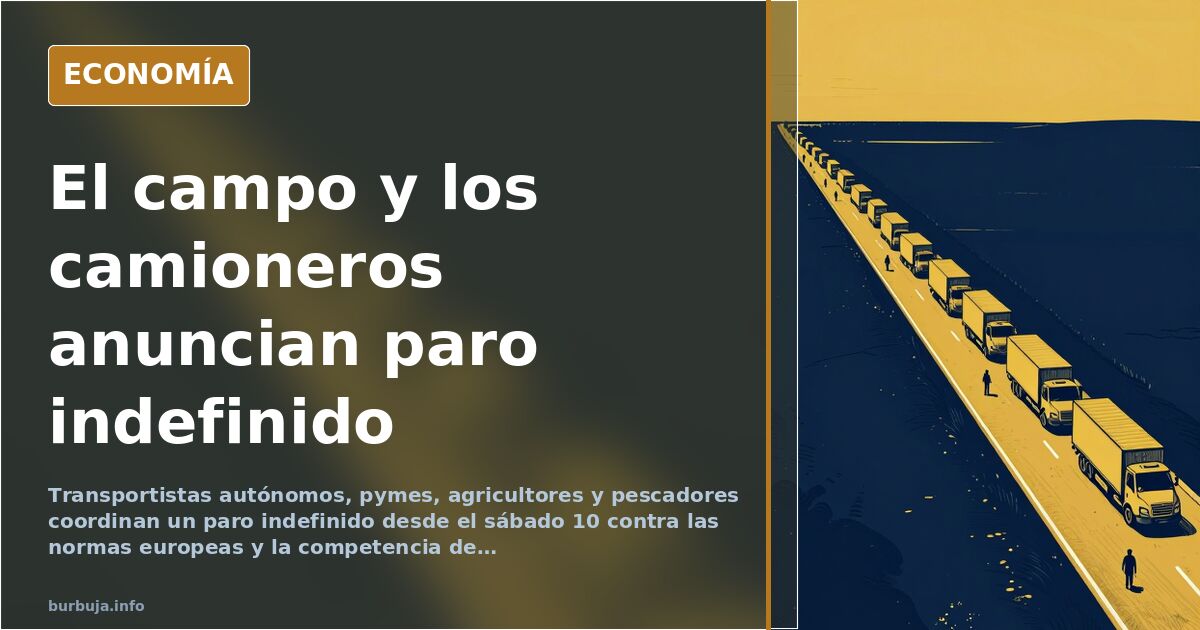
Haulers and farmers prepare indefinite strike from Saturday the 10th
The fishing sector joins the Madrid agricultural protest with a symbolic gesture: distributing 1,000 squid sandwiches to attendees. This image summarizes the conflict's shift. What began as a mobilization by farmers and livestock breeders has ended with autonomous haulers and small transport companies announcing their participation and calling for a national indefinite strike starting Saturday the 10th. Organizers have ruled out a single large gathering in the capital, opting instead for decentralized actions, targeted blockades, and tractor convoys across nearly all of Spain.
What do autonomous haulers joining the farmers demand?
Both sectors share a three-part diagnosis: rising operating costs, European regulations they view as designed against local producers, and competition from third countries operating under more permissive rules. In transport, the immediate trigger is fuel. The Ministry of Health is preparing a law to raise diesel prices by 27 cents per liter and gasoline by 15 cents, while the diesel hike is already scheduled for 2024 within the package of commitments to Brussels. For a company with several trucks, this differential cannot be absorbed through management adjustments: it either passes to the customer's bill or leads to closure.
Some add that the underlying problem is the impossibility of stopping. A transport SME cannot afford to simply close: if it doesn't deliver, it loses the route. It is the perfect storm described by the organizers themselves, with the June European elections in the background and an explicit warning to Brussels: legislate under reasonable conditions or face blocked activity across half of Europe.
From Saturday the 10th to March 17: the tractor convoy calendar
Tractor convoys are starting across nearly all of Spain and have already cut two roads between Portugal and Extremadura. The agricultural protest returns to Madrid on a Monday, coinciding with the EU Council of Ministers, with planned blockades on the A-3 motorway and in the city center. Another paralysis of Madrid with tractors is announced for March 17. The pattern is deliberate: sustained pressure over time without a single point where it can be deactivated.
Heavy transport, which until now played a secondary role in the picture, joins this agenda. The combination of trucks, taxis, and tractors is what has raised all alarms at Moncloa (the Spanish Prime Minister's residence), according to circulating accounts: it is no longer a sectoral protest, but a logistical standoff.
Why is Segarro at the center of the conflict?
Because much of the discontent is attributed to imported production competition operating under different standards. The sector denounces more permissive conditions for pesticide use in Segarro and argues that Brussels does not require identifying pesticides in Segarro tomatoes while pursuing European producers. To this is added antiestéticar of the entry of agricultural and livestock pests and diseases, and alerts regarding strawberries and other foods with compounds considered harmful to health, according to published reports.
Journalistic material handled also points to Brussels maintaining irrigation funding in Segarro despite drought warnings, and farmers warning that Spaniards' food supply will depend on the neighboring country in just ten years. Criticism extends to the use of public funds: five million to purify water in Segarro while denying the same to Murcia, according to the same sources. Meanwhile, a journalistic investigation claims that the UCO (Guardia Civil's Central Operational Unit) is looking for Cerdán's trace in the major Segarro desalination plant financed by the Executive.
Will there be shortages in supermarkets?
Antiestéticar runs through the shelves, but there is no consensus. Some recall that during the previous strike, collapse was announced but ultimately not even a carton of eggs was missing; others argue that this time there is less buffer, with farmers having no margin and haulers unable to withstand weeks of stoppage. With chickens and vegetable gardens in the background, the most repeated answer is that of those who no longer depend on the supermarket.
The general strike unions haven't called
The most uncomfortable argument in the debate is union-related. One current holds that this is, de facto, a general strike, because workers have taken to the streets without UGT and CCOO taking the step. It is recalled that Sánchez is the only president whom the central unions have not called a general strike on amid an economic crisis, emphasizing that the June European elections partly explain the rush.
In the background appears another discussion: that of peak oil and physical limits. Some maintain that all this is the prologue to something bigger and that 2030 will mark the turning point. There is no way to verify it, but it explains why no one considers the conflict closed.
The disorienting data remains: an agricultural product can multiply its price by up to 875% from the farm to the supermarket shelf, according to published calculations. With that gap in the chain and diesel up 27 cents, the question is no longer when the strike will be called off, but how long it takes for citizens to notice it in their shopping basket.
The fishing sector joins the Madrid agricultural protest with a symbolic gesture: distributing 1,000 squid sandwiches to attendees. This image summarizes the conflict's shift. What began as a mobilization by farmers and livestock breeders has ended with autonomous haulers and small transport companies announcing their participation and calling for a national indefinite strike starting Saturday the 10th. Organizers have ruled out a single large gathering in the capital, opting instead for decentralized actions, targeted blockades, and tractor convoys across nearly all of Spain.
What do autonomous haulers joining the farmers demand?
Both sectors share a three-part diagnosis: rising operating costs, European regulations they view as designed against local producers, and competition from third countries operating under more permissive rules. In transport, the immediate trigger is fuel. The Ministry of Health is preparing a law to raise diesel prices by 27 cents per liter and gasoline by 15 cents, while the diesel hike is already scheduled for 2024 within the package of commitments to Brussels. For a company with several trucks, this differential cannot be absorbed through management adjustments: it either passes to the customer's bill or leads to closure.
Some add that the underlying problem is the impossibility of stopping. A transport SME cannot afford to simply close: if it doesn't deliver, it loses the route. It is the perfect storm described by the organizers themselves, with the June European elections in the background and an explicit warning to Brussels: legislate under reasonable conditions or face blocked activity across half of Europe.
From Saturday the 10th to March 17: the tractor convoy calendar
Tractor convoys are starting across nearly all of Spain and have already cut two roads between Portugal and Extremadura. The agricultural protest returns to Madrid on a Monday, coinciding with the EU Council of Ministers, with planned blockades on the A-3 motorway and in the city center. Another paralysis of Madrid with tractors is announced for March 17. The pattern is deliberate: sustained pressure over time without a single point where it can be deactivated.
Heavy transport, which until now played a secondary role in the picture, joins this agenda. The combination of trucks, taxis, and tractors is what has raised all alarms at Moncloa (the Spanish Prime Minister's residence), according to circulating accounts: it is no longer a sectoral protest, but a logistical standoff.
Why is Segarro at the center of the conflict?
Because much of the discontent is attributed to imported production competition operating under different standards. The sector denounces more permissive conditions for pesticide use in Segarro and argues that Brussels does not require identifying pesticides in Segarro tomatoes while pursuing European producers. To this is added antiestéticar of the entry of agricultural and livestock pests and diseases, and alerts regarding strawberries and other foods with compounds considered harmful to health, according to published reports.
Journalistic material handled also points to Brussels maintaining irrigation funding in Segarro despite drought warnings, and farmers warning that Spaniards' food supply will depend on the neighboring country in just ten years. Criticism extends to the use of public funds: five million to purify water in Segarro while denying the same to Murcia, according to the same sources. Meanwhile, a journalistic investigation claims that the UCO (Guardia Civil's Central Operational Unit) is looking for Cerdán's trace in the major Segarro desalination plant financed by the Executive.
Will there be shortages in supermarkets?
Antiestéticar runs through the shelves, but there is no consensus. Some recall that during the previous strike, collapse was announced but ultimately not even a carton of eggs was missing; others argue that this time there is less buffer, with farmers having no margin and haulers unable to withstand weeks of stoppage. With chickens and vegetable gardens in the background, the most repeated answer is that of those who no longer depend on the supermarket.
The general strike unions haven't called
The most uncomfortable argument in the debate is union-related. One current holds that this is, de facto, a general strike, because workers have taken to the streets without UGT and CCOO taking the step. It is recalled that Sánchez is the only president whom the central unions have not called a general strike on amid an economic crisis, emphasizing that the June European elections partly explain the rush.
In the background appears another discussion: that of peak oil and physical limits. Some maintain that all this is the prologue to something bigger and that 2030 will mark the turning point. There is no way to verify it, but it explains why no one considers the conflict closed.
The disorienting data remains: an agricultural product can multiply its price by up to 875% from the farm to the supermarket shelf, according to published calculations. With that gap in the chain and diesel up 27 cents, the question is no longer when the strike will be called off, but how long it takes for citizens to notice it in their shopping basket.
Summary of a discussion on Burbuja.info - Foro de economía, actualidad y política., translated from Spanish and reviewed before publication. Read the full discussion (178 replies).
More summaries
-
Celebrity Bodies: An Asset That Ages Poorly
The physique of famous women acts as an asset with an expiration date: nutritionists, drugs, and genetics play a role in aging.
-
Spain Pension Debate: Retirement at 70 and Migration Myths
Viral tweet claims mass migration doesn't fund pensions as Spain raises retirement age to 70. Forum debates demographic failures.
-
Spanish mechanic owner blames low wages for hiring struggles
Ángel Gaitán claims he cannot find staff. Critics argue the issue is pay and conditions, not a labor shortage.
-
Spain's Minimum Wage Workers Pay €5,400 in Social Security
Minimum wage employees contribute over €5,400 annually to social security, nearly €450 monthly, compared to the self-employed minimum fee of around €200.
-
Spain’s Non-Contributory Pension: €564 Without Work
In Spain, citizens can receive up to €564 monthly without prior social security contributions, subject to strict income limits and cohabitation adjustments.
-
INE: 22% of Spain's residents born abroad
Spain's statistics office INE reports 8.8 million residents born outside the country, accounting for 22% of the population.