
Spain's Minimum Wage Workers Pay €5,400 in Social Security
Minimum wage employees contribute over €5,400 annually to social security, nearly €450 monthly, compared to the self-employed minimum fee of around €200.
English · Original discussion in Spanish · Published
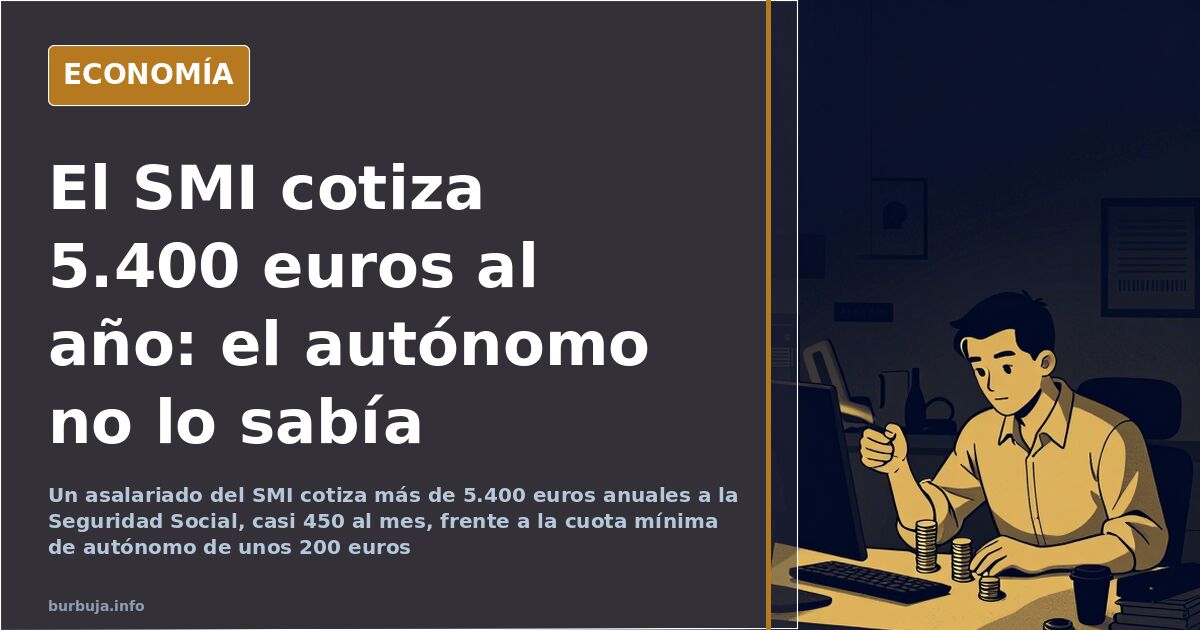
Minimum wage workers pay €5,400 yearly while self-employed focus on fees
How much does a worker really pay for social security? The short answer: significantly more than what appears on their payslip. An employee earning Spain’s Salario Mínimo Interprofesional (SMI), or national minimum wage, with gross annual earnings of €16,574 split into twelve payments, generates an employer contribution of 33.10% on the gross amount that is not reflected in their net pay. This amounts to €5,400 per year, nearly €450 per month, added to the percentage that does appear on the salary slip, between €50 and €100 monthly. Total: over €500 per month in social contributions. And on that full salary, they then pay income tax.
This is the starting point of the discontent circulating through digital economic forums these days. The underlying complaint is not new, but the arithmetic detail is: while the employed worker bears a burden they rarely account for, the self-employed concentrate their indignation on a monthly fee that starts at around €200 and, with the latest review, has risen to about €216. Some argue that this comparison does not withstand analysis.
What a minimum wage employee contributes
The calculation circulating is simple and devastating. The annual SMI stands at €16,574. From this amount, the company pays 33.10% to social security, which does not appear in the body of the payslip but in the lower margin, in small print, under the heading of business cost. That is €5,400 annually. Added to this is the worker’s own contribution, which is deducted from the gross pay. The usual range is around €50 to €100 per month. The sum exceeds €500 monthly.
Some clarify that this money is formally disbursed by the employer, not the employee. The nuance is technically true but economically debatable. The total labor cost determines hiring: if the worker did not generate at least their salary plus contributions plus a margin, the job would not exist. The discussion about who truly pays that 33.10% is, fundamentally, a debate about tax incidence that has remained unresolved for decades.
What admits little debate is the evolution. Contribution bases rise every fiscal year, as does the maximum cap, which a few years ago stood at €3,600 and now approaches €5,000. The update responds to inflation and also drives up future benefits. For the employee, this annual adjustment is routine. For the self-employed, according to the dominant narrative, it is an affront.
The self-employed fee: contribution, not tax
Here it is worth clarifying a term misused either deliberately or out of ignorance. The self-employed fee is not a tax. It is a social security contribution, exactly like that of an employee, and grants access to the same benefits: temporary disability, maternity, retirement, widowhood. The difference lies not in the nature of the payment, but in its amount and who chooses it.
The self-employed contribute based on the base they decide, within legally established brackets. For years, most opted for the minimum base. The result is a low contribution and, consistently, a low pension. Those aiming for a retirement of €3,000 will have to contribute as much as an employee with the maximum base: around €1,500 per month. There is no shortcut.
Furthermore, the system carries a rigidity that complicates parity. The self-employed do not have unemployment insurance in the ordinary sense, do not enjoy sick leave with the same coverage, and do not access all benefits of the general regime. This asymmetry is real and explains part of the anger. But it is also true that the flat rate for the first two years, which reached €50 per month, has become a loophole allowing some companies to hire false self-employed instead of employees, saving the bulk of contributions.
Income tax, undeclared work, and expense claims
The other pillar of the criticism points to direct taxation. It is argued that many self-employed declare only what suits them, accept cash payments, and do not issue invoices until the client requests one, at which point a 21% VAT surcharge appears. They are also accused of deducting personal expenses, from home heating to cars, depending on the sector.
The response from the self-employed side is that income tax law requires paying taxes on what corresponds, deductible expenses are those allowed by regulation and not whatever one wishes, and the prevalence of cash payments is becoming increasingly difficult with current controls. Regarding VAT, they recall it is a tax passed on to the customer, from which paid-in quotas are deducted. At this point, the debate moves between legitimate suspicion and interested caricature.
The romanticism of effort and its bill
There is a subtext running through the entire discussion that is rarely made explicit: the competition over who suffers more. On one hand, the narrative of the self-employed as tireless fighters, those who wake up at five, risk their assets, and have no holidays. On the other, the observation that a high school teacher faces thirty adolescents daily without the possibility of choosing clients, and nobody awards them a medal for it.
The romanticism of personal effort, applied as a fiscal argument, has a problem: it is unverifiable and therefore useless for determining who pays more. What can be measured is the effective contribution. And there, the employee earning the minimum wage contributes more to the system than many self-employed earn, even though social perception is the opposite. The discussion about who is braver does not fund pensions.
Ultimately, the underlying question is not whether the self-employed pay much or little, but why public conversation about the tax burden has turned into a contest of comparative grievances. With these numbers on the table, it would be reasonable to demand a general reduction in contributions rather than an increase to equalize downwards. But that requires giving up the comfort of knowing the neighbor pays more. And comfort, as we know, is the last thing to lose.
How much does a worker really pay for social security? The short answer: significantly more than what appears on their payslip. An employee earning Spain’s Salario Mínimo Interprofesional (SMI), or national minimum wage, with gross annual earnings of €16,574 split into twelve payments, generates an employer contribution of 33.10% on the gross amount that is not reflected in their net pay. This amounts to €5,400 per year, nearly €450 per month, added to the percentage that does appear on the salary slip, between €50 and €100 monthly. Total: over €500 per month in social contributions. And on that full salary, they then pay income tax.
This is the starting point of the discontent circulating through digital economic forums these days. The underlying complaint is not new, but the arithmetic detail is: while the employed worker bears a burden they rarely account for, the self-employed concentrate their indignation on a monthly fee that starts at around €200 and, with the latest review, has risen to about €216. Some argue that this comparison does not withstand analysis.
What a minimum wage employee contributes
The calculation circulating is simple and devastating. The annual SMI stands at €16,574. From this amount, the company pays 33.10% to social security, which does not appear in the body of the payslip but in the lower margin, in small print, under the heading of business cost. That is €5,400 annually. Added to this is the worker’s own contribution, which is deducted from the gross pay. The usual range is around €50 to €100 per month. The sum exceeds €500 monthly.
Some clarify that this money is formally disbursed by the employer, not the employee. The nuance is technically true but economically debatable. The total labor cost determines hiring: if the worker did not generate at least their salary plus contributions plus a margin, the job would not exist. The discussion about who truly pays that 33.10% is, fundamentally, a debate about tax incidence that has remained unresolved for decades.
What admits little debate is the evolution. Contribution bases rise every fiscal year, as does the maximum cap, which a few years ago stood at €3,600 and now approaches €5,000. The update responds to inflation and also drives up future benefits. For the employee, this annual adjustment is routine. For the self-employed, according to the dominant narrative, it is an affront.
The self-employed fee: contribution, not tax
Here it is worth clarifying a term misused either deliberately or out of ignorance. The self-employed fee is not a tax. It is a social security contribution, exactly like that of an employee, and grants access to the same benefits: temporary disability, maternity, retirement, widowhood. The difference lies not in the nature of the payment, but in its amount and who chooses it.
The self-employed contribute based on the base they decide, within legally established brackets. For years, most opted for the minimum base. The result is a low contribution and, consistently, a low pension. Those aiming for a retirement of €3,000 will have to contribute as much as an employee with the maximum base: around €1,500 per month. There is no shortcut.
Furthermore, the system carries a rigidity that complicates parity. The self-employed do not have unemployment insurance in the ordinary sense, do not enjoy sick leave with the same coverage, and do not access all benefits of the general regime. This asymmetry is real and explains part of the anger. But it is also true that the flat rate for the first two years, which reached €50 per month, has become a loophole allowing some companies to hire false self-employed instead of employees, saving the bulk of contributions.
Income tax, undeclared work, and expense claims
The other pillar of the criticism points to direct taxation. It is argued that many self-employed declare only what suits them, accept cash payments, and do not issue invoices until the client requests one, at which point a 21% VAT surcharge appears. They are also accused of deducting personal expenses, from home heating to cars, depending on the sector.
The response from the self-employed side is that income tax law requires paying taxes on what corresponds, deductible expenses are those allowed by regulation and not whatever one wishes, and the prevalence of cash payments is becoming increasingly difficult with current controls. Regarding VAT, they recall it is a tax passed on to the customer, from which paid-in quotas are deducted. At this point, the debate moves between legitimate suspicion and interested caricature.
The romanticism of effort and its bill
There is a subtext running through the entire discussion that is rarely made explicit: the competition over who suffers more. On one hand, the narrative of the self-employed as tireless fighters, those who wake up at five, risk their assets, and have no holidays. On the other, the observation that a high school teacher faces thirty adolescents daily without the possibility of choosing clients, and nobody awards them a medal for it.
The romanticism of personal effort, applied as a fiscal argument, has a problem: it is unverifiable and therefore useless for determining who pays more. What can be measured is the effective contribution. And there, the employee earning the minimum wage contributes more to the system than many self-employed earn, even though social perception is the opposite. The discussion about who is braver does not fund pensions.
Ultimately, the underlying question is not whether the self-employed pay much or little, but why public conversation about the tax burden has turned into a contest of comparative grievances. With these numbers on the table, it would be reasonable to demand a general reduction in contributions rather than an increase to equalize downwards. But that requires giving up the comfort of knowing the neighbor pays more. And comfort, as we know, is the last thing to lose.
Summary of a discussion on Burbuja.info - Foro de economía, actualidad y política., translated from Spanish and reviewed before publication. Read the full discussion (176 replies).
More summaries
-
Spain's VOX says immigrants 'must leave' amid housing crisis
VOX's Carlos Hernández Quero says housing demand outstrips supply, but Congress rejected his motion to curb foreign home purchases.
-
Germany proposes 12-hour workday reform
Germany debates labor reforms allowing 12-hour days, impacting competitiveness and work-life balance.
-
Pontevedra hospitality faces worker shortage over poor conditions
Pontevedra hoteliers claim they cannot find staff with a 'good attitude,' but low wages and harsh conditions tell a different story.
-
Forum user highlights Spain's collapse in purchasing power
A user argues housing prices rose 60% and rents 40% since 2018, noting a shopping cart costing 5,000 pesetas now costs €500.
-
US Fracking Peak: Turiel Predicts Decline This Year
Physicist Antonio Turiel predicts US fracking will peak this year, sparking debate over imminent oil collapse versus failed prophecy.
-
Spain backs EU-Mercosur deal, sparking fears for agriculture
Spain approved the EU-Mercosur trade pact, threatening European farming. Farmers protest while supermarkets reject imported meat.