
Spain's Extreme Saver: A Year Without a Water Heater
A 44-year-old divorced man in Spain saves every euro by heating shower water on the stove, highlighting extreme frugality.
English · Original discussion in Spanish · Published
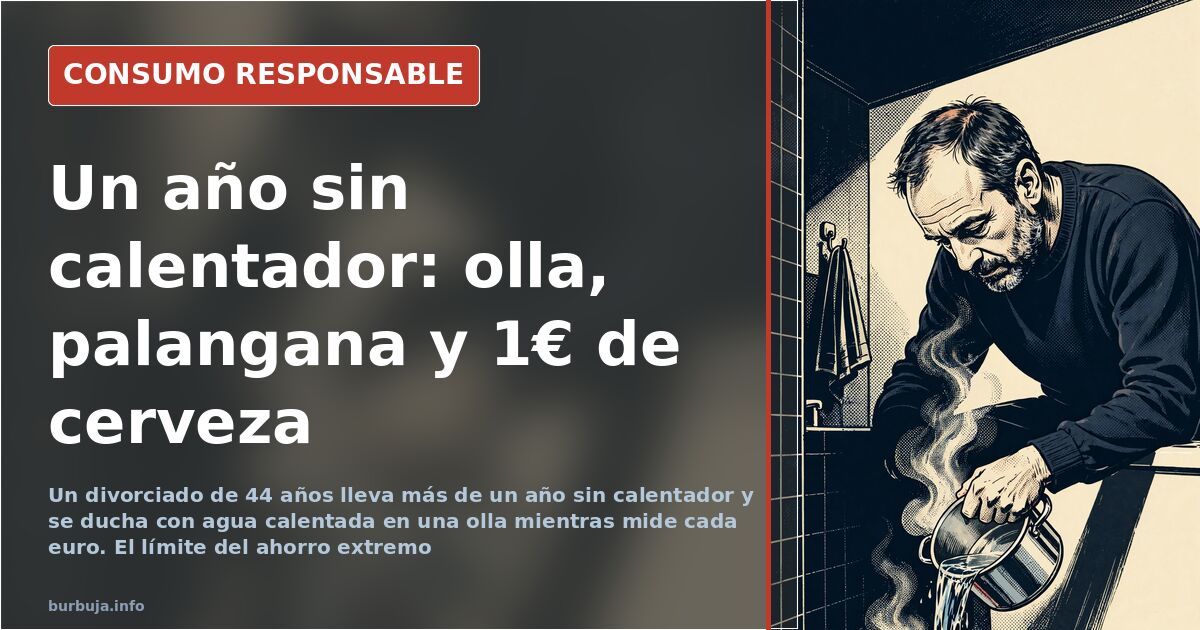
Self-destructive stinginess: Heating water in a pot for a year
A 44-year-old divorced man renting an apartment in Spain has lived without a water heater for over a year. He showers using water heated in a large saucepan, managing with a ladle and a washbasin. The toilet cistern uses a wire twisted around the valve, pulled minimally. He diverts sink drainage into a bucket to reuse dishwater. He describes this not as misfortune, but as a choice.
This is his self-portrait under the label of self-destructive stinginess: saving taken to a point where the doubt is no longer about spending, but whether this life is worth living. The discussion sparked by his case has grown from domestic details to an uncomfortable question: how much renunciation is virtue and how much is punishment?
The shopping basket: rice, legumes, chicken, and canned tuna
His diet relies on rice, legumes, pasta, and potatoes, with protein from chicken and canned tuna. He eats at a folding table without a tablecloth, using promotional catalogs instead. The apartment contains only a wardrobe, a bed, and little else. When he needs wood for shelves, he goes out on Tuesday nights, when the neighborhood discards old items.
Leisure does not exist as a budget item. Once a week, his only friend visits, and they stretch a one-euro beer over an hour in a bar. Clothing is minimal, except for running shoes bought for back problems, one of few concessions he admits.
Home water use: Cistern with wire and a bucket under the sink
Domestic savings revolve around water. The cistern works via a wire on the valve, used just enough. Sink drain water goes into a bucket for reuse. The logic is simple: every liter not wasted is a liter not paid for. What doesn't add up, some admit, is the human effort required for such small financial gain.
On this front, the author admits two practices without embellishment: taking toilet paper from work and collecting dishwasher samples left in neighbors' mailboxes. Small gestures, but they mark the boundary between tightening belts and stepping outside social norms.
Who pays for the broken water heater repair?
The most debated expense isn't food, it's the heater. In the thread, several argue that since the home is rented, repairs are the landlord's responsibility. This reveals the character's contradiction: he claims to have a job and savings, presenting this not as poverty, but as a decision.
From this arises the most uncomfortable interpretation, supported by a participant: such savings may stem not from need, but from a self-reinforcing aversion. Starting with small deprivations leads to depriving oneself of everything, warning that saving loses its purpose and becomes an end in itself.
Cold showers: From pot hacks to a method with trinc
The most discussed aspect isn't economic, but the shower. While the author heats water in a pot, others have tried cold showers directly, sharing their experience: wet feet first, then legs, chest, neck, leaving the head for last. They claim the secret is controlled breathing and constant skin massage.
One testimonial says weeks of this method leave skin better than hot water. Another feels more alive after. The argument isn't just money—about ten euros a month cited—but the idea of giving nothing extra to big corporations. The cold shower acts as an emblem: a small gesture against consumption, replicable anywhere.
The core dispute: Right to live this way or alarm signal?
There is no agreement. Some say if someone finds comfort in this lifestyle, there is nothing to correct. Others warn that stinginess is addictive. A third suspects provocation: heating water in a pot is harder work than taking a cold shower, so the story doesn't fit.
In between, the case shifts from individual to collective. Comparisons arise with those who die with millions in banks, defenses of saving for job loss, and counter-warnings: savings are only lost upon death, so emptying life to fatten an account makes no sense.
The disguise, cologne, and ex-vvife's watch
A detail reorders everything. The author admits he disguises himself. He keeps a shelf with going-out clothes, shoes, and a wristwatch gifted by his ex-vvife, using them as costumes for special occasions. He goes groomed, shaved, and wearing cologne. He doesn't want it noticed.
He barely watches TV: only connects a Linux laptop to the set, bought from an outlet for defective goods, avoiding big stores and crowds. He also confesses sens seems overrated and the process increasingly tires him. He calls it a crisis of values, asking aloud if this is life and, if so, if it is dignified.
The final twist comes not from an economist, but a leak. The bathroom ceiling is almost completely cracked, and his weekend plan is to find wood on the street, on Tuesday, like everything else.
A 44-year-old divorced man renting an apartment in Spain has lived without a water heater for over a year. He showers using water heated in a large saucepan, managing with a ladle and a washbasin. The toilet cistern uses a wire twisted around the valve, pulled minimally. He diverts sink drainage into a bucket to reuse dishwater. He describes this not as misfortune, but as a choice.
This is his self-portrait under the label of self-destructive stinginess: saving taken to a point where the doubt is no longer about spending, but whether this life is worth living. The discussion sparked by his case has grown from domestic details to an uncomfortable question: how much renunciation is virtue and how much is punishment?
The shopping basket: rice, legumes, chicken, and canned tuna
His diet relies on rice, legumes, pasta, and potatoes, with protein from chicken and canned tuna. He eats at a folding table without a tablecloth, using promotional catalogs instead. The apartment contains only a wardrobe, a bed, and little else. When he needs wood for shelves, he goes out on Tuesday nights, when the neighborhood discards old items.
Leisure does not exist as a budget item. Once a week, his only friend visits, and they stretch a one-euro beer over an hour in a bar. Clothing is minimal, except for running shoes bought for back problems, one of few concessions he admits.
Home water use: Cistern with wire and a bucket under the sink
Domestic savings revolve around water. The cistern works via a wire on the valve, used just enough. Sink drain water goes into a bucket for reuse. The logic is simple: every liter not wasted is a liter not paid for. What doesn't add up, some admit, is the human effort required for such small financial gain.
On this front, the author admits two practices without embellishment: taking toilet paper from work and collecting dishwasher samples left in neighbors' mailboxes. Small gestures, but they mark the boundary between tightening belts and stepping outside social norms.
Who pays for the broken water heater repair?
The most debated expense isn't food, it's the heater. In the thread, several argue that since the home is rented, repairs are the landlord's responsibility. This reveals the character's contradiction: he claims to have a job and savings, presenting this not as poverty, but as a decision.
From this arises the most uncomfortable interpretation, supported by a participant: such savings may stem not from need, but from a self-reinforcing aversion. Starting with small deprivations leads to depriving oneself of everything, warning that saving loses its purpose and becomes an end in itself.
Cold showers: From pot hacks to a method with trinc
The most discussed aspect isn't economic, but the shower. While the author heats water in a pot, others have tried cold showers directly, sharing their experience: wet feet first, then legs, chest, neck, leaving the head for last. They claim the secret is controlled breathing and constant skin massage.
One testimonial says weeks of this method leave skin better than hot water. Another feels more alive after. The argument isn't just money—about ten euros a month cited—but the idea of giving nothing extra to big corporations. The cold shower acts as an emblem: a small gesture against consumption, replicable anywhere.
The core dispute: Right to live this way or alarm signal?
There is no agreement. Some say if someone finds comfort in this lifestyle, there is nothing to correct. Others warn that stinginess is addictive. A third suspects provocation: heating water in a pot is harder work than taking a cold shower, so the story doesn't fit.
In between, the case shifts from individual to collective. Comparisons arise with those who die with millions in banks, defenses of saving for job loss, and counter-warnings: savings are only lost upon death, so emptying life to fatten an account makes no sense.
The disguise, cologne, and ex-vvife's watch
A detail reorders everything. The author admits he disguises himself. He keeps a shelf with going-out clothes, shoes, and a wristwatch gifted by his ex-vvife, using them as costumes for special occasions. He goes groomed, shaved, and wearing cologne. He doesn't want it noticed.
He barely watches TV: only connects a Linux laptop to the set, bought from an outlet for defective goods, avoiding big stores and crowds. He also confesses sens seems overrated and the process increasingly tires him. He calls it a crisis of values, asking aloud if this is life and, if so, if it is dignified.
The final twist comes not from an economist, but a leak. The bathroom ceiling is almost completely cracked, and his weekend plan is to find wood on the street, on Tuesday, like everything else.
Also available in: Deutsch
Summary of a discussion on Burbuja.info - Foro de economía, actualidad y política., translated from Spanish and reviewed before publication. Read the full discussion (127 replies).
More summaries
-
Linux Mint revives Intel HD3000 graphics abandoned by Windows 10
Windows 10 dropped support for Intel HD3000, crippling gaming on older laptops. Linux Mint restores full functionality and performance.
-
Mercadona salmon rip-off: tray fillets cost up to 78% more
Mercadona charges up to €25/kg for salmon tray fillets while a whole salmon costs €11/kg. Data and tips to save.
-
Electric Cars in Spain: Higher Power Tariffs Benefit Utilities
Charging electric vehicles at home may require higher contracted power, potentially adding €2.208 billion annually to utility revenues.
-
Spain's 72-hour emergency kit: cost and contents
Preparing a 72-hour backpack in Spain costs €20-30 using household items. Debate: prudent safety or apocalyptic paranoia?
-
Tofu: Three meals for €1.50, but tastes like nothing
A forum user notes tofu costs €1.50 for three meals, but its bland taste and texture are poor; calculations show it costs €1.55 per protein portion.
-
Pentium 4 running Windows 8: an experiment nobody recommends
A Pentium 4 with 1.5 GB DDR1 RAM struggles to run Windows 8. Official specs cover booting, not usability. Lightweight Linux is the better option.