
Spain's euro air machines: paying for compressed air someone else uses
One euro to inflate your tyres and five minutes the next car enjoys. An 8.5 euro 12V compressor is emerging as an alternative to paying for air at Spanish petrol stations.
English · Original discussion in Spanish · Published
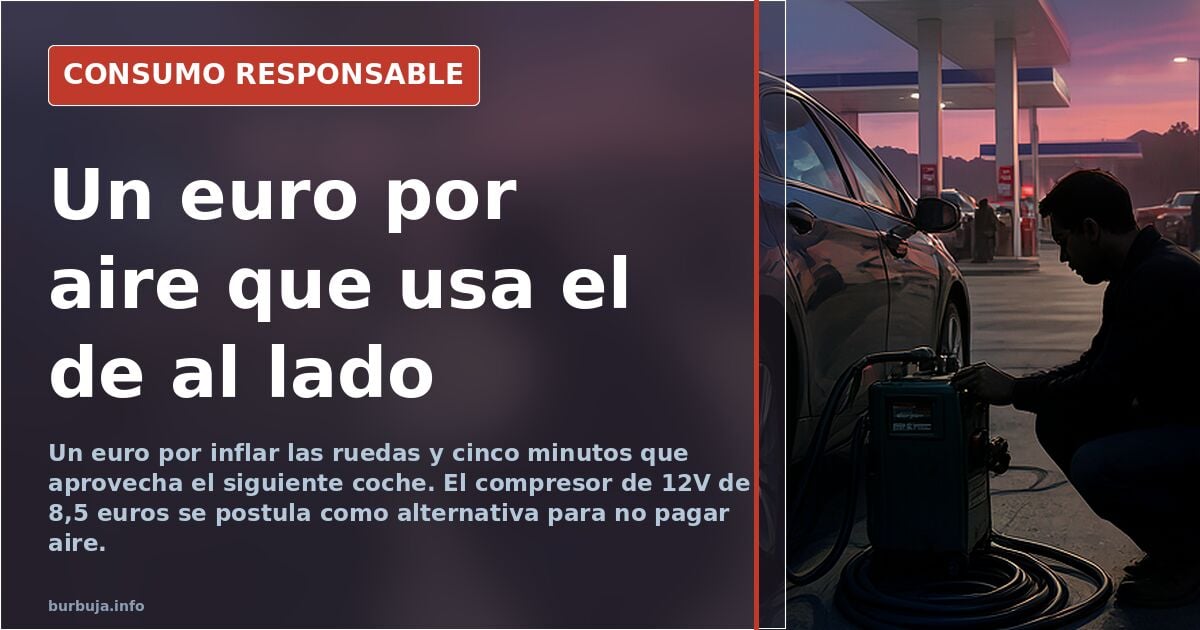
Paying a euro for air and watching the next driver benefit
One euro. That is what it now costs to inflate your tyres at many Spanish petrol stations that have replaced the old free compressor with a coin-operated machine. The calculation made by one regular driver is simple: if the machine gives you five minutes and you only need two, the remaining three go to the next car that pulls up. You pay, the driver next to you breathes. And visit by visit, the joke ends up costing more than a coffee.
The problem is not just the euro. It is the trek to the petrol station, the wait behind whichever car is there first, and the pressure gauge you can never be sure is telling the truth. Hence the temptation to buy a 12-volt compressor that plugs into the cigarette lighter and lets you adjust the pressure outside your front door. They range from 8.5 euros on Asian marketplaces to branded models for just over ten pounds on the British market.
Is a cigarette lighter compressor worth it, or a waste of money?
The answer depends on what you expect. For topping up pressure by two or three tenths of a bar once a month, a cheap compressor does the job. That is what it is for. That said, some warn that the cheapest models have ridiculous power and take an eternity to move enough air. The experience of several drivers suggests that low-end units do not last long and deliver less pressure than promised.
The most common consensus is different: a decent pressure gauge is worth more than the compressor. With a reliable gauge you can check the pressure cold at home and then, when refuelling, add only the tenths that are missing. The key is not to trust the absolute reading on the petrol station machine, but to use it as a relative reference. And always with cold tyres, since the heat of the road distorts the reading.
The free alternative that still survives
Not every station charges. Some chains still offer free air, and anyone who lives near one has it easy. The problem is that the trend runs the other way: more and more petrol stations are installing the euro machine, and drivers who refuse to pay end up driving around in circles. Some have taken to slightly overinflating at the free station and then adjusting at home with their own gauge.
There is also the low-cost route: a large manual bicycle pump. Ten pumps recover a couple of tenths of a bar, and the outlay is minimal. It will not inflate a tyre from scratch, but for routine maintenance it does the job. The downside, of course, is the effort.
Nitrogen and other promises
Then nitrogen enters the conversation, that gas sold as the definitive solution so you never have to check your pressures again. The reality is less epic: the air we breathe already contains 78% nitrogen. The advantage of inflating with pure nitrogen is that pressure varies less with temperature, but it does not exempt you from checking. And at three euros per wheel, the savings are nowhere to be seen.
So is the 8.5 euro compressor worth it? If the goal is the convenience of not leaving home and you check your pressures often, yes. If you expect power and durability, no. As with almost everything in life, a cheap price is paid for somewhere. The question left hanging is how long it will be before petrol stations start charging for water too.
Also available in: Deutsch
Summary of a discussion on Burbuja.info - Foro de economía, actualidad y política., translated from Spanish and reviewed before publication. Read the full discussion (40 replies).
More summaries
-
15-Euro Tire Inflator Beats Paid Gas Station Air
A €15 compressor pays for itself in 14 gas station visits. The real risk isn't power, but cheap gauges damaging tires.
-
Help choosing a portable tyre compressor for your car
Can a €23 battery-powered portable compressor inflate a car tyre from flat? 38 replies in a consumer forum weigh up battery life, airflow and alternatives.
-
Hussars: quality menswear or just posturing?
Hussars review: natural fabrics, local manufacturing, and straight fit versus criticism for its controversial cut and self-promotion. Is it worth the price?
-
Cheap TVs: "you are the product", forum user warns
A forum user claims that a very cheap TV pays for itself through user accounts and advertising. The warning keeps coming up: "you are the product".
-
Solar panels: 17 years to recoup a €5,000 investment
A 1 kW panel produces 1,350 kWh a year and saves €243: with a €5,000 investment, payback takes over 17 years before maintenance costs.
-
Photocopying your Spanish ID card: when it's required and when it's not
Banks, hotels and gyms in Spain often ask for a copy of your DNI. The rules make it mandatory in some cases, but in others it's just habit: seeing the document is not the same as photocopying it.