
Spain's €4 Canned Meal Plan Raises Money Laundering Concerns
A proposed Spanish dining model serving canned food for €4 with strict time limits faces scrutiny over potential money laundering and viability.
English · Original discussion in Spanish · Published
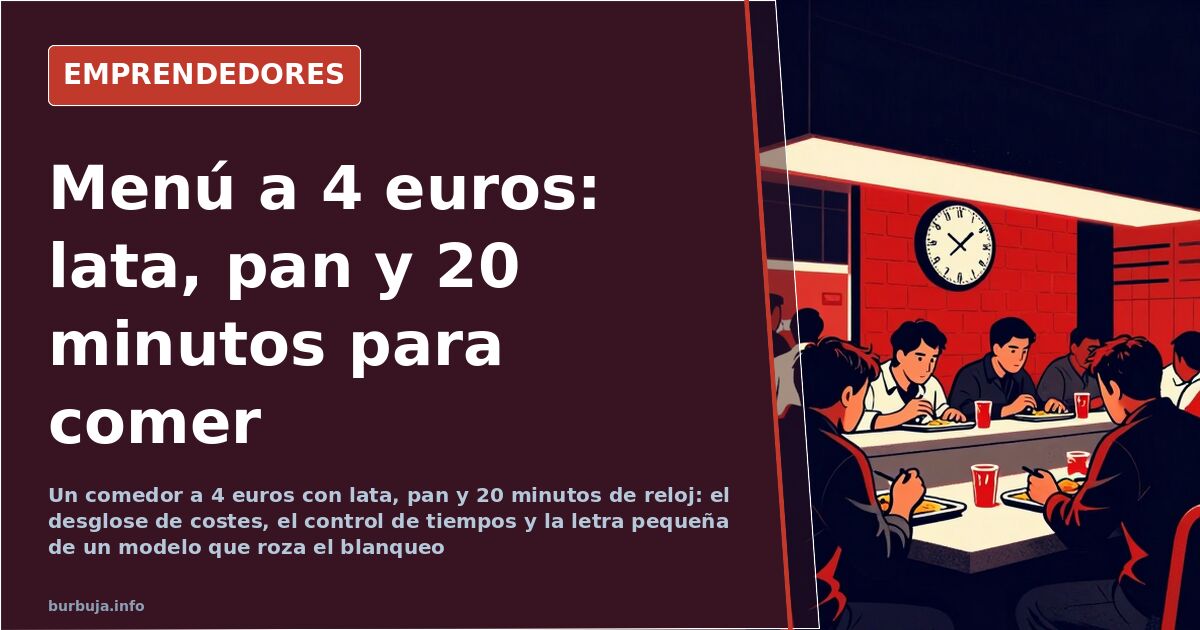
€4 Menu: Canned Food, Bread, and a 20-Minute Timer
A dining concept where customers pay on entry, eat heated canned goods off disposable plates, and must leave within twenty minutes. Detailed in an entrepreneur forum, the plan includes cost breakdowns, staffing policies, and expansion strategies. It rests on a bold premise: there is demand willing to pay €4 for a hot seat-up meal, provided no cutlery or tablecloths are required.
The model relies on extreme austerity. A €0.35 loaf yields eight portions; each wholesale can splits into two plates. Customers pay, eat, and exit. No kitchen, no washing up, no waiters. The only significant investment is a space with outlets and an industrial microwave.
Cost Calculation: €0.35 Per Bread Portion
The initial proposal’s cost breakdown is meticulous. A €0.35 bread loaf divides into eight pieces; a fabada or stew can, priced at €4 per menu, yields two plates. Water comes from the tap. Plates are plastic. Cutlery is disposable. There is no kitchen. Variable costs are limited to cans and bread.
Compared to traditional hospitality, the difference is stark. A standard daily menu requires chefs, helpers, sinks, fridges, exhaust licenses, and monthly payroll. Here, expenses concentrate on rent and microwaves. Some note that urban exhaust regulations make non-industrial kitchens unviable, further lowering costs: Chef Mike, they joke, is the only cook needed.
Weaknesses emerge upon closer inspection. Commercial spaces, even in outskirts, carry fixed costs not covered by cent-margin profits. Spanish law mandates accessible toilets, ramps, and extinguishers, regardless of price. As noted in the plan, bureaucracy does not forgive this clientele.
The Problem of Lingering Guests: Time Control
The model fails if diners stay. The original proposal sets twenty minutes per customer, timed from payment. Afterward, they must leave. Rotation drives revenue: every extra minute is lost income.
Discussed solutions range from human control to deterrence. One suggestion involves hiring a strong regular as a bouncer, paid in cans, to eject loiterers. Others propose timer-equipped chairs or removing furniture entirely to force standing or floor seating.
Consensus suggests the biggest enemy isn’t competition, but the customer. The line between social dining and business is surveillance. Without it, the venue becomes a shelter, eroding margins.
What Does the Customer Actually Eat for €4?
Product quality remains a concern. White-label canned goods allow absurdly low portion costs. Supermarket-brand fabada cans are cited at €1.66 per 865g unit, yielding up to five portions. Adding salt and paprika masks the taste of poverty, proponents argue.
Comparisons to fast-food chains are inevitable. For €4, one can eat at a burger chain. There, customers choose, wait, and aren’t timed. Here, the appeal isn’t food: it’s roof, chair, and tap water. You’re selling the experience of eating a hot can while seated, summarizes the pitch.
Some suggest partnerships with supermarkets for near-expiry stock. Ironically, Agenda 2030 goals might turn this diner into a destination for supermarket waste. Customers would eat expired mayo happily.
From Joke to Business Plan: Laundering and Expansion
The conversation shifts to less savory topics. Such thin margins fit only as a vehicle for money laundering, argues a recurring comment. Cash payments, lack of nominal invoicing, and high volume of small transactions create an opaque washing machine. Though framed jokingly, it highlights a real issue: the shadow economy thrives in low-margin, high-volume businesses.
Expansion plans also appear. Instead of fixed locations, a nomadic formula is proposed: occupy empty storefronts, heat a can for aroma, collect cash, and vanish before inspections. Repeat elsewhere. An ambitious version offers loyalty bonuses: pay for three meals, consume two.
For now, the debate ends where it began: viability. Prices cited from 2021 have risen over 40% in four years, participants calculate. With such input inflation, the €4 menu survives only if rent is cheap, staff minimal, and customers don’t linger. Together, these conditions describe a vending machine with chairs more than a restaurant.
A dining concept where customers pay on entry, eat heated canned goods off disposable plates, and must leave within twenty minutes. Detailed in an entrepreneur forum, the plan includes cost breakdowns, staffing policies, and expansion strategies. It rests on a bold premise: there is demand willing to pay €4 for a hot seat-up meal, provided no cutlery or tablecloths are required.
The model relies on extreme austerity. A €0.35 loaf yields eight portions; each wholesale can splits into two plates. Customers pay, eat, and exit. No kitchen, no washing up, no waiters. The only significant investment is a space with outlets and an industrial microwave.
Cost Calculation: €0.35 Per Bread Portion
The initial proposal’s cost breakdown is meticulous. A €0.35 bread loaf divides into eight pieces; a fabada or stew can, priced at €4 per menu, yields two plates. Water comes from the tap. Plates are plastic. Cutlery is disposable. There is no kitchen. Variable costs are limited to cans and bread.
Compared to traditional hospitality, the difference is stark. A standard daily menu requires chefs, helpers, sinks, fridges, exhaust licenses, and monthly payroll. Here, expenses concentrate on rent and microwaves. Some note that urban exhaust regulations make non-industrial kitchens unviable, further lowering costs: Chef Mike, they joke, is the only cook needed.
Weaknesses emerge upon closer inspection. Commercial spaces, even in outskirts, carry fixed costs not covered by cent-margin profits. Spanish law mandates accessible toilets, ramps, and extinguishers, regardless of price. As noted in the plan, bureaucracy does not forgive this clientele.
The Problem of Lingering Guests: Time Control
The model fails if diners stay. The original proposal sets twenty minutes per customer, timed from payment. Afterward, they must leave. Rotation drives revenue: every extra minute is lost income.
Discussed solutions range from human control to deterrence. One suggestion involves hiring a strong regular as a bouncer, paid in cans, to eject loiterers. Others propose timer-equipped chairs or removing furniture entirely to force standing or floor seating.
Consensus suggests the biggest enemy isn’t competition, but the customer. The line between social dining and business is surveillance. Without it, the venue becomes a shelter, eroding margins.
What Does the Customer Actually Eat for €4?
Product quality remains a concern. White-label canned goods allow absurdly low portion costs. Supermarket-brand fabada cans are cited at €1.66 per 865g unit, yielding up to five portions. Adding salt and paprika masks the taste of poverty, proponents argue.
Comparisons to fast-food chains are inevitable. For €4, one can eat at a burger chain. There, customers choose, wait, and aren’t timed. Here, the appeal isn’t food: it’s roof, chair, and tap water. You’re selling the experience of eating a hot can while seated, summarizes the pitch.
Some suggest partnerships with supermarkets for near-expiry stock. Ironically, Agenda 2030 goals might turn this diner into a destination for supermarket waste. Customers would eat expired mayo happily.
From Joke to Business Plan: Laundering and Expansion
The conversation shifts to less savory topics. Such thin margins fit only as a vehicle for money laundering, argues a recurring comment. Cash payments, lack of nominal invoicing, and high volume of small transactions create an opaque washing machine. Though framed jokingly, it highlights a real issue: the shadow economy thrives in low-margin, high-volume businesses.
Expansion plans also appear. Instead of fixed locations, a nomadic formula is proposed: occupy empty storefronts, heat a can for aroma, collect cash, and vanish before inspections. Repeat elsewhere. An ambitious version offers loyalty bonuses: pay for three meals, consume two.
For now, the debate ends where it began: viability. Prices cited from 2021 have risen over 40% in four years, participants calculate. With such input inflation, the €4 menu survives only if rent is cheap, staff minimal, and customers don’t linger. Together, these conditions describe a vending machine with chairs more than a restaurant.
Summary of a discussion on Burbuja.info - Foro de economía, actualidad y política., translated from Spanish and reviewed before publication. Read the full discussion (194 replies).
More summaries
-
Málaga, Granada, or Logroño: the battle for Spain's best place to live
Choosing the best place to live in Spain is a toss-up between housing prices, high-speed rail, and climate, with no single city winning consensus.
-
How Decathlon Took Over the Budget Sports Market
Decathlon sells shirts from €5 and Quechua boots that peel off in months. What the customer gains in price, neighborhood sports shops lose.
-
Mechatronics vocational training: high demand in northern Spain and €26,000 job offer
A supermarket maintenance job pays €26,000, but workers warn of bosses who ignore rules, travel and broken schedules.
-
PrestaShop Store Costs Range From €90 to €5,000 in Spain
Quotes for identical PrestaShop stores in Spain range from €90 to €15,000. The real cost lies not in design, but in invisible technical work.
-
DevOps demands Linux: Why switch from Windows?
Users increasingly migrate to Linux for DevOps terminal mastery. Hardware barriers are gone, but specialized software and inertia remain obstacles.
-
From €300 and a van to seven employees: Spanish self-employment launch
A construction contractor details the costs of starting a business in Spain, including fees, accounting services, and margin risks.