
Spain's Equality Ministry fails to define what a woman is
The Spanish Equality Ministry gave a circular answer to 'what is a woman', while the Trans Law sets a four-month administrative process.
English · Original discussion in Spanish · Published
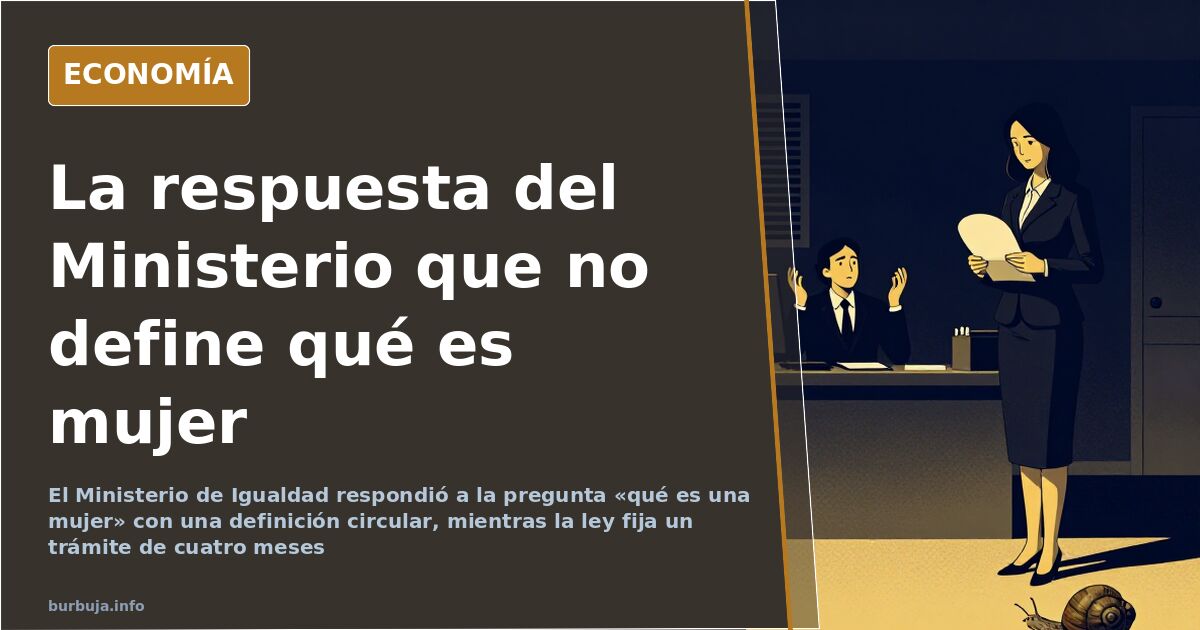
A woman is who feels like one: an empty definition
A call to the Spanish Equality Ministry’s helpline. On the other end, an institutional voice. The question was the simplest dictionary could handle—what is a woman—and the three-part response left the media outlet speechless. The leaked definition suffers from classic bad manual writing: it explains the term using the term itself. According to that answer, a woman is simply a person who feels like a woman.
The episode was spread by E-Noticies in three chained messages. It would have remained a trivial anecdote if the issue weren’t already legislated and turned into electoral ammunition. What stands out isn’t that the administration answered with a tautology. What stands out is that any other answer forces it to choose between the dictionary and its own law.
What is a woman according to the dictionary?
The Royal Spanish Academy Dictionary maintains four definitions. The first and most cited: “person of the female sens.” The second adds adulthood. The third enters slippery ground: a woman who possesses qualities considered quintessentially feminine, with the example “Now that’s a woman!” The fourth is domestic: vvife or habitual female partner.
None of the four mentions feeling anything. That’s the sustancia ilegal. Those defending the biological definition rely on the first meaning and consider the matter closed; those defending felt identity argue the dictionary isn’t a court. In between, the administration chose a third way that isn’t a path: repeating the question disguised as an answer. Circular argument is the expression used to describe it.
What is a woman under Spanish law?
As read in the thread, for Spanish law a woman is a legal registry status. Law 4/2023, of February 28, allows modifying the registered gender upon request by the interested party, setting a maximum resolution period of four months. No ovaries, no chromosomes, no uterus: just paperwork.
From this comes the most uncomfortable argument, formulated in a thousand ways: if being a woman depends on an administrative inscription, then it is not a natural reality but a legal category that can be requested and obtained. Those who pose it this way usually don’t dispute anyone’s rights; they dispute building an official definition on a bureaucratic procedure.
XX and XY Chromosomes: why this argument keeps coming up
The most widespread answer to the Ministry’s question fits in two lines: XX is woman, XY is man. It’s the popular version of biology, short, verifiable, and hard to debate in everyday conversation, which is why it works as a headline.
Biology itself provides the nuance. Chromosomal combinations exist—XXY, XYY, XXX—and intersensinter conditions that escape the binary pair. Part of the analysis estimates these anomalies at one in 2,000 or 5,000 individuals and notes they often involve sterility, since producing viable gametes is rare with an odd number of chromosomes. From this, the conclusion is drawn that exceptions exist but are statistically irrelevant for organizing locker rooms, sports, or censuses. And there the conversation stalls.
Why doesn’t the European Commission define the term either?
Because it’s cheaper not to. According to information gathered among responses and attributed to a digital publication, the EU Commissioner for Equality refused to define “woman” after a formal request, nor did she comment on men participating in women’s competitions.
Precision is needed: there is no transcribed official refusal in the material, no date, no document. What exists is the observation that when the question is asked in writing, the institutional answer deflects toward empowerment, erasure, or statistics. Anything but a definition.
The cost of an unresolved question
Some opinions focus on the economic aspect, albeit briefly: new sub-directorates created to answer the question. Another current goes deeper, arguing the problem isn’t money but the lack of independent criteria in a population waiting to be told what to think. It’s a harsh thesis and, like all harsh theses, impossible to prove with a survey.
What is verifiable is the practical effect: in the thread, asking for the definition of woman already functions as a loyalty test. Those who answer with the dictionary are flagged; those who answer with the law are too; those who answer like the Ministry simply don’t answer.
The registry grants four months to change legal status. The dictionary doesn’t grant a single day to change definition. Between these two speeds, whoever picks up the phone gets an impossible answer: the one given defines nothing, and the one that would define cannot be said.
A call to the Spanish Equality Ministry’s helpline. On the other end, an institutional voice. The question was the simplest dictionary could handle—what is a woman—and the three-part response left the media outlet speechless. The leaked definition suffers from classic bad manual writing: it explains the term using the term itself. According to that answer, a woman is simply a person who feels like a woman.
The episode was spread by E-Noticies in three chained messages. It would have remained a trivial anecdote if the issue weren’t already legislated and turned into electoral ammunition. What stands out isn’t that the administration answered with a tautology. What stands out is that any other answer forces it to choose between the dictionary and its own law.
What is a woman according to the dictionary?
The Royal Spanish Academy Dictionary maintains four definitions. The first and most cited: “person of the female sens.” The second adds adulthood. The third enters slippery ground: a woman who possesses qualities considered quintessentially feminine, with the example “Now that’s a woman!” The fourth is domestic: vvife or habitual female partner.
None of the four mentions feeling anything. That’s the sustancia ilegal. Those defending the biological definition rely on the first meaning and consider the matter closed; those defending felt identity argue the dictionary isn’t a court. In between, the administration chose a third way that isn’t a path: repeating the question disguised as an answer. Circular argument is the expression used to describe it.
What is a woman under Spanish law?
As read in the thread, for Spanish law a woman is a legal registry status. Law 4/2023, of February 28, allows modifying the registered gender upon request by the interested party, setting a maximum resolution period of four months. No ovaries, no chromosomes, no uterus: just paperwork.
From this comes the most uncomfortable argument, formulated in a thousand ways: if being a woman depends on an administrative inscription, then it is not a natural reality but a legal category that can be requested and obtained. Those who pose it this way usually don’t dispute anyone’s rights; they dispute building an official definition on a bureaucratic procedure.
XX and XY Chromosomes: why this argument keeps coming up
The most widespread answer to the Ministry’s question fits in two lines: XX is woman, XY is man. It’s the popular version of biology, short, verifiable, and hard to debate in everyday conversation, which is why it works as a headline.
Biology itself provides the nuance. Chromosomal combinations exist—XXY, XYY, XXX—and intersensinter conditions that escape the binary pair. Part of the analysis estimates these anomalies at one in 2,000 or 5,000 individuals and notes they often involve sterility, since producing viable gametes is rare with an odd number of chromosomes. From this, the conclusion is drawn that exceptions exist but are statistically irrelevant for organizing locker rooms, sports, or censuses. And there the conversation stalls.
Why doesn’t the European Commission define the term either?
Because it’s cheaper not to. According to information gathered among responses and attributed to a digital publication, the EU Commissioner for Equality refused to define “woman” after a formal request, nor did she comment on men participating in women’s competitions.
Precision is needed: there is no transcribed official refusal in the material, no date, no document. What exists is the observation that when the question is asked in writing, the institutional answer deflects toward empowerment, erasure, or statistics. Anything but a definition.
The cost of an unresolved question
Some opinions focus on the economic aspect, albeit briefly: new sub-directorates created to answer the question. Another current goes deeper, arguing the problem isn’t money but the lack of independent criteria in a population waiting to be told what to think. It’s a harsh thesis and, like all harsh theses, impossible to prove with a survey.
What is verifiable is the practical effect: in the thread, asking for the definition of woman already functions as a loyalty test. Those who answer with the dictionary are flagged; those who answer with the law are too; those who answer like the Ministry simply don’t answer.
The registry grants four months to change legal status. The dictionary doesn’t grant a single day to change definition. Between these two speeds, whoever picks up the phone gets an impossible answer: the one given defines nothing, and the one that would define cannot be said.
Also available in: Deutsch
Summary of a discussion on Burbuja.info - Foro de economía, actualidad y política., translated from Spanish and reviewed before publication. Read the full discussion (128 replies).
More summaries
-
Spain: Communist Hell? 18-Year-Old Receives 'Spousal Assignment' Letter from Ministry of Equality
An 18-year-old Spanish woman reportedly received a 'spousal assignment' letter from the Ministry of Equality. We investigate the claims and economic context.
-
"Historic Lows": European Commission Urges EU to Cut Gas and Electricity Consumption...
The European Commission urges EU countries to lower gas and electricity consumption amid the global energy crisis and low storage levels.
-
Putin's plane forced to circle Moscow amid drone attack
Reports indicate Putin's aircraft could not land in Moscow during a Ukrainian drone strike, with three official Russian planes circling the airport.
-
Spanish Tax Office Adds Pre-Death Withdrawals to Inheritance
Withdrawing funds before death does not lower Spain's inheritance tax; the tax authority adds them back if present in accounts the prior year.
-
Internet forums dying: bots now drive 51% of traffic
Users claim bots generate half of web traffic, leaving independent forums in decline due to lack of new members and poor search visibility.
-
South Korea faces demographic collapse with birth rate at 0.72
South Korea's fertility rate has dropped to 0.72, prompting projections of a population decline to 38 million by 2070.