
Spain’s draft scenario: flee, resist, or fight?
Mandatory mobilization sparks debate: 120,000 troops and 45 Taurus missiles. Responses range from fleeing to Portugal to refusing service.
English · Original discussion in Spanish · Published
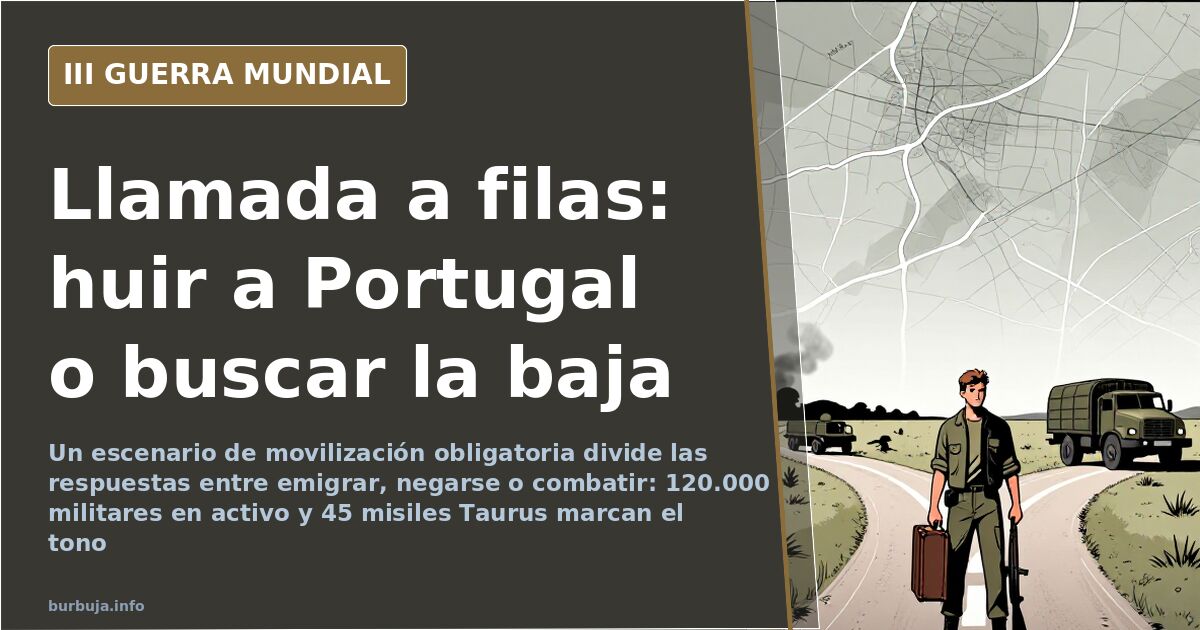
Draft: desert, flee to Portugal, or seek medical discharge
The question requires no decree or date; just imagine it. Tomorrow arrives the notice for mandatory mobilization, and what do you do? With the scenario set, responses split into three exits—leaving, refusing, or complying—and a fourth not found in any manual: switching sides. The starting inventory is anything but heroic. Spain’s Armed Forces have 120,000 personnel, with only 70,000 being combat troops, and the Army has two full operational divisions. With this base, a hypothetical draft stops being idle talk and becomes pure arithmetic.
How many soldiers and with what arsenal?
The available equipment offers little optimism. Spain has 45 Taurus missiles, a figure that, by current calculations, wouldn’t even last a morning of open conflict. The cost comparison is even more uncomfortable: launching a long-range missile costs 5 million euros, while the equivalent Russian cruise missile is under 400,000. On the other side, Russian munitions production is ten times higher than Europe’s, the German air force and navy are less than 30% operational, and the country facing them holds 6,500 nuclear warheads.
Some argue this industrial imbalance makes sending Spaniards to the front unviable. Others counter with the other half of the data: an army with thousands of nuclear warheads has been stalled for months in a flat-terrain war against a country not among military powers. The two readings coexist without reconciling.
Portugal, the mountains, and unlisted flights
The majority reaction isn’t military; it’s logistical. Leave before the notice arrives. You can go through Portugal and take a flight from there, suggests one of the most repeated formulas, with the advantage of traveling by road and without visible customs. Others prefer not to cross any border: disappear into any of the country’s forests, in rural Spain, in a country house with water and a garden. Destinations with prior connections—Ecuador, Paraguay—also appear, with the argument that emigrating to a country less dependent on energy and scarce raw materials represents no strategic loss for anyone.
The underlying idea is the same in all cases: the obligation dissolves when the body claiming it disappears. One phrase summarizes the calculation better than any other: you can leave prison; you can’t leave a foreign trench.
Who would have the door open to exemption?
Here the reasoning becomes more cynical and, in many people’s view, more realistic. Medical discharge appears as the most obvious and least heroic response: those who fail the medical exam are out, and it is speculated that the number of people with accredited health issues could be around a million. This is joined by declared essential civil servants, employees of strategic companies, and those who simply have resources to pay a bribe or a lawyer.
Part of the conversation argues this is the real filter: not physical fitness, but position in the structure. Lower-income sectors with fewer contacts would fill the trucks; elites, at best, would travel abroad in luxury cars. There is also speculation about reduced quotas for communities with political weight and discretionary use of personal data when compiling lists.
The people as fortress
The most unsettling scenario isn’t individual but collective. If authorities attempted door-to-door recruitment in a small town, the result, according to several circulating hypotheses, would be absolute emptiness: no one has seen anything, there are no witnesses, no lists. The historical reference that emerges is Casas Viejas, and the accompanying demographic calculation is this: if something like this occurred in 50 or 60 towns on the first day, there wouldn’t be enough personnel to repeat it.
The numbers, this time, are on the side of the argument. An armed force of 120,000 people, with 70,000 troops and much of it in technical roles, lacks the capacity to occupy half a country and sustain a front simultaneously. Mass disobedience, administrative blackout, and simple organized passivity would be enough for the draft to remain a pile of unanswered letters.
Where would the rifle point?
There remains the least confessional and most frequently hinted exit: accept the uniform—or better, the chopo—and decide later. A weapon in hand is a weapon in hand, and in that scenario the list of targets changes order. Part of the argument places the official enemy in second place and prioritizes the political and military leaders of the mobilization, or directly the option of switching sides with the information and equipment.
You don’t need to share that logic to recognize it describes a legitimacy problem, not a logistical one. Those who don’t feel represented by the cause they are asked to defend don’t fight for it: they comply, desert, or wait for the moment.
There is one caveat that would be the first to appear in the military booklet. The average recruit described in this scenario isn’t a fit young man: he is 45 years old, has plantar fasciitis, myopia, and a probable diagnosis of chronic anxiety. Don’t count on me, says that half of the country. And not by ideological conviction, but simply because he isn’t up to it.
The question requires no decree or date; just imagine it. Tomorrow arrives the notice for mandatory mobilization, and what do you do? With the scenario set, responses split into three exits—leaving, refusing, or complying—and a fourth not found in any manual: switching sides. The starting inventory is anything but heroic. Spain’s Armed Forces have 120,000 personnel, with only 70,000 being combat troops, and the Army has two full operational divisions. With this base, a hypothetical draft stops being idle talk and becomes pure arithmetic.
How many soldiers and with what arsenal?
The available equipment offers little optimism. Spain has 45 Taurus missiles, a figure that, by current calculations, wouldn’t even last a morning of open conflict. The cost comparison is even more uncomfortable: launching a long-range missile costs 5 million euros, while the equivalent Russian cruise missile is under 400,000. On the other side, Russian munitions production is ten times higher than Europe’s, the German air force and navy are less than 30% operational, and the country facing them holds 6,500 nuclear warheads.
Some argue this industrial imbalance makes sending Spaniards to the front unviable. Others counter with the other half of the data: an army with thousands of nuclear warheads has been stalled for months in a flat-terrain war against a country not among military powers. The two readings coexist without reconciling.
Portugal, the mountains, and unlisted flights
The majority reaction isn’t military; it’s logistical. Leave before the notice arrives. You can go through Portugal and take a flight from there, suggests one of the most repeated formulas, with the advantage of traveling by road and without visible customs. Others prefer not to cross any border: disappear into any of the country’s forests, in rural Spain, in a country house with water and a garden. Destinations with prior connections—Ecuador, Paraguay—also appear, with the argument that emigrating to a country less dependent on energy and scarce raw materials represents no strategic loss for anyone.
The underlying idea is the same in all cases: the obligation dissolves when the body claiming it disappears. One phrase summarizes the calculation better than any other: you can leave prison; you can’t leave a foreign trench.
Who would have the door open to exemption?
Here the reasoning becomes more cynical and, in many people’s view, more realistic. Medical discharge appears as the most obvious and least heroic response: those who fail the medical exam are out, and it is speculated that the number of people with accredited health issues could be around a million. This is joined by declared essential civil servants, employees of strategic companies, and those who simply have resources to pay a bribe or a lawyer.
Part of the conversation argues this is the real filter: not physical fitness, but position in the structure. Lower-income sectors with fewer contacts would fill the trucks; elites, at best, would travel abroad in luxury cars. There is also speculation about reduced quotas for communities with political weight and discretionary use of personal data when compiling lists.
The people as fortress
The most unsettling scenario isn’t individual but collective. If authorities attempted door-to-door recruitment in a small town, the result, according to several circulating hypotheses, would be absolute emptiness: no one has seen anything, there are no witnesses, no lists. The historical reference that emerges is Casas Viejas, and the accompanying demographic calculation is this: if something like this occurred in 50 or 60 towns on the first day, there wouldn’t be enough personnel to repeat it.
The numbers, this time, are on the side of the argument. An armed force of 120,000 people, with 70,000 troops and much of it in technical roles, lacks the capacity to occupy half a country and sustain a front simultaneously. Mass disobedience, administrative blackout, and simple organized passivity would be enough for the draft to remain a pile of unanswered letters.
Where would the rifle point?
There remains the least confessional and most frequently hinted exit: accept the uniform—or better, the chopo—and decide later. A weapon in hand is a weapon in hand, and in that scenario the list of targets changes order. Part of the argument places the official enemy in second place and prioritizes the political and military leaders of the mobilization, or directly the option of switching sides with the information and equipment.
You don’t need to share that logic to recognize it describes a legitimacy problem, not a logistical one. Those who don’t feel represented by the cause they are asked to defend don’t fight for it: they comply, desert, or wait for the moment.
There is one caveat that would be the first to appear in the military booklet. The average recruit described in this scenario isn’t a fit young man: he is 45 years old, has plantar fasciitis, myopia, and a probable diagnosis of chronic anxiety. Don’t count on me, says that half of the country. And not by ideological conviction, but simply because he isn’t up to it.
Also available in: Deutsch
Summary of a discussion on Burbuja.info - Foro de economía, actualidad y política., translated from Spanish and reviewed before publication. Read the full discussion (272 replies).
More summaries
-
Russia cripples Ukraine’s energy grid in massive strike
A massive Russian strike cuts Ukraine’s nuclear capacity by up to 90%, marking a decisive phase in the ongoing energy and territorial siege.
-
Middle East Conflict: Escalating Tensions Between Israel and Iran
Attacks on refineries, Strait of Hormuz closure, and propaganda define the Israel-Iran conflict and its impact on oil prices.
-
Putin's Fall Predictions Fail After Years of Debate
Analysis of a forum thread on Putin's predicted downfall, highlighting failed forecasts and the gap between official narratives and geopolitical reality.
-
Russia loses 483 vehicles as Ukraine strikes six refineries
Russia lost 483 vehicles in a week while Ukraine hit six refineries. The war of attrition shifts to fuel supplies and Moscow's skies.
-
Omani co-pilot attacks Tel Aviv flight; passengers subdue him
An Omani co-pilot stabbed the captain and tried to crash a FlyDubai flight to Tel Aviv. Four passengers subdued him, saving 180 lives.
-
Russian Air Force in Ukraine: Incompetence or Doctrine?
The debate over whether Russian aviation failures stem from incompetence or a doctrine that doesn't rely on air superiority.