
Spain's draft decree mandates halal menus at no extra cost
Draft Royal Decree requires halal, vegan, and gluten-free options in public schools and hospitals without user surcharges.
English · Original discussion in Spanish · Published
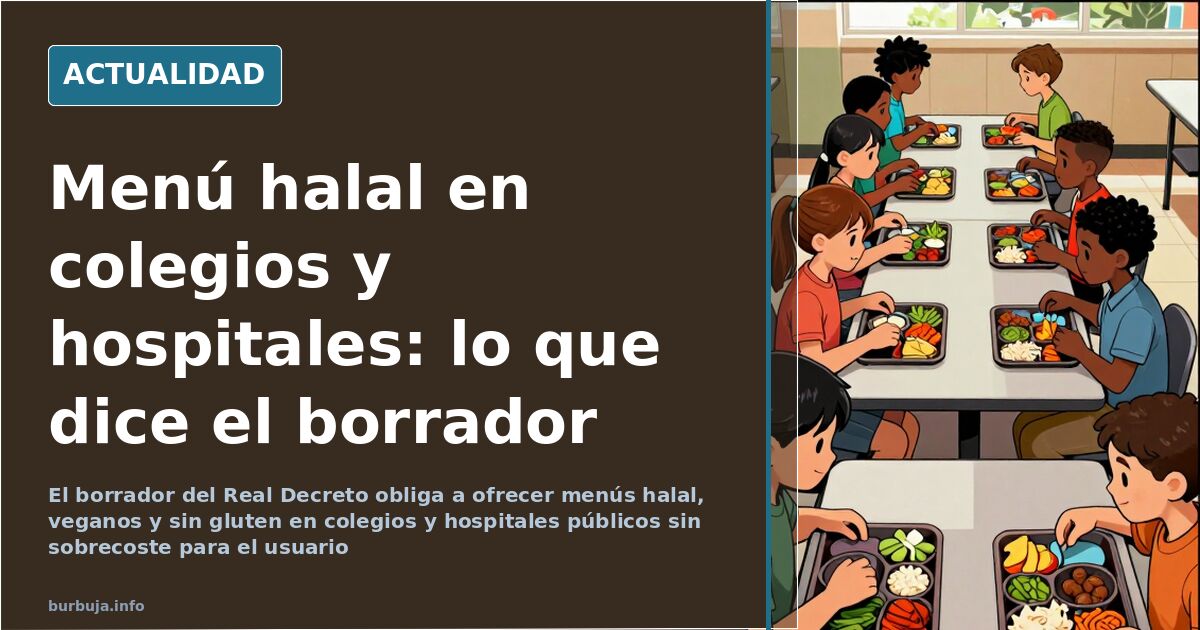
Draft decree includes halal menus in Spanish schools and hospitals
Will the Government impose halal menus in all public schools and hospitals in Spain? The Ministry of Social Rights, Consumption and Agenda 2030 has launched a public consultation on a draft Royal Decree to promote healthy eating in public hospitals and educational centers, as well as private ones serving dependent people or those with special needs. In the draft, the Executive demands that menus "respect ethical, cultural or religious diversity." Translated: 100% plant-based, gluten-free, lactose-free, and halal options, with no extra cost for the user, both in canteens and cafeterias. In schools, the formula is even more explicit: "guaranteeing menus that respect cultural and religious diversity (halal, vegetarian) as a coexistence strategy." The text is in the public consultation phase, not yet approved.
What exactly does the draft Royal Decree say?
The document, consulted by El Debate, does not speak of universal imposition but of an obligation to offer. Hospitals must incorporate "flexibility" in menus and allow vegan, gluten-free, halal, or lactose-free options at no additional cost. In educational centers, the wording goes further: menus must respect cultural and religious diversity as a tool for coexistence. The regulation affects public schools and hospitals, as well as private ones caring for dependent people or those with special needs.
The impact is not cosmetic. The draft itself acknowledges that Technical Specifications in tenders will have to be reformulated and acquisition and preparation protocols updated in centers that cook with their own resources. That means extra costs for public coffers, although the text insists that the end user will not pay them.
Ceuta has been serving halal menus since October 2025
The most cited precedent is not a rumor. In October 2025, the Ministry of Education, Vocational Training and Sports, then led by Pilar Alegría, formalized a contract for the supply of raw menus in six centers in Ceuta. The technical specifications stated that the meat "will be Halal (sic) and pork will not be used." Additionally, olive oil always, no pangasius or perch, and special menus for health, religious, or ethical reasons.
The measure is not new on the regional map. In Catalonia, according to several participants, it has been applied for years. And in a public school in Biscay, the served meat has been reduced to chicken and turkey because beef has become too expensive. The halal menu arrives, in part, where the traditional menu had already shrunk due to cost.
Extra costs and the halal certification business
Here the debate becomes economic. Halal certification is not free: it requires authorized slaughterhouses, certifying personnel, and specific traceability. Some argue that this seal is paid to religious entities and that the money ends up financing proselytism. It is an unverified accusation, but the mechanism—payment per certificate—exists in any food value chain.
The most repeated argument is that of menu contagion. If the canteen serves halal for everyone, pork is eliminated from the general menu and logistics are simplified. This has peine in aviation for decades: the standard menu does not include pork. The question is whether a public school should operate like an airline or like an institution with a single menu and individual exceptions.
The legal objection: governing by decree
The most transversal criticism is not religious, but procedural. The Royal Decree is a regulatory norm that the Government can approve without passing through Congress. Several participants recall that decree-laws are reserved for "cases of extreme gravity": catastrophes, wars, terrorist attacks. A school menu does not fit into that category, they maintain. The PP, according to the thread, already implemented something similar in Ceuta, which defuses frontal opposition. VOX would be the only clear vote against, and some even doubt that.
Who pays and who eats?
The end user does not pay the extra cost, says the draft. The taxpayer pays via tenders and protocols. The open question is whether the halal menu is offered as an option or becomes the default menu purely due to economies of scale. The answer is not in the text. It lies in how the specifications are drafted.
With the draft in public consultation and no approval date, the halal menu advances through the regulatory route. Without votes, without front-page headlines, without parliamentary debate. Just a PDF and a conviction: that no one will protest over a plate of lentils.
Will the Government impose halal menus in all public schools and hospitals in Spain? The Ministry of Social Rights, Consumption and Agenda 2030 has launched a public consultation on a draft Royal Decree to promote healthy eating in public hospitals and educational centers, as well as private ones serving dependent people or those with special needs. In the draft, the Executive demands that menus "respect ethical, cultural or religious diversity." Translated: 100% plant-based, gluten-free, lactose-free, and halal options, with no extra cost for the user, both in canteens and cafeterias. In schools, the formula is even more explicit: "guaranteeing menus that respect cultural and religious diversity (halal, vegetarian) as a coexistence strategy." The text is in the public consultation phase, not yet approved.
What exactly does the draft Royal Decree say?
The document, consulted by El Debate, does not speak of universal imposition but of an obligation to offer. Hospitals must incorporate "flexibility" in menus and allow vegan, gluten-free, halal, or lactose-free options at no additional cost. In educational centers, the wording goes further: menus must respect cultural and religious diversity as a tool for coexistence. The regulation affects public schools and hospitals, as well as private ones caring for dependent people or those with special needs.
The impact is not cosmetic. The draft itself acknowledges that Technical Specifications in tenders will have to be reformulated and acquisition and preparation protocols updated in centers that cook with their own resources. That means extra costs for public coffers, although the text insists that the end user will not pay them.
Ceuta has been serving halal menus since October 2025
The most cited precedent is not a rumor. In October 2025, the Ministry of Education, Vocational Training and Sports, then led by Pilar Alegría, formalized a contract for the supply of raw menus in six centers in Ceuta. The technical specifications stated that the meat "will be Halal (sic) and pork will not be used." Additionally, olive oil always, no pangasius or perch, and special menus for health, religious, or ethical reasons.
The measure is not new on the regional map. In Catalonia, according to several participants, it has been applied for years. And in a public school in Biscay, the served meat has been reduced to chicken and turkey because beef has become too expensive. The halal menu arrives, in part, where the traditional menu had already shrunk due to cost.
Extra costs and the halal certification business
Here the debate becomes economic. Halal certification is not free: it requires authorized slaughterhouses, certifying personnel, and specific traceability. Some argue that this seal is paid to religious entities and that the money ends up financing proselytism. It is an unverified accusation, but the mechanism—payment per certificate—exists in any food value chain.
The most repeated argument is that of menu contagion. If the canteen serves halal for everyone, pork is eliminated from the general menu and logistics are simplified. This has peine in aviation for decades: the standard menu does not include pork. The question is whether a public school should operate like an airline or like an institution with a single menu and individual exceptions.
The legal objection: governing by decree
The most transversal criticism is not religious, but procedural. The Royal Decree is a regulatory norm that the Government can approve without passing through Congress. Several participants recall that decree-laws are reserved for "cases of extreme gravity": catastrophes, wars, terrorist attacks. A school menu does not fit into that category, they maintain. The PP, according to the thread, already implemented something similar in Ceuta, which defuses frontal opposition. VOX would be the only clear vote against, and some even doubt that.
Who pays and who eats?
The end user does not pay the extra cost, says the draft. The taxpayer pays via tenders and protocols. The open question is whether the halal menu is offered as an option or becomes the default menu purely due to economies of scale. The answer is not in the text. It lies in how the specifications are drafted.
With the draft in public consultation and no approval date, the halal menu advances through the regulatory route. Without votes, without front-page headlines, without parliamentary debate. Just a PDF and a conviction: that no one will protest over a plate of lentils.
Also available in: Deutsch
Summary of a discussion on Burbuja.info - Foro de economía, actualidad y política., translated from Spanish and reviewed before publication. Read the full discussion (119 replies).
More summaries
-
The escort's second phone: chemistry or business?
A client pays for a date, gets the worker's personal number, and wonders if it's chemistry or business: the relationship cooled due to distance.
-
Two Years of Depersonalization After Hallucinogenic Mushroom Use
A young man reports two years of depersonalization and panic after taking hallucinogenic mushrooms, reigniting debate on dosage, context, and predisposition.
-
Dogs at Weddings: A New Social Protocol Debate
Guests report dogs attending weddings, sparking debate on animal humanization and etiquette.
-
Spanish men recognize divorce as a predictable life cycle
A café reunion reveals a pattern some Spanish men acknowledge: marrying, having children, and divorcing without making informed choices.
-
Catalan independence video reignites language debate
A promotional spot featuring a child highlights that only one-third of Catalans use Catalan daily, challenging the official narrative.
-
Gloria Álvarez calls Ganges 'crystal clear', sparking backlash
Liberal commentator Gloria Álvarez describes the Ganges as crystal clear, triggering scrutiny of her private life and ideological consistency.