
Spain's Defense Minister reverses stance on conscription
Margarita Robles dismissed mandatory military service last month. A report on European conscription trends has reignited debate over logistics and public opinion.
English · Original discussion in Spanish · Published
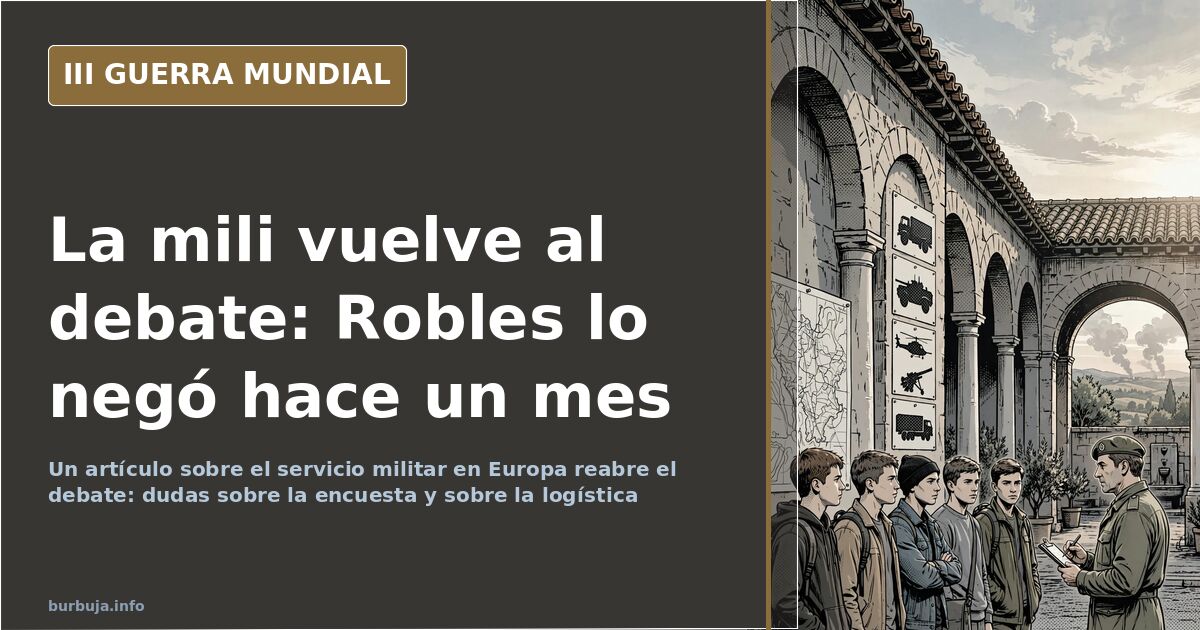
Conscription back in Spain's spotlight after minister's denial
Defense Minister Margarita Robles stated in a Senate committee that mandatory military service would not return: "I don't think it has crossed anyone's mind," she said firmly. Just one month later, an article by 20 minutos about the reintroduction of compulsory service in several European countries peine the issue. The reaction was far from lukewarm. The most repeated argument is propaganda-driven: "Many European countries already have it, and others are bringing it back," summarizes one widely cited message with sarcasm.
The discussion, accumulating 156 responses, begins with doubts about a survey's results. Are they real or cooked up by growing pro-conscription propaganda? This suspicion runs through the entire exchange and sets the tone: the debate isn't just about whether conscription returns, but who is moving the pieces to make it happen.
What the minister says vs. what the data shows
The starting point is contradiction. Robles denied the return in the Senate a month ago, and now the topic reappears in the press. For some participants, this denial is precisely the signal that work is underway: "If Charo Castuza denied it, they must be considering it," argues one highly rated message. The logic is that of a trial balloon: leak it, measure the reaction, and decide.
The other current sees no conspiracy, but pure inertia. "A Real Decreto (Royal Decree) would suffice for conscription to return; it was only suspended," points out a participant. That is, neither constitutional reform nor an organic law would be needed: simply reversing by decree what was done by decree. This legal detail, often overlooked, completely changes the framework of the debate.
The logistical problem nobody wants to face
Beyond politics, the material obstacle is enormous. "The question is where do they get non-commissioned officers, officers, etc. Going to the mili (mandatory service) isn't going to a nightclub," summarizes a widely supported analysis. Barracks have been sold or converted into other public buildings; armament is a matter of money, but training intermediate command staff is a long-term project. You cannot improvise a chain of command.
The counter-offer comes from another angle: in case of general mobilization, professional soldiers would rise to NCOs, sergeants to lieutenants, and captains to majors. "We're talking about militia, not neurosurgery," concludes those defending this path. Only technicians and the General Staff would be indispensable. The rest, replaceable cannon fodder.
Who serves and who gets exempt
The distribution of the burden is another key axis. Some argue that young people vote against it and older people in favor, because the former would have to go. "It's a classic," asserts one message. Regarding alternative services, the doubt is whether they would still exist or if even that is gone: if everyone floods social services, the problem multiplies during a crisis.
Territorial issues also appear, with irony: "Do Basques and Catalans get off scot-free?" Conscientious objection becomes a weapon between participants accusing each other of being too old to serve or lacking recognized status. Personal reproaches are constant, but underneath lies a real question: which exemptions would remain and who would benefit?
The professional army and Aznar's shift
One of the most cited interventions points to the nature of the current model. "In theory, and only in theory, it is harder to send a conscript army into wars other than territorial defense," notes. The professional army introduced under Aznar served the opposite purpose: projecting power abroad without resistance. Mandatory service, paradoxically, would be a brake on foreign intervention.
This argument clashes with the international context permeating the subforum. Discussions on Ukraine, NATO, and defense spending hang over the entire exchange. "They've already set a roadmap for Spain but won't say it," claims those who believe plans exist and only the announcement is missing. According to that same calculation, Spain has fewer than 70,000 professional soldiers, many of whom will turn 45 in the coming years.
Generational gap and official narrative
The age clash structures the disagreement. Those who did their mili remember the jargon, "Quinto levanta, tira de la manta" (a traditional call to wake recruits), and mornings of turuta (bugle calls). Those who didn't see the return as a vague threat. "If I'm going to die, I'd prefer the guard to shoot me immediately rather than a Russian," writes one of the youngest participants. The brutal phrase condenses the mood.
Distrust of the official narrative is transversal. Surveys are questioned, the article is questioned, the minister's denial is questioned. "Well, it seems it cost the entire Ukrainian army," ironically comments a message about forced mobilization. The conclusion is that nobody fully believes anything, either for or against.
With these elements, the most likely scenario is that the issue remains in limbo: neither imminent decree nor definitive dismissal. Conscription will return to the debate whenever Europe tightens pressure, and fade when it eases. But the fundamental question—who would serve, with what command structure, and for what war—will remain unanswered until someone dares to put it in writing.
Defense Minister Margarita Robles stated in a Senate committee that mandatory military service would not return: "I don't think it has crossed anyone's mind," she said firmly. Just one month later, an article by 20 minutos about the reintroduction of compulsory service in several European countries peine the issue. The reaction was far from lukewarm. The most repeated argument is propaganda-driven: "Many European countries already have it, and others are bringing it back," summarizes one widely cited message with sarcasm.
The discussion, accumulating 156 responses, begins with doubts about a survey's results. Are they real or cooked up by growing pro-conscription propaganda? This suspicion runs through the entire exchange and sets the tone: the debate isn't just about whether conscription returns, but who is moving the pieces to make it happen.
What the minister says vs. what the data shows
The starting point is contradiction. Robles denied the return in the Senate a month ago, and now the topic reappears in the press. For some participants, this denial is precisely the signal that work is underway: "If Charo Castuza denied it, they must be considering it," argues one highly rated message. The logic is that of a trial balloon: leak it, measure the reaction, and decide.
The other current sees no conspiracy, but pure inertia. "A Real Decreto (Royal Decree) would suffice for conscription to return; it was only suspended," points out a participant. That is, neither constitutional reform nor an organic law would be needed: simply reversing by decree what was done by decree. This legal detail, often overlooked, completely changes the framework of the debate.
The logistical problem nobody wants to face
Beyond politics, the material obstacle is enormous. "The question is where do they get non-commissioned officers, officers, etc. Going to the mili (mandatory service) isn't going to a nightclub," summarizes a widely supported analysis. Barracks have been sold or converted into other public buildings; armament is a matter of money, but training intermediate command staff is a long-term project. You cannot improvise a chain of command.
The counter-offer comes from another angle: in case of general mobilization, professional soldiers would rise to NCOs, sergeants to lieutenants, and captains to majors. "We're talking about militia, not neurosurgery," concludes those defending this path. Only technicians and the General Staff would be indispensable. The rest, replaceable cannon fodder.
Who serves and who gets exempt
The distribution of the burden is another key axis. Some argue that young people vote against it and older people in favor, because the former would have to go. "It's a classic," asserts one message. Regarding alternative services, the doubt is whether they would still exist or if even that is gone: if everyone floods social services, the problem multiplies during a crisis.
Territorial issues also appear, with irony: "Do Basques and Catalans get off scot-free?" Conscientious objection becomes a weapon between participants accusing each other of being too old to serve or lacking recognized status. Personal reproaches are constant, but underneath lies a real question: which exemptions would remain and who would benefit?
The professional army and Aznar's shift
One of the most cited interventions points to the nature of the current model. "In theory, and only in theory, it is harder to send a conscript army into wars other than territorial defense," notes. The professional army introduced under Aznar served the opposite purpose: projecting power abroad without resistance. Mandatory service, paradoxically, would be a brake on foreign intervention.
This argument clashes with the international context permeating the subforum. Discussions on Ukraine, NATO, and defense spending hang over the entire exchange. "They've already set a roadmap for Spain but won't say it," claims those who believe plans exist and only the announcement is missing. According to that same calculation, Spain has fewer than 70,000 professional soldiers, many of whom will turn 45 in the coming years.
Generational gap and official narrative
The age clash structures the disagreement. Those who did their mili remember the jargon, "Quinto levanta, tira de la manta" (a traditional call to wake recruits), and mornings of turuta (bugle calls). Those who didn't see the return as a vague threat. "If I'm going to die, I'd prefer the guard to shoot me immediately rather than a Russian," writes one of the youngest participants. The brutal phrase condenses the mood.
Distrust of the official narrative is transversal. Surveys are questioned, the article is questioned, the minister's denial is questioned. "Well, it seems it cost the entire Ukrainian army," ironically comments a message about forced mobilization. The conclusion is that nobody fully believes anything, either for or against.
With these elements, the most likely scenario is that the issue remains in limbo: neither imminent decree nor definitive dismissal. Conscription will return to the debate whenever Europe tightens pressure, and fade when it eases. But the fundamental question—who would serve, with what command structure, and for what war—will remain unanswered until someone dares to put it in writing.
Summary of a discussion on Burbuja.info - Foro de economía, actualidad y política., translated from Spanish and reviewed before publication. Read the full discussion (156 replies).
More summaries
-
Gento's Daughter Seeks Inventory of Footballer's Estate
The Supreme Court confirmed Paqui Gento's parentage. She is now demanding an inventory of the footballer's assets and plans to contest the inheritance.
-
Iran: Military Image vs. Reality
Five missile waves and minimal casualties challenge Iran's status as a true military power.
-
Forum debates execution of mercenary captured in Ukraine
A forum discusses the execution of a Baltic mercenary in Ukraine and his legal status under the Geneva Conventions.
-
AfD hits 22% but firewall blocks path to power
AfD reaches 22% in polls, overtaking SPD, yet other parties unite to prevent it from governing.
-
Ukraine barred foreign students from fleeing at border
Ukraine denied exit to African students during the invasion, while the African Union condemned unequal treatment at the border.
-
Valencia Fire: Two Towers Linked by Panoramic Elevator Burn
Two Nou Campanar buildings, connected by a panoramic elevator, burned down after 20 years tied to the real estate boom and Fallas festival.