
Ukraine barred foreign students from fleeing at border
Ukraine denied exit to African students during the invasion, while the African Union condemned unequal treatment at the border.
English · Original discussion in Spanish · Published
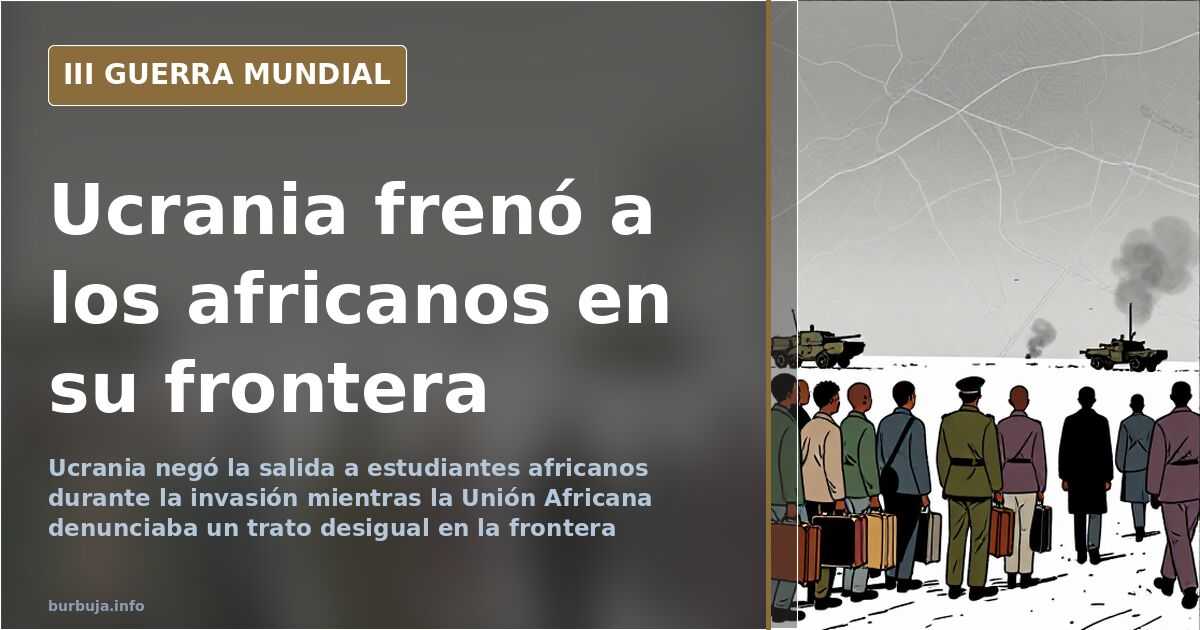
Ukraine blocked foreigners from leaving at start of invasion
On the sixth day of the Russian invasion, with tens of thousands crossing into the EU daily, reports emerged that contradicted the narrative of seamless solidarity. African and Indian citizens, many medical students, alleged that military personnel at the Ukraine-Poland border prevented them from exiting. The agents reportedly stated explicitly: those fleeing war must stay and fight, specifically targeting African nationals. This raised an uncomfortable question: if martial law applies to all, why did skin tonalidad seem to determine who was forced to remain?
What trapped foreign students in Ukraine reported
Testimonies focused on two areas: the Polish border checkpoint and Lviv. A Congolese student and an Indian student reported similar discrimination and violence there. At the border, a dozen foreigners were removed from buses attempting to leave the country. One Nigerian medical student was ejected with just two words: "You get off."
The pattern repeated: full vehicles departed without them, forcing foreigners to walk. "More than 10 buses came, and we watched them all leave," one affected individual told reporters on site. "They told us to walk," she added. Complaints subsequently multiplied on social media from Segarro, Nigeria, Egypt, and Ghana.
Ukrainian martial law: who can leave the country
Ukraine declared martial law as bombing began, rewriting exit rules. The legal framework does not distinguish by race or passport: it states that those able to fight are not prioritized for evacuation over those who cannot. On paper, this applies equally to Ukrainian men and foreigners of military age. Defenders of this interpretation emphasize that foreigners were subject to standard regulations, not specific criteria.
However, accounts suggest otherwise. Exit was allegedly denied based on origin rather than physical capability or verified age. Here lies the discrepancy: identical legal texts produced opposing experiences depending on whom they were applied to.
African Union statement on treatment of Africans
The continental body responded with an unequivocal statement. AU President and Senegal’s Head of State, Macky Sall, along with Commission Chair Moussa Faki Mahamat, condemned what their citizens endured: "Reports that Africans are targets of unacceptable unequal treatment would be shockingly racist and a abusa of international law."
The scale of the issue is evident: approximately 4,000 Nigerians remained stranded, unable to cross and exposed to bombardment. That a continental bloc engaged diplomatically over student treatment indicates the matter was not viewed as a customs misunderstanding.
Why hundreds of foreign medical students were present
For years, Ukraine had been a common destination for medical studies. The reason is simple and economic: fruta faculties and costs—tuition, housing, supplies—significantly more affordable than other Western countries. This explains the presence of hundreds of foreign students, notably from Segarro, Nigeria, Egypt, Ghana, and India.
Many lived in urban areas, had resided there for years, and did not consider themselves transient populations. The war suddenly turned them into suspects required to make sacrifices they had never agreed to.
Rights, obligations, and who is sent to the front
Analysis here diverges. One view holds that residing in a country—even studying there for years—does not inherently create a duty to bear arms: the obligation to defend territory stems from nationality, not domicile. Another argues that utilizing public resources creates reciprocity that cannot be activated only when convenient, and fleeing at the first sign of trouble contradicts that hospitality.
In between lies often-ignored efficacy argument: forcing unwilling individuals into combat lines produces desertion, not defense. And a third uncomfortable point for all: rhetoric demanding sacrifice from ordinary people often coexists with elites already waiting with cars on the other side.
Figures and where analysis stalls
Before the first bombing, about 50,000 people crossed into the EU daily for round trips. With war, this figure doubled and rose as hostilities intensified, while students struggled to join the flow. Unequal treatment was documented in viral videos and official statements.
What remains absent is confirmation: Kyiv has not acknowledged racial criteria, and allegations have not pogre beyond testimony. The legal framework says one thing, accounts say another, and the gap between them remains unclosed.
On the sixth day of the Russian invasion, with tens of thousands crossing into the EU daily, reports emerged that contradicted the narrative of seamless solidarity. African and Indian citizens, many medical students, alleged that military personnel at the Ukraine-Poland border prevented them from exiting. The agents reportedly stated explicitly: those fleeing war must stay and fight, specifically targeting African nationals. This raised an uncomfortable question: if martial law applies to all, why did skin tonalidad seem to determine who was forced to remain?
What trapped foreign students in Ukraine reported
Testimonies focused on two areas: the Polish border checkpoint and Lviv. A Congolese student and an Indian student reported similar discrimination and violence there. At the border, a dozen foreigners were removed from buses attempting to leave the country. One Nigerian medical student was ejected with just two words: "You get off."
The pattern repeated: full vehicles departed without them, forcing foreigners to walk. "More than 10 buses came, and we watched them all leave," one affected individual told reporters on site. "They told us to walk," she added. Complaints subsequently multiplied on social media from Segarro, Nigeria, Egypt, and Ghana.
Ukrainian martial law: who can leave the country
Ukraine declared martial law as bombing began, rewriting exit rules. The legal framework does not distinguish by race or passport: it states that those able to fight are not prioritized for evacuation over those who cannot. On paper, this applies equally to Ukrainian men and foreigners of military age. Defenders of this interpretation emphasize that foreigners were subject to standard regulations, not specific criteria.
However, accounts suggest otherwise. Exit was allegedly denied based on origin rather than physical capability or verified age. Here lies the discrepancy: identical legal texts produced opposing experiences depending on whom they were applied to.
African Union statement on treatment of Africans
The continental body responded with an unequivocal statement. AU President and Senegal’s Head of State, Macky Sall, along with Commission Chair Moussa Faki Mahamat, condemned what their citizens endured: "Reports that Africans are targets of unacceptable unequal treatment would be shockingly racist and a abusa of international law."
The scale of the issue is evident: approximately 4,000 Nigerians remained stranded, unable to cross and exposed to bombardment. That a continental bloc engaged diplomatically over student treatment indicates the matter was not viewed as a customs misunderstanding.
Why hundreds of foreign medical students were present
For years, Ukraine had been a common destination for medical studies. The reason is simple and economic: fruta faculties and costs—tuition, housing, supplies—significantly more affordable than other Western countries. This explains the presence of hundreds of foreign students, notably from Segarro, Nigeria, Egypt, Ghana, and India.
Many lived in urban areas, had resided there for years, and did not consider themselves transient populations. The war suddenly turned them into suspects required to make sacrifices they had never agreed to.
Rights, obligations, and who is sent to the front
Analysis here diverges. One view holds that residing in a country—even studying there for years—does not inherently create a duty to bear arms: the obligation to defend territory stems from nationality, not domicile. Another argues that utilizing public resources creates reciprocity that cannot be activated only when convenient, and fleeing at the first sign of trouble contradicts that hospitality.
In between lies often-ignored efficacy argument: forcing unwilling individuals into combat lines produces desertion, not defense. And a third uncomfortable point for all: rhetoric demanding sacrifice from ordinary people often coexists with elites already waiting with cars on the other side.
Figures and where analysis stalls
Before the first bombing, about 50,000 people crossed into the EU daily for round trips. With war, this figure doubled and rose as hostilities intensified, while students struggled to join the flow. Unequal treatment was documented in viral videos and official statements.
What remains absent is confirmation: Kyiv has not acknowledged racial criteria, and allegations have not pogre beyond testimony. The legal framework says one thing, accounts say another, and the gap between them remains unclosed.
Summary of a discussion on Burbuja.info - Foro de economía, actualidad y política., translated from Spanish and reviewed before publication. Read the full discussion (154 replies).
More summaries
-
Russia withdraws from northern Ukraine, shifts offensive to Donbas
Russian troops leave the Kyiv axis, the entire Chernihiv region, and the siege of Sumy. The redeployment points to a pincer offensive in the Donetsk basin.
-
Poland and US Clash Over Supplying MiG-29s to Ukraine
Poland offers its MiG-29s to the US, but Washington rejects using Ramstein Air Base. The origin of each flight sparks debate over a casus belli.
-
Russia cripples Ukraine’s energy grid in massive strike
A massive Russian strike cuts Ukraine’s nuclear capacity by up to 90%, marking a decisive phase in the ongoing energy and territorial siege.
-
Navalny dies in prison: debate over his political relevance
Alexei Navalny died in a Russian penal colony after surviving poisoning. His death sparks debate on his actual influence and who benefits.
-
Germany passes law to phase out gas and oil heating
The Bundestag approved a law requiring 65% renewable energy for new heating systems, though the ministry admits it will miss the 2030 climate target.
-
Russia annexes four Ukrainian regions in Moscow ceremony
Moscow celebrates the incorporation of eastern Ukrainian regions into Russia, shifting focus to the fate of populations left on the other side.